The $7 Million Question
For the last decade, the advice was simple: “Go All-In on Cloud.” Buying your own servers was seen as backward—something dinosaurs did.
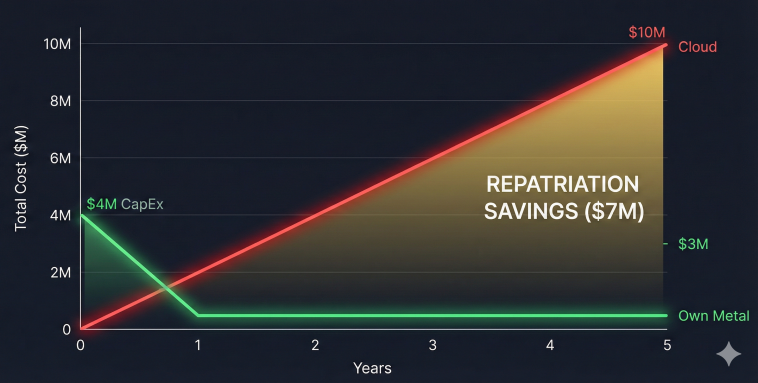
But in 2026, the pendulum is swinging back. Companies like 37Signals (Basecamp) shocked the industry by leaving AWS, saving $7 million over five years. X (Twitter) reduced cloud spend by 60% by moving workloads on-prem.
Why? Because the Cloud is a Hotel. It is amazing for short stays, rapid scaling, and uncertain growth. But if you live in a hotel for 10 years, you will go bankrupt. Eventually, you need to buy a house.
The Rent vs. Buy Equation
Cloud pricing includes a massive premium for flexibility.
Cloud EC2: You pay for the hardware, power, cooling, management, and cloud provider’s 30% margin.
Own Hardware: You pay for the hardware once. It depreciates over 5 years.
If your startup is growing 100% MoM, stay in the Cloud. You need the flexibility. But if you are a mature SaaS with predictable workloads spending >$1M/year, you are likely overpaying by 50% or more just to avoid “hardware.”
The "Egress" Prison
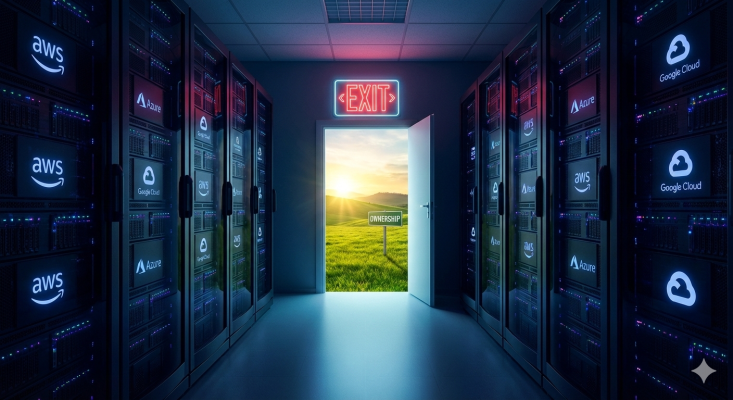
The biggest barrier to leaving isn’t hardware; it’s Data Transfer (Egress). Cloud providers make it free to put data in (Ingress) but incredibly expensive to take it out (Egress).
This is the “Hotel California” strategy. A successful “Cloud Exit” requires a surgical plan to move data without triggering a massive one-time ransom fee.
Are you paying a “Luxury Tax” on compute? Compare your Cloud TCO vs. On-Prem TCO
The Cloud is a launchpad, not a retirement home. When you are small, you optimize for Growth. When you are big, you optimize for Profit. Know which stage you are in. Read the Cloud Exit Guide + Check your readiness #CloudRepatriation #FinOps #Techtips #SaaS
The Hybrid Compromise
You don’t have to go back to 1999-style server racks. Modern Repatriation means Colocation and Bare Metal Cloud. You rent rack space in a Tier-1 data center, buy high-performance Dell/HPE servers, and run Kubernetes on top.
The Strategy:
Buy the Base: Run your core, predictable database and API on your own metal.
Rent the Spike: Use AWS for seasonal bursts or testing new features.
Conclusion: Maturity Means Ownership The Cloud is a launchpad, not a retirement home. When you are small, you optimize for Growth (Cloud). When you are big, you optimize for Profit (Ownership). Know which stage you are in.
Audit Your Infrastructure Strategy Should you Rent or Buy? Get the financial breakdown.
Understanding that the cloud is a “Hotel” is step one. Step two is calculating if you can afford the down payment on a “House.”
We use a proprietary Cloud Repatriation Framework at GYSP to help enterprises analyze their workloads, calculate TCO, and determine if moving to bare metal would save millions.
Stop guessing about your infrastructure strategy. Use the exact diagnostic tool we use with our enterprise clients to measure your readiness.
Take the Repatriation Readiness Assessment Below👇