The Haunted House
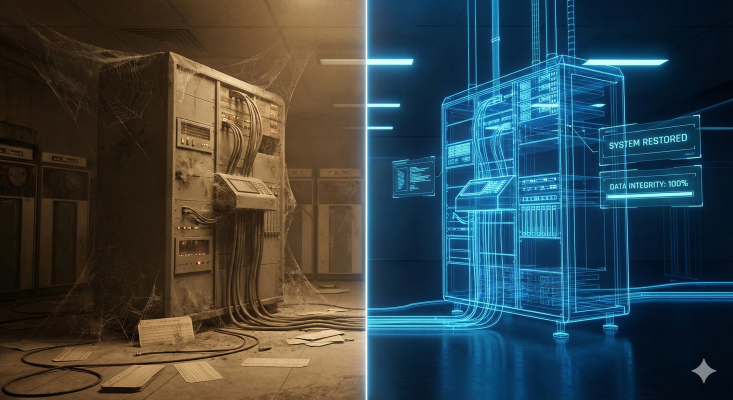
Every enterprise has one. A server in the basement running a Mission Critical application written in 2005. The original developers retired. There is no documentation. The variable names are x, y, and temp.
We call this “The Haunted House.” It runs the business, but no one dares to enter it. If you touch a line of code, the payment system might go down. So, you leave it alone. And the Technical Debt accumulates.
The "Big Bang" Trap
Every new CTO looks at it and says: “Let’s rewrite this from scratch in Go/Rust!” Two years and $5M later, the project is cancelled. The “Big Bang Rewrite” almost always fails because you don’t actually know what the old system does.
Section 1: AI as the Archaeologist Generative AI (GPT-4, Claude 3) is a mediocre Product Manager, but it is a world-class Archaeologist. It excels at reading messy, undocumented code and explaining what it does.
Input: Paste a 500-line spaghetti function.
Prompt: “Explain this logic in plain English and generate a Mermaid diagram of the data flow.”
Output: A clear map of the Haunted House.
The Safety Net (Generating Tests)
You cannot refactor code without tests. But legacy code never has tests. This is the Catch-22. AI solves this. You can feed the legacy code to the AI and ask: “Generate a suite of Unit Tests that cover all edge cases for this function.” Now you have a Safety Net. You can start refactoring knowing that if you break something, the test will catch it.
Is your Monolith slowing you down? Assess the risk level of your legacy systems.
Generative AI is a mediocre Product Manager, but it is a world-class Archaeologist. It excels at reading messy, undocumented legacy code and explaining what it actually does. #LegacyCode #Refactoring #GenAI #SoftwareArchitecture #TechDebt
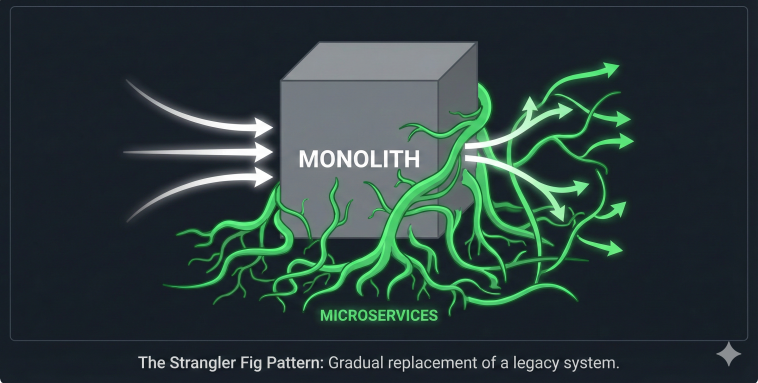
The Strangler Fig Pattern
Once you understand the code and have tests, you don’t rewrite it all at once. You use the Strangler Fig Pattern. You peel off one function (e.g., “User Login”), rewrite it as a Microservice, and route traffic to it. Then you peel off the next one. AI accelerates this by writing the “Translation Layer” between the old Monolith and the new Microservice.
Conclusion: Respect the Legacy Legacy code is not “bad” code. It is code that has survived. It pays the bills. Don’t bomb the Haunted House. Use AI to turn on the lights, clean up the cobwebs, and renovate it room by room.
Plan Your Migration Don’t start a rewrite without a map. Assess your risk level before you touch the code.
Understanding that the “Big Bang Rewrite” is a trap is step one. Step two is accurately measuring the fragility of your monolith before you touch a single line of code.
We use a proprietary Legacy Migration Framework at GYSP to help enterprises use AI to map dependencies, generate automated test coverage, and execute the Strangler Pattern safely.
Stop guessing what the old code does. Use the exact diagnostic tool we use with our enterprise clients to measure your readiness to modernize.
Take the Legacy Migration Readiness Assessment Below 👇