The "Detective" Problem
Imagine you are a detective trying to solve a crime. You have a room full of witness statements (documents).
Standard RAG (Vector Search) is like a Librarian. You ask: “Show me statements about the suspect.” The Librarian hands you 5 documents that mention the name.
GraphRAG is like a Detective. It pins photos on a wall and connects them with red string. It says: “The suspect didn’t mention the victim, BUT the suspect called the Driver, and the Driver was seen at the victim’s house.”
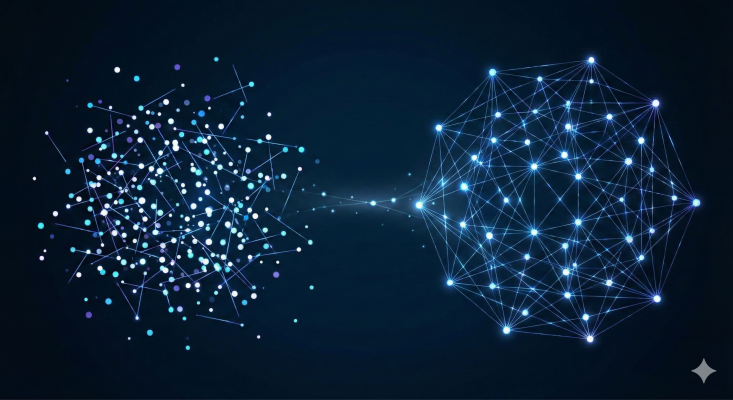
Standard RAG sees dots. GraphRAG sees connections. For simple FAQs, dots are fine. For Enterprise Intelligence, you need connections.
The Limitation of Vectors (Similarity != Logic)
Vector Databases (Pinecone/Weaviate) changed the game. They allow us to search by meaning, not just keywords. But they have a fatal flaw: They treat every chunk of text in isolation.
If Document A says “Project X relies on Component Y,” and Document B says “Component Y is delayed,” a Vector Search often fails to answer: “Is Project X delayed?” Why? Because neither document explicitly states “Project X is delayed.” The connection is missing.
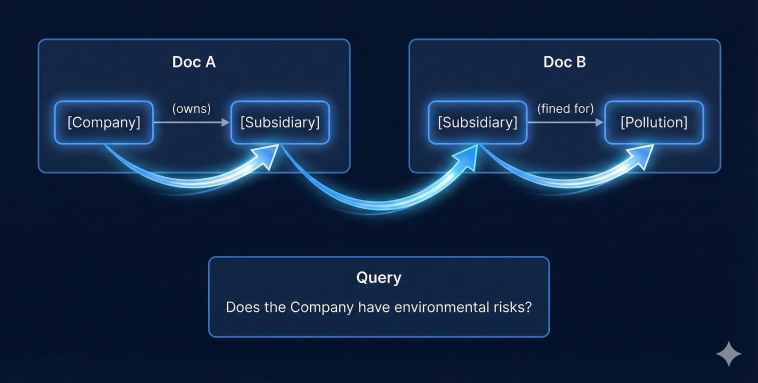
Enter GraphRAG
GraphRAG fixes this by structuring your unstructured data. Before ingestion, an LLM scans your documents and extracts:
Nodes: (Entities like “Project X”, “Component Y”, “Supplier Z”).
Edges: (Relationships like “relies on”, “is delayed”, “supplied by”).
It builds a Knowledge Graph. Now, when you ask a question, the AI traverses the graph. It “hops” from node to node to find the answer.
Is your RAG bot missing the big picture? Find out if your use case needs simple Vectors or complex Graphs.
Vector Search is like a Librarian finding books. 📚 GraphRAG is like a Detective connecting clues with red string. 🕵️♂️ For complex reasoning, you need the Detective. Read the GraphRAG Guide + Take the assessment #GraphRAG #AI #LLM #Datascience
When to use GraphRAG?
GraphRAG is expensive (it costs money to extract the graph). Do not use it for a simple FAQ bot. Use it for:
Supply Chain: Tracing impact across tiers.
Legal Discovery: Connecting clauses across 50 contracts.
Financial Fraud: Linking suspicious transactions across accounts.
Medical Research: Connecting symptoms to drugs to proteins.
Conclusion: Connect the Dots Intelligence isn’t just about knowing facts. It’s about understanding how facts relate to each other. Stop building “Search Engines.” Start building “Reasoning Engines.”
Audit Your Architecture Vectors or Graphs? Choose the right tool for the job.
Understanding that standard RAG has a “Reasoning Ceiling” is step one. Step two is identifying if your specific business questions require the complexity of a Knowledge Graph.
We use a proprietary GraphRAG Suitability Framework at GYSP to help enterprises analyze their data structures, assess query complexity, and determine if they need to map relationships to prevent blind spots.
Stop hitting the reasoning wall. Use the exact diagnostic tool we use with our enterprise clients to measure your GraphRAG readiness.
Take the GraphRAG Use-Case Assessment Below 👇