


The "Bill Panic" Ritual
It happens every month. The cloud invoice arrives. It is 8% higher than last month. The CFO sends an urgent email: “Why is spend up? We need to cut costs immediately.” The Engineering VP gets defensive: “Traffic is up! We need the capacity!”
This cyclical argument happens because you are both looking at the wrong metric. You are looking at Total Spend.
In a growth company, looking at Total Spend is useless. If your user base doubled, of course your bill went up. The real question is: Did your efficiency improve?
Welcome to Unit Economics—the art of measuring cloud spend not as a bill, but as a Cost of Goods Sold (COGS).
The “Total Spend” Fallacy
Imagine you run a pizza shop.
Scenario A: You spent $1,000 on flour and sold 100 pizzas. (Cost per pizza: $10).
Scenario B: You spent $5,000 on flour and sold 1,000 pizzas. (Cost per pizza: $5).
Scenario B has a much higher bill ($5k vs $1k), but it is a far healthier business. If you only looked at the “Flour Bill,” you would fire the manager in Scenario B.
This is exactly what companies do with Cloud. They punish engineering for success (growth) because they lack the granularity to see the efficiency gains.
Finding Your "North Star" Unit Metric
You cannot optimize what you cannot measure. You need to define a single Unit of Value that aligns with your business revenue.
For SaaS: Cost Per Active User (MAU).
For E-Commerce: Cost Per Transaction.
For Streaming: Cost Per Streamed Hour.
At GYSP.tech, we help clients tag their infrastructure to map every dollar back to this unit by implying strict FinOps Principles.
Bad KPI: “We reduced AWS spend by $5k.”
Good KPI: “We reduced Cost Per Transaction from $0.04 to $0.03.”
Stop apologizing for your cloud bill. A flat bill is often a sign of stagnation. The goal isn't to spend less; it's to widen the margin between Cost and Revenue. Calculate your unit economics score now #FinOps #CFO #SaaS #CloudStrategy #UnitEconomics
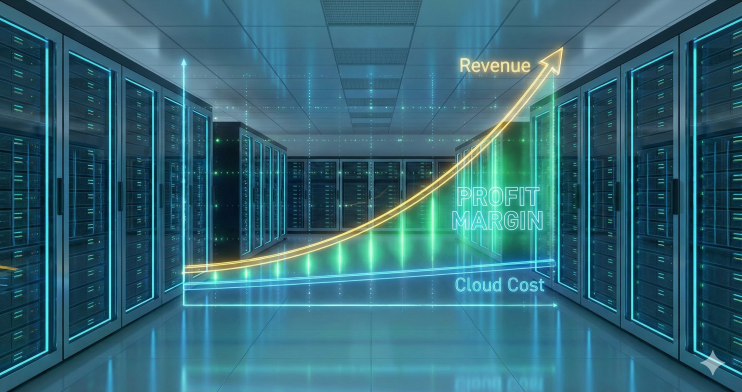
The "Jaws of Profit" (Healthy Divergence)
Your goal is not a flat cloud bill. Your goal is Divergence. Visualize two lines on a graph:
Revenue (or Users): Climbing steeply.
Cloud Costs: Climbing slowly.
The gap between those two lines is your Margin. This is the “Jaws of Profit.” If your cloud costs are growing at the exact same rate as your revenue (Linear Scaling), you have a problem. You aren’t getting the benefits of the cloud’s economies of scale. If your costs are growing faster than revenue, you are in the death zone.
Stop apologizing for the cloud bill. Start contextualizing it. When you can say, “Yes, the bill went up 10%, but our user base grew 20%, effectively increasing our margins,” the panic stops. The strategy begins.
Stop the Bill Panic Shift your culture from “Cost Cutting” to “Margin Optimization.”
Understanding that “Total Spend” is a vanity metric is step one. Step two is identifying exactly how to track your true Cost of Goods Sold (COGS) in the cloud.
We use a proprietary Cloud Efficiency Framework at GYSP to help enterprises stop the monthly bill panic and map every gigabyte of compute directly back to a profitable business transaction.
Stop guessing about your margins. Use the exact diagnostic tool we use with our enterprise clients to measure your Unit Economics and find your financial blind spots.
Take the Unit Economics Health Check Below: 👇


I love the ‘Jaws of Profit’ concept—finally a way to explain the bill to Finance without getting defensive.
However, our biggest challenge is attribution. We run a massive multi-tenant Kubernetes cluster shared by 6 different product teams. How do you calculate ‘Unit Cost’ when 40% of the compute is shared infrastructure? Do you split by namespace?