The "Tetris" Game You Are Losing
Kubernetes was promised as the ultimate efficiency engine. The sales pitch was simple: “It packs your applications onto servers like Tetris blocks, squeezing every ounce of value out of the hardware.”
The reality? You are playing Tetris with round blocks.
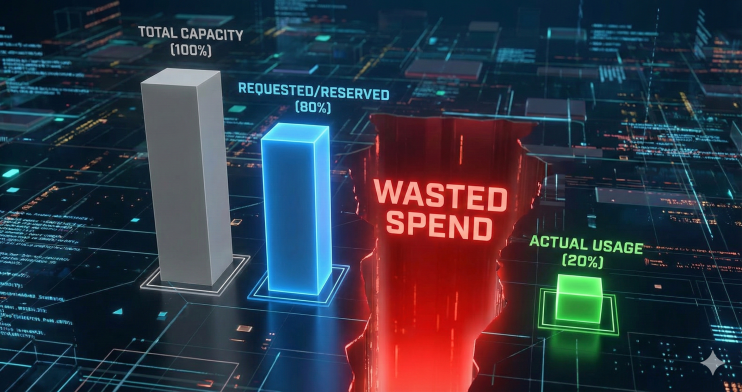
Most enterprise Kubernetes clusters run at 20% to 30% utilization. That means for every $100 you spend on compute nodes, $70 is being wasted on “Air”—idle capacity that is reserved but never used.
The "Requests vs. Limits" Trap
The root cause is a misunderstanding of how K8s scheduling works.
Requests: What you tell K8s you need (Guaranteed). You pay for this.
Limits: The maximum you can burst to.
Usage: What you actually use.
Engineers are risk-averse. To prevent crashing, they set Requests high.
Engineer: “I’ll ask for 4 CPUs, just in case.”
Reality: The app uses 0.5 CPUs.
The Cost: You pay for 4 CPUs. The other 3.5 CPUs sit idle, unable to be used by anyone else because they are “Reserved.”
The Bin Packing Problem
Because Requests are inflated, the K8s scheduler creates “Stranded Capacity.” Imagine a moving truck (The Node). You put one giant box (The Pod) inside. The box is mostly empty, but it takes up floor space. You can’t fit anything else in the truck. So, you buy another truck.
You end up with a fleet of half-empty trucks. This is Poor Bin Packing.
Understanding that your Kubernetes cluster is full of “Air” is step one. Step two is identifying exactly how much stranded capacity is hiding in your nodes.
We use a proprietary Kubernetes Efficiency Framework at GYSP to help enterprises stop Fear-Based Provisioning, automate their rightsizing, and achieve true “Tetris-level” bin packing.
Stop guessing about your utilization. Use the exact diagnostic tool we use with our enterprise clients to measure your K8s efficiency.
👇 Take the Kubernetes Efficiency Assessment Below:
In Kubernetes, 'Resource Requests' are a financial contract. Every time an engineer guesses a number, they are signing a cheque on behalf of the CFO. Stop guessing, Start Right-Sizing. #Kubernetes #K8s #FinOps #CloudCost #DevOps
Squeezing Out the Air
To fix this, you need to automate “Right-Sizing.” Humans are bad at guessing CPU usage. Machines are good at it.
Vertical Pod Autoscaler (VPA): Implement tools (like Goldilocks) that watch your apps and say: “You asked for 4 CPUs, but you only ever use 0.5. Change your Request to 0.6.”
Spot Instances: For stateless workloads, use Spot nodes. They are 70-90% cheaper. Even if they are inefficient, the unit cost is so low it protects your margin.
Trust the Data, Not the Guess Stop letting engineers “guess” their resource requirements. In 2026, efficiency isn’t about buying cheaper servers; it’s about packing them full.
Stop Paying for Air Optimize your requests, limits, and bin packing strategy.
Understanding that your Kubernetes cluster is full of “Air” is step one. Step two is identifying exactly how much stranded capacity is hiding in your nodes.
We use a proprietary Kubernetes Efficiency Framework at GYSP to help enterprises stop Fear-Based Provisioning, automate their rightsizing, and achieve true “Tetris-level” bin packing.
Stop guessing about your utilization. Use the exact diagnostic tool we use with our enterprise clients to measure your K8s efficiency.
Take the Kubernetes Efficiency Assessment Below 👇