Data Quality Management Services
Catch data problems before your business does.
Data quality management services that give every team a single source of truth they can trust. We implement quality rules, pipeline observability, lineage tracking, and a data catalogue, so broken data is caught before it reaches your dashboards.
What We Deliver
Core Capabilities
- Data Profiling & Quality Assessment
- Data Quality Rules & Validation Framework
- Data Observability & Pipeline Monitoring
- Data Lineage & Impact Analysis
- Data Catalogue & Metadata Management
- Data Governance & Stewardship Framework
Ready to get started?
Get a free technical brief — architecture options, timelines, and cost estimates delivered within 48 hours. No commitment required.
- 01Submit your challenge≈ 1 min
- 02Receive your Technical BriefWithin 48h
- 03Discovery call — no obligationOptional
Or call us: +1 (929) 588-8364
By the Numbers
What clients achieve with GYSP
proactive monitoring surfaces broken pipelines and schema drift before anyone opens a ticket
automated quality checks run on every pipeline execution and alert on anomalies in near-real-time
every field traced from source to dashboard, eliminating the 'where does this number come from?' question
Proven Results
Data Quality Management Case Studies
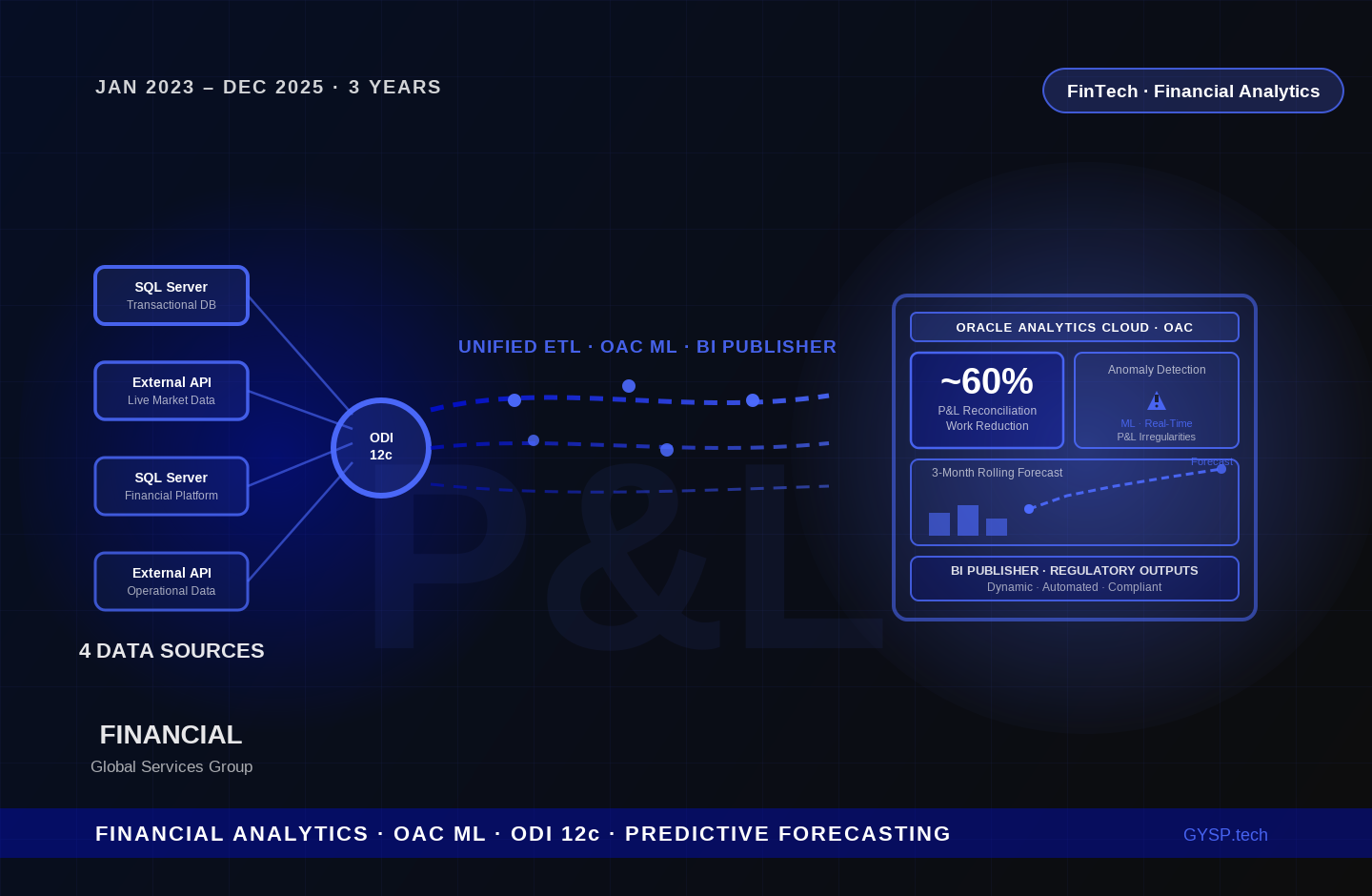 FinTech
Global Financial Services Group
A global financial services group was spending significant analyst bandwidth on manual P&L reconciliation across 4 disparate data systems, with no anomaly detection, no forward-looking forecast, and regulatory reports still produced from static spreadsheets. GYSP unified the data layers on ODI 12c, reduced reconciliation work by 60%, deployed OAC ML anomaly detection on live P&L pipelines, and built rolling 3-month commercial forecasting, all within a single integrated analytics architecture.
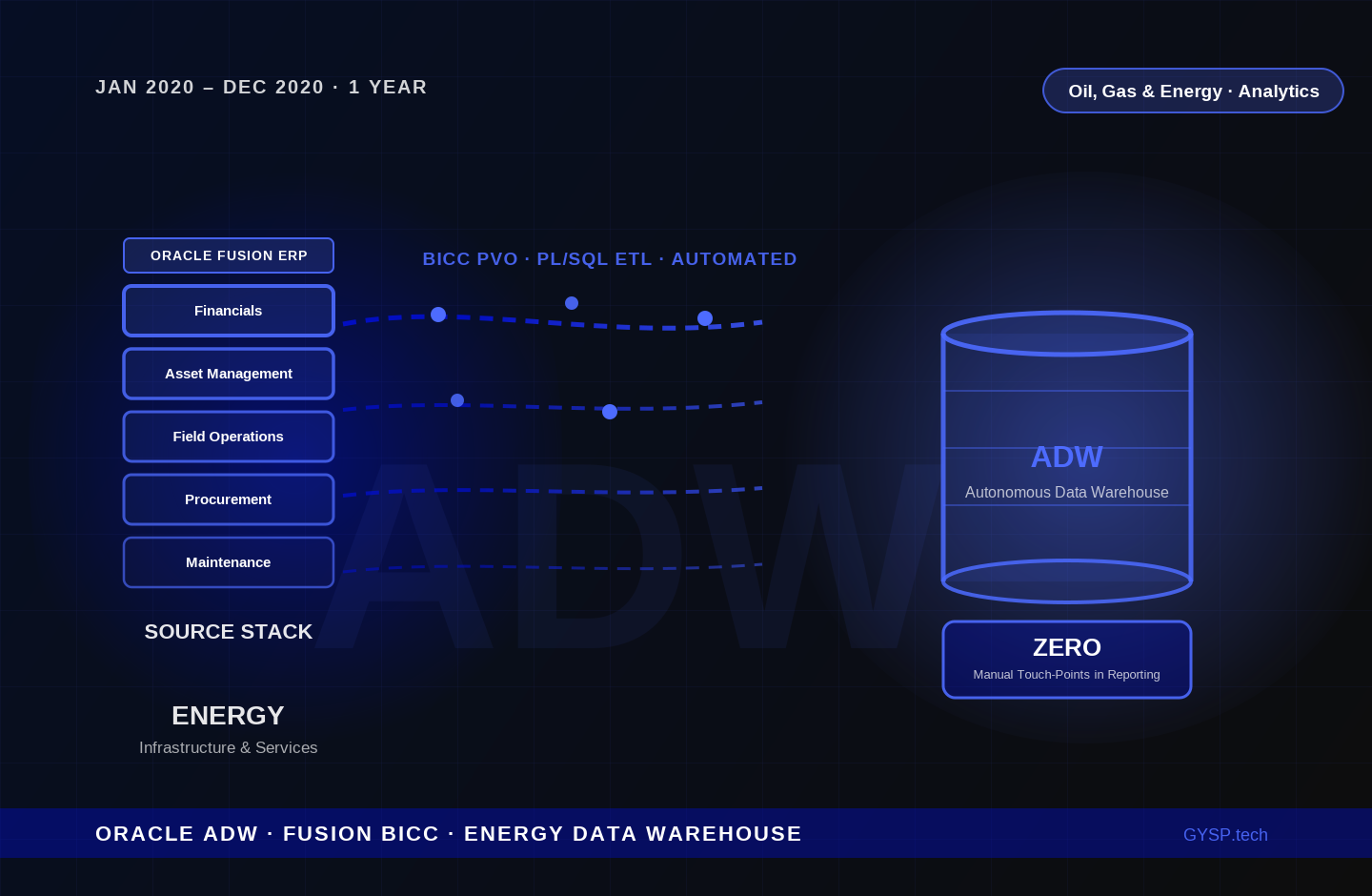 Oil, Gas & Energy
Energy Infrastructure & Services Provider
An energy infrastructure and services company was running financial and operational reporting through a cycle of manual extractions, transformations, and handoffs from Oracle Fusion, slow, error-prone, and dependent on IT for every update. GYSP built an Oracle Autonomous Data Warehouse from scratch, automated the full BICC extraction pipeline, and eliminated every manual touch-point from the reporting loop.
 Automotive
Cars24
Scaling India's largest digital auto marketplace meant modernising cloud infrastructure, real-time data pipelines, and observability, simultaneously, without slowing the product team.
Industry Expertise
Industries We Serve with Data Quality Management
FAQs
Common questions
Everything buyers typically ask before starting a data quality management engagement.
Ask us anythingWhat is data quality management?
Data quality management is the practice of measuring, monitoring, and improving the accuracy, completeness, consistency, timeliness, and validity of data across your pipelines and systems. It covers everything from profiling raw data to enforcing business rules, detecting anomalies, and tracking lineage, so every team trusts the data they work with.
How does data observability differ from data quality?
Data quality answers whether your data meets defined standards right now. Data observability answers whether your pipelines are behaving reliably over time, detecting freshness issues, schema drift, volume anomalies, and distribution changes automatically, before they become a downstream incident. We implement both: quality rules catch known problems, observability catches unknown ones.
What tools do you use for data quality and observability?
We use Great Expectations and dbt tests for rule-based quality checks, Monte Carlo or Soda Core for observability and anomaly detection, and OpenLineage or Apache Atlas for lineage. The right stack depends on your existing data platform, we build on what you already have rather than replacing it.
How long does a data quality implementation take?
A foundational implementation, data profiling, quality rules on critical datasets, and pipeline monitoring, typically takes 6-8 weeks. Full lineage mapping and a data catalogue across a complex environment takes 12-16 weeks. We prioritise by business impact: the datasets powering your revenue-critical dashboards get coverage first.
How does data quality connect to our existing BI stack?
We integrate quality checks directly into your existing dbt or Airflow pipelines, so bad data is caught before it reaches Tableau, Power BI, or Looker. Lineage maps every field from source through transformation to dashboard column, so when a metric moves unexpectedly your team can trace it in minutes rather than hours.
Let's build something together
Get a free technical brief on your data quality management challenge — architecture, timeline, and cost estimate in 48 hours.
Get Free Technical Brief