What you'll take away
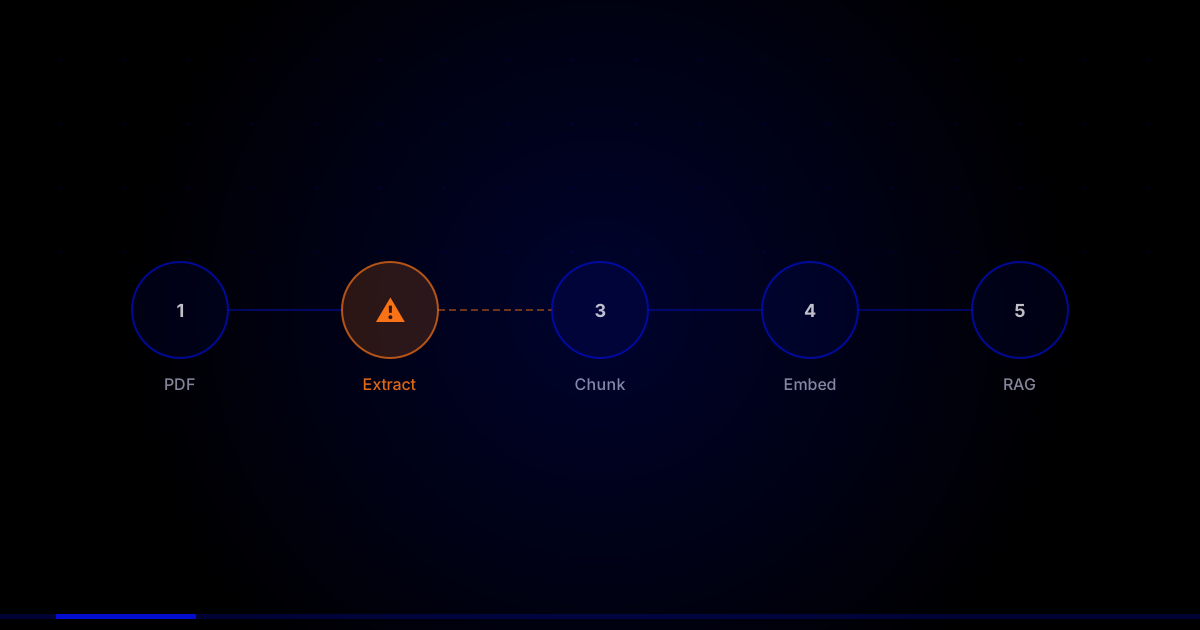
The majority of enterprise knowledge is locked in PDFs: contracts, compliance documentation, technical specifications, research reports, HR policies, financial statements. When companies build RAG systems over this knowledge, the first engineering decision, how to extract text from these documents, determines the quality ceiling of everything that follows.
Most teams reach for the simplest approach: PyPDF2, pdfplumber, or a basic text extraction library. These tools extract the characters on the page. They do not understand the layout. They do not know that a block of text at the top right of a page is a header and a block of text spanning two columns is the body. They produce a stream of characters that looks like text but has lost the structural relationships that give that text meaning.
How Standard PDF Parsing Destroys Information
PDFs are not documents, they are rendering instructions. A PDF page specifies where each glyph should be drawn on the page, in what order, and with what styling. The text extraction libraries that most RAG systems use read these rendering instructions and concatenate the characters in the order they appear in the file, which is frequently not the reading order a human would follow.
The consequences are systematic and severe: multi-column academic papers merge their columns into nonsense sentences that alternate between left and right column content; tables render as scrambled rows where the relationship between column headers and cell values is destroyed; numbered lists lose their numbering because the list marker and the list content are stored as separate text objects; section headers become indistinguishable from body text because font size and weight information is discarded.
Why This Directly Degrades RAG Performance
The corrupted text that standard PDF parsing produces affects RAG systems at every layer. Chunking algorithms that split on sentence boundaries or character counts produce chunks that cut through the middle of tables, mix content from adjacent sections, and separate questions from their answers in FAQ documents. The embedding of these corrupted chunks captures semantic noise rather than semantic signal.
At retrieval time, the wrong chunks are retrieved because the semantic content of the chunk does not accurately represent the information it nominally contains. At generation time, the model receives context that is structurally ambiguous, it cannot tell which column header applies to which table cell, which list item belongs to which section, and hallucination rates increase because the model is reasoning from a corrupted representation of the source document.
What Layout-Aware Ingestion Actually Does
Layout-aware document processing uses computer vision alongside text extraction to understand the spatial structure of a document page before extracting its content. It identifies: reading order across columns and text blocks, table boundaries and the relationship between headers and cells, section hierarchy from visual cues (font size, weight, indentation), figure boundaries and their associated captions, and the distinction between body text, callouts, footnotes, and headers.
The output of layout-aware parsing is not a flat text string, it is a structured document representation that preserves the semantic relationships the original PDF author created. A table becomes a structured object with headers and rows. A multi-column paper is linearised in the correct reading order. A section hierarchy becomes navigable metadata that informs chunking strategy.
The Tools That Deliver Layout Awareness
Most enterprise AI spend underperforms. Benchmark yours.
- Unstructured.io. Open-source document parsing library that supports PDFs, Word documents, PowerPoint, HTML, and more. Provides layout analysis, table extraction, and semantic chunking. The managed API offers higher accuracy than the local library. Suitable for most enterprise document types.
- LlamaParse. Launched by LlamaIndex specifically for RAG use cases. Uses a multimodal model to understand document layout and extract structured content. Particularly strong for complex layouts and mixed-content documents.
- AWS Textract. Amazon's managed document processing service. Provides table and form extraction alongside standard OCR. Best choice for AWS-native architectures processing high volumes of standardised forms and documents.
- Adobe PDF Extract API. The highest-accuracy option for complex PDF layouts. Adobe has more PDF processing patents than any other company. Appropriate for high-value document processing where accuracy justifies the cost premium.
Validated Outcomes
Harvey, the AI platform for legal professionals, documented the centrality of document ingestion quality in their engineering blog. Legal documents, contracts, case law, regulatory filings, have complex layouts with tables, cross-references, footnotes, and defined terms that are deeply meaningful to interpretation. Harvey's team found that naive text extraction produced retrieval accuracy low enough to make the system legally unusable. After implementing layout-aware parsing with semantic chunking aligned to document structure, retrieval accuracy improved by over 40% and the system became viable for production legal research. The model quality was the same, the ingestion quality was the differentiator.
GYSP's document AI engagements audit the ingestion pipeline as the first step of every RAG quality review. The most common finding: clients using naive PDF-to-text conversion are losing 20–50% of the semantic content in their documents because tables, headers, and structured data are being stripped or corrupted during extraction. Upgrading to layout-aware parsing, LlamaParse, AWS Textract, or Adobe PDF Extract API depending on document type and volume, typically produces measurable retrieval accuracy improvements within a single sprint.
The Right Chunking Strategy for Structured Documents
Layout-aware parsing enables semantic chunking, splitting documents at meaningful boundaries rather than arbitrary character counts. For a well-structured document, the right chunk boundaries are section boundaries: each H2 section becomes a chunk, with metadata indicating which document, which section, and which position in the document hierarchy. This produces chunks whose semantic content is coherent, retrievable, and attributable.
Improving PDF ingestion quality is typically the highest-ROI optimisation available to a RAG system that is underperforming. Before tuning retrieval algorithms or prompts, audit what your document processing pipeline is actually producing. The answer is usually surprising.
GYSP's AI/ML Development practice builds document RAG systems with production-grade ingestion pipelines, layout-aware parsing, semantic chunking, and metadata enrichment that gives retrieval systems the signal quality needed to serve accurate answers.
“A RAG system is only as good as the quality of its context. If the context is a corrupted representation of the source document, the model's responses will reflect that corruption, confidently and at scale.”
— Rahul, AI/ML Delivery Head — GYSP.tech