What you'll take away
Every data science team has a version of this story. Months of model development, clean evaluation metrics, stakeholder sign-off, and then deployment. And then: silence. Or worse, a spike in support tickets that traces back to the model producing confident, wrong answers on inputs that never appeared in the training set.
Gartner's often-cited figure, that only 53% of AI projects make it from prototype to production, understates the real problem. The harder failure mode is the model that does make it to production and then degrades silently, producing increasingly unreliable outputs while dashboards show it is technically running.
Why Production Is a Different World From Development
In development, the data scientist controls every variable. The training data is clean, well-labelled, and representative of what they expect the model to handle. The evaluation data is held out from training but drawn from the same distribution. Performance looks excellent because the problem is artificially well-defined.
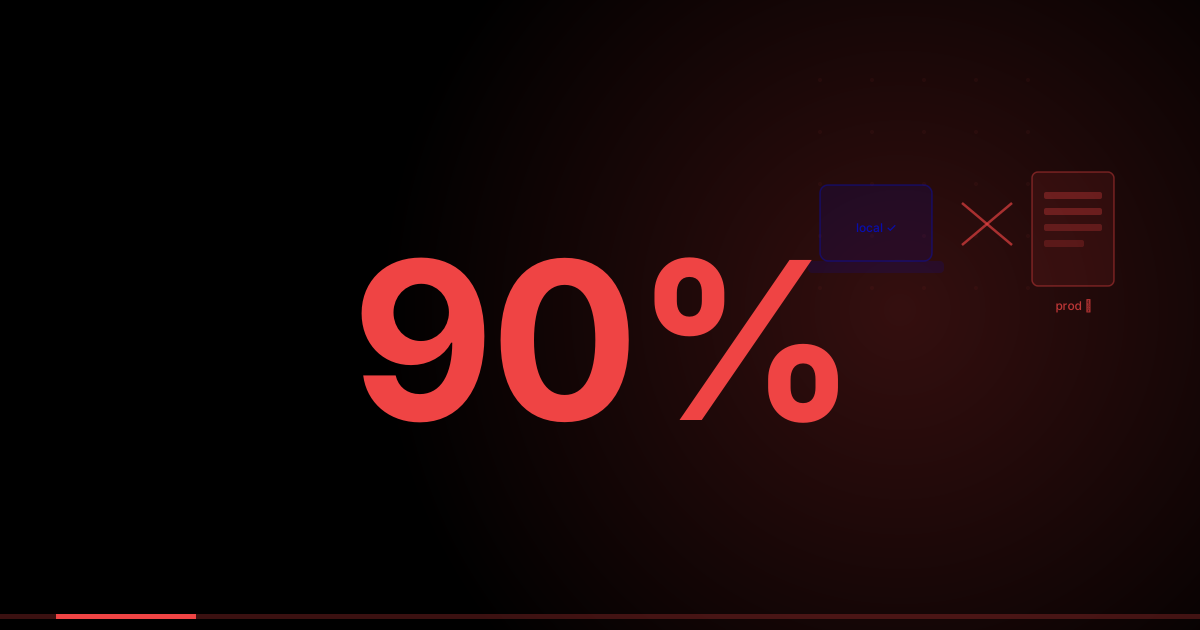
In production, reality is messier. Users submit inputs that have no analogue in the training data. Feature values drift as business conditions change. The relationship between features and the target variable itself evolves over time. The model that was correct 94% of the time in evaluation may be correct 70% of the time six months after deployment and without production monitoring, nobody notices until the business impact is significant.
The 5 Production Killers for ML Models
1. Training-Serving Skew
Training-serving skew is the mismatch between the features computed during training and the features computed at inference time. It is the most common and most insidious production failure mode. The feature pipeline that processed training data was built by the data science team. The feature pipeline that processes production requests was built by the engineering team. They are never perfectly identical and the small differences compound.
A missing feature normalisation step, a different handling of null values, a date format inconsistency, any of these creates a systematic bias between training and inference that degrades performance in ways that are extremely difficult to diagnose without a feature store that enforces consistency.
2. Data Drift
Data drift occurs when the statistical properties of production input data change from the distribution the model was trained on. A fraud detection model trained on 2022 transaction data and deployed in 2024 without retraining has learned patterns from a different fraud landscape. A recommendation model trained on pre-pandemic user behaviour that is still running in 2025 has never seen the changed preferences that emerged in subsequent years.
3. Concept Drift
Concept drift is more fundamental than data drift: the underlying relationship between features and the target label changes. A model predicting credit default risk becomes incorrect not because the input data distribution shifted, but because the economic conditions that determine default risk changed. No amount of feature monitoring catches concept drift, only output monitoring and evaluation against ground truth labels does.
4. No Version Control for Models or Data
Software has Git. ML models have, in most teams, a folder on a shared drive named model_final_v3_ACTUALFINAL.pkl. Without model versioning (MLflow, Weights and Biases, or DVC), rolling back a bad model update is manual and error-prone. Without data versioning, reproducing a model's training conditions is impossible, making debugging a root-cause exercise in futility.
5. Missing Production Monitoring
Application monitoring catches service downtime. ML monitoring catches model degradation and the two are not the same. A model can be technically running (200 OK on every inference endpoint) while producing outputs that are systematically wrong for an entire segment of users. Production ML monitoring requires input distribution tracking, output distribution tracking, and regular evaluation against labelled ground truth.
Most enterprise AI spend underperforms. Benchmark yours.
What Production-Ready AI Actually Requires
Production-grade ML systems need engineering disciplines that data science teams are not typically trained in:
- Feature stores (Feast, Tecton, or Databricks Feature Store) that enforce training-serving consistency by computing features once and serving them to both training pipelines and inference endpoints
- Model registries with versioning, metadata, and stage management (development, staging, production) that allow clean promotion and rollback workflows
- Shadow mode deployment where a new model runs in parallel with the current production model, consuming the same production inputs but not serving responses, to validate performance before full promotion
- Champion-challenger testing where a percentage of traffic is routed to the challenger model and performance is compared statistically before the challenger becomes champion
- Automated drift detection that monitors input feature distributions and output distributions on a scheduled basis and alerts when significant drift is detected
Validated Outcomes
Uber's Michelangelo ML platform, described in a 2017 engineering blog post that became a reference architecture for enterprise MLOps, was built specifically because Uber's data science teams were producing models that could not be reliably deployed to production. Before Michelangelo, the median time from model completion to production deployment was weeks to months; after deploying a standardised ML platform with defined training, serving, and monitoring pipelines, that median fell to days. More significantly, the number of production incidents related to model behaviour dropped substantially because the platform enforced consistency in how models were evaluated before promotion.
GYSP's production AI engagements build the MLOps infrastructure alongside the model, not as an afterthought. Clients who have previously deployed AI without a formal MLOps layer report that the majority of their production incidents trace to the same root causes: no shadow deployment, no input drift monitoring, and no ownership defined for the model serving layer. Addressing all three at project start eliminates the most common production AI failure modes before they are encountered in production.
The Ownership Question Nobody Answers
The deepest root cause of production AI failures is an ownership gap: the data scientist who built the model does not own production, and the platform engineer who owns production did not build the model. Neither team has the full context needed to diagnose production failures efficiently.
The structural solution is an ML Engineering function that bridges data science and platform engineering, owning the training pipeline, the feature store, the model registry, the deployment infrastructure, and the monitoring stack. Without this role, you are hoping that handoffs between two different teams produce reliable production systems. They do not.
The gap between a model that works on a laptop and a model that works in production is not a gap in model quality. It is a gap in engineering discipline, specifically the MLOps discipline that most data science teams were never asked to develop.
GYSP's AI/ML Development practice delivers production AI systems with the full MLOps stack included, not notebooks that need an engineering team to figure out deployment. We own the path from model development to production monitoring end-to-end.
“A model with 94% accuracy in development and 70% accuracy in production is not a 94% accurate model. It is a 70% accurate model with misleading documentation. Production performance is the only performance that matters.”
— Rahul, AI/ML Delivery Head — GYSP.tech