What you'll take away
Your application logging is excellent. Every API call is traced. Latency percentiles are charted. Error rates are alarmed. And yet when a user reports that the AI assistant gave them completely wrong advice, you open the logs and find: 200 OK, 847ms, no exceptions. The system performed correctly by every metric you are measuring. It just produced a wrong answer.
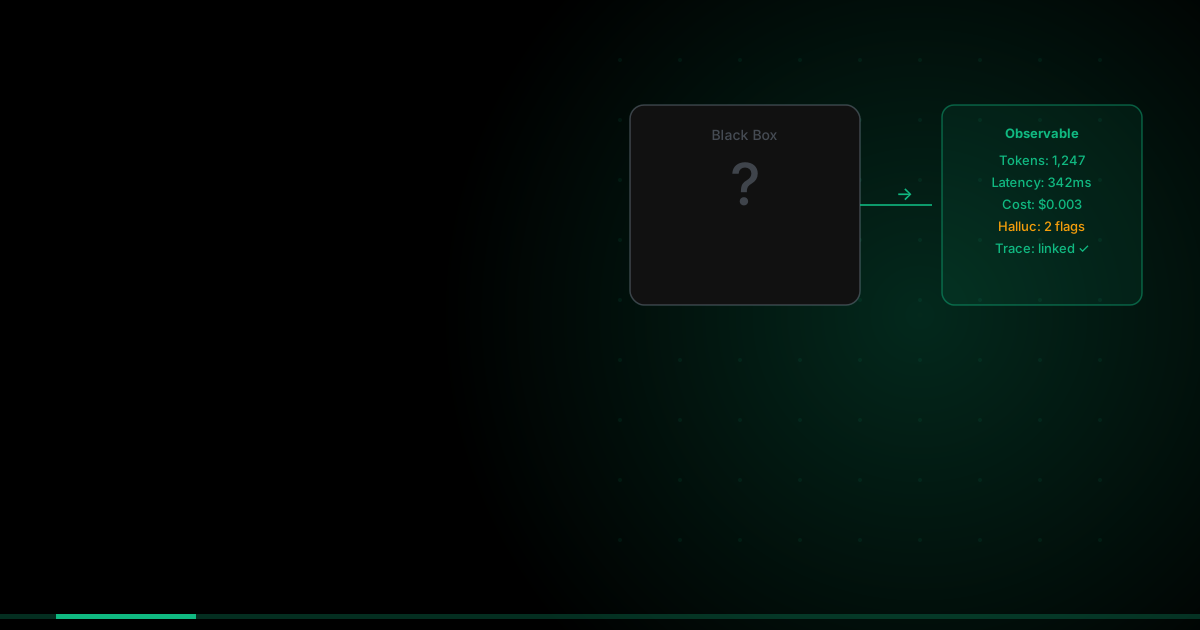
This is the fundamental limitation of applying traditional observability to AI systems. Traditional observability answers the question: did the system execute as programmed? AI observability answers a different question: did the system produce correct output? These are not the same question, and they require fundamentally different instrumentation.
Why Traditional Observability Misses AI Failures
In deterministic software, correct execution equals correct output. If a payment processing function executes without exception and returns a 200, the payment was processed correctly. The function's behaviour is fully specified by its code, observable execution implies correct output.
In probabilistic AI systems, correct execution explicitly does not guarantee correct output. An LLM inference call that completes in 800ms with a 200 response code may have returned a hallucinated answer, an inconsistent response, a response that violates a safety policy, or an answer that was correct yesterday but is incorrect today because the model was updated. None of these failure modes are observable in execution metrics.
The 4 AI Observability Dimensions
1. Input and Output Capture
Every AI inference call must log the complete input (prompt, retrieved context, conversation history) and the complete output (model response, token usage, model version). This is the foundational AI observability primitive without full input/output capture, post-incident investigation is guesswork. Privacy constraints may require input redaction, but the structure and metadata must be preserved even when content is redacted.
2. Evaluation Scoring
Captured inputs and outputs are only useful if they are evaluated against quality criteria. LLM-as-judge evaluation, using a capable model to assess whether responses are accurate, relevant, complete, and safe, enables automated quality scoring at scale. Combined with rule-based checks (response length, format compliance, prohibited content) and human spot-checking, evaluation scoring transforms raw logs into a quality signal that can be monitored and alarmed on.
3. Latency Breakdown by Stage
A RAG pipeline has multiple latency-contributing stages: query embedding, vector retrieval, context assembly, LLM generation, response post-processing. Total latency logged as a single metric hides which stage is the bottleneck. Stage-level latency breakdown is essential for performance optimisation and for detecting when a specific component (a new retrieval model, a different LLM endpoint) is degrading pipeline performance.
4. Input Drift and Output Quality Trends
Both the distribution of inputs your AI system receives and the quality of outputs it produces change over time. Input drift monitoring detects when users are asking questions outside the system's designed scope. Output quality trend monitoring detects gradual degradation, the slow drift from 87% response quality to 74% over three months that no individual request reveals but that aggregate evaluation scoring makes visible.
The Prompt Versioning Problem
Most enterprise AI spend underperforms. Benchmark yours.
Prompts are code. They encode the business rules, safety guidelines, and persona instructions that govern AI behaviour. Without version control for prompts, a prompt change can silently alter the AI system's behaviour across all future requests with no audit trail, no rollback capability, and no way to compare before and after in evaluation metrics.
Prompt versioning in production means treating system prompts as versioned artefacts stored in your model registry alongside model versions, with a clear association between which prompt version and which model version produced each logged interaction. When evaluation scores drop, the first diagnostic question, did a model update or prompt change precede the degradation?, becomes answerable in seconds rather than hours.
The AI Observability Stack
- LangSmith. LangChain's managed observability platform. Full trace capture for LangChain and LangGraph applications, built-in evaluation, prompt versioning. Best choice for teams already using the LangChain ecosystem.
- Langfuse. Open-source, self-hostable LLM observability. Full input/output logging, evaluation scoring, cost tracking, prompt management. The self-hosted option is compelling for teams with data residency requirements.
- Weights and Biases. The ML experiment tracking standard, now with LLM evaluation capabilities. Best for teams that need to connect model training metrics with production performance.
- Helicone. LLM proxy with logging, caching, and cost tracking. Minimal integration overhead (single endpoint change). Good for teams wanting production visibility without a major observability investment.
If you cannot answer these three questions about your AI system, you do not have sufficient observability: What percentage of responses were rated high quality in the last 7 days? Did quality change after the last model or prompt update? Which input categories have the lowest quality scores?
Validated Outcomes
Notion's AI team published an engineering post describing their response quality monitoring infrastructure and why they built it. The core finding: without systematic quality tracking, Notion's team had no reliable way to distinguish model improvements from model regressions across prompt or model version changes. After deploying LangSmith-based tracing with structured evaluation scoring, they identified a prompt change that had caused a measurable quality regression across one category of AI tasks that had gone undetected for three weeks before the observability infrastructure surfaced it. The cost of that silent regression, in user experience and trust, would have been substantially higher without early detection.
GYSP's AI deployments include observability infrastructure as a standard deliverable, not an optional add-on. In retrospective reviews of client AI systems that had previously operated without structured observability, the consistent finding is that quality degradation events averaging 15–20% below baseline had occurred and persisted for weeks without detection, because the team had no mechanism to distinguish normal variance from a genuine performance regression. Deploying an evaluation pipeline that scores output quality daily makes these events detectable within 24 hours.
GYSP's AI/ML Development practice deploys AI systems with full observability stacks included, input/output capture, evaluation pipelines, and drift monitoring that make AI performance as visible and manageable as application performance.
“You cannot manage what you cannot measure. For AI systems, the measurement that matters is not latency or uptime, it is output quality. And output quality requires an entirely different instrumentation approach than the one your operations team is used to.”
— Rahul, AI/ML Delivery Head — GYSP.tech