AI-Ready Data Infrastructure Services
The data foundation your AI and ML systems actually need to work.
AI-ready data infrastructure services that build the data layer your AI and ML systems depend on, ML data pipelines, vector databases, feature pipelines, and LLM data foundations designed for production AI workloads.
What We Deliver
Core Capabilities
- AI Data Infrastructure Assessment & Roadmap
- ML Data Pipeline Design & Implementation
- Vector Database Design & Integration
- Feature Pipeline Architecture
- LLM Data Layer & RAG Data Infrastructure
- AI Data Governance & Lineage for ML
Ready to get started?
Get a free technical brief — architecture options, timelines, and cost estimates delivered within 48 hours. No commitment required.
- 01Submit your challenge≈ 1 min
- 02Receive your Technical BriefWithin 48h
- 03Discovery call — no obligationOptional
Or call us: +1 (929) 588-8364
By the Numbers
What clients achieve with GYSP
standardised ML data pipelines eliminate the ad-hoc data wrangling that delays every model deployment
governed, versioned, and monitored data foundations mean model degradation is caught before it affects production
assessment and architecture blueprint delivered before engineering begins, so your team builds in the right direction from day one
Proven Results
AI-Ready Data Infrastructure Case Studies
 FinTech
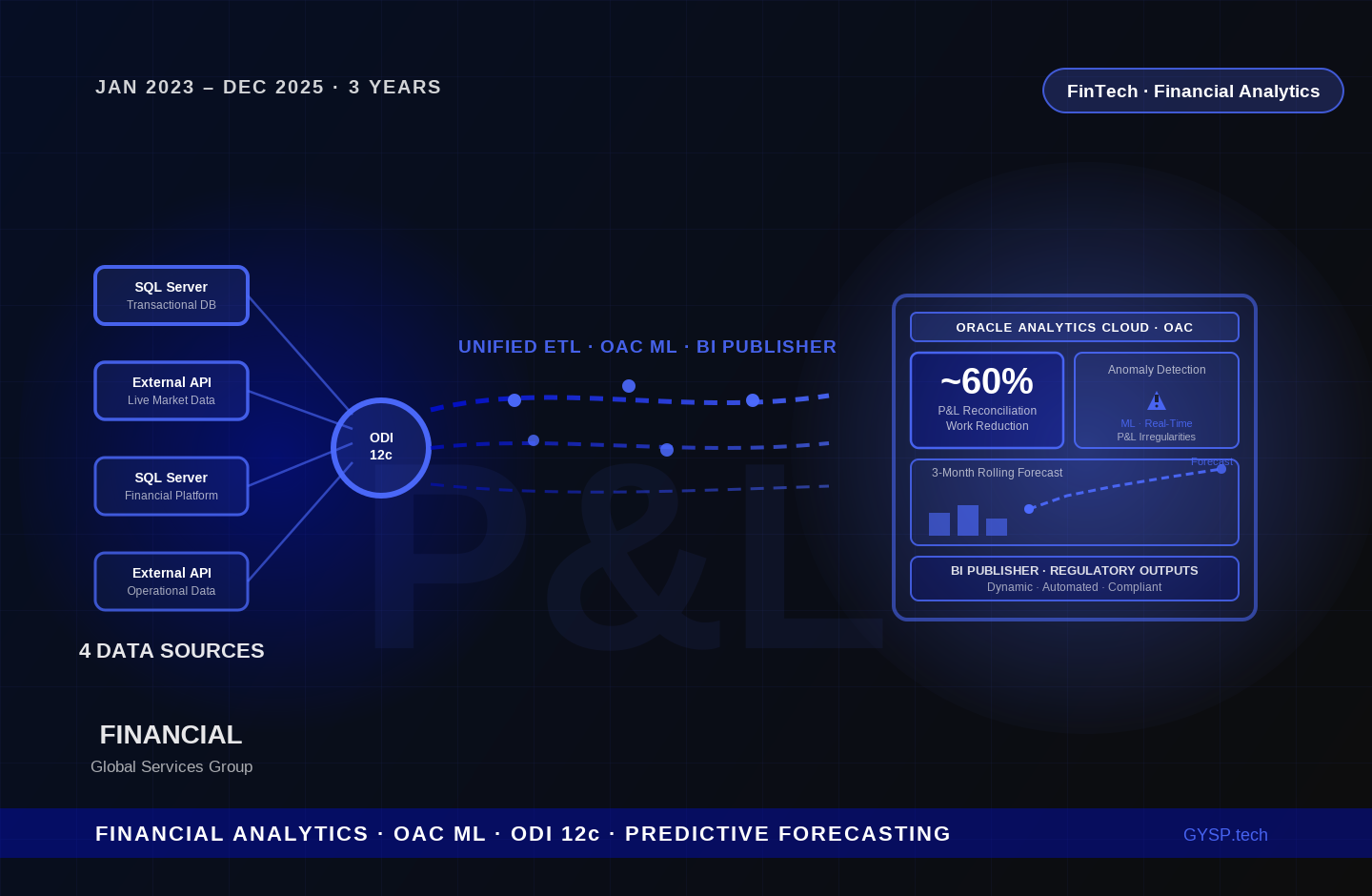
Global Financial Services Group
A global financial services group was spending significant analyst bandwidth on manual P&L reconciliation across 4 disparate data systems, with no anomaly detection, no forward-looking forecast, and regulatory reports still produced from static spreadsheets. GYSP unified the data layers on ODI 12c, reduced reconciliation work by 60%, deployed OAC ML anomaly detection on live P&L pipelines, and built rolling 3-month commercial forecasting, all within a single integrated analytics architecture.
 Enterprise Technology
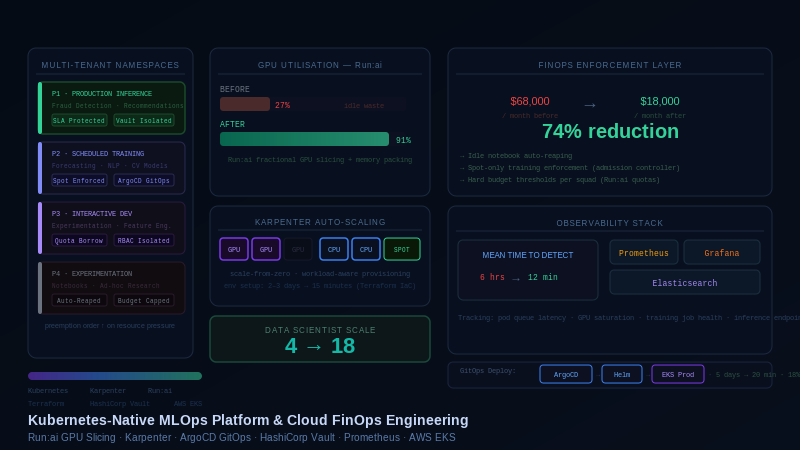
Global Enterprise AI Platform
A global enterprise AI platform operating ML workloads across recommendation engines, demand forecasting systems, and fraud detection pipelines needed to scale from 4 to 18 data scientists without GPU spend spiralling out of control. GYSP engineered a Kubernetes-native, multi-tenant MLOps platform with Run:ai fractional GPU virtualisation, Karpenter dynamic compute provisioning, and a full FinOps enforcement layer that cut monthly GPU infrastructure spend from $68,000 to $18,000 while driving average GPU utilisation from 27% to 91%.
 Automotive
Cars24
Scaling India's largest digital auto marketplace meant modernising cloud infrastructure, real-time data pipelines, and observability, simultaneously, without slowing the product team.
Industry Expertise
Industries We Serve with AI-Ready Data Infrastructure
FAQs
Common questions
Everything buyers typically ask before starting a ai-ready data infrastructure engagement.
Ask us anythingWhat is AI-ready data infrastructure?
AI-ready data infrastructure is the data layer purpose-built to support AI and ML workloads, covering ML data pipelines that deliver clean, versioned training data, vector databases for semantic search and retrieval-augmented generation, feature pipelines that compute and serve model inputs consistently, and LLM data foundations for enterprise RAG systems. It is the data engineering layer that sits between your raw data and your AI models.
How is this different from standard data engineering?
Standard data engineering optimises for analytics and reporting, structured data, SQL transformations, and BI dashboards. AI-ready infrastructure is built around different requirements: unstructured data handling, vector embeddings, feature consistency between training and serving, low-latency feature retrieval, and data versioning for model reproducibility. The tools, patterns, and performance benchmarks are distinct.
What platforms and tools do you use?
For ML data pipelines: Databricks, Spark, and dbt for transformation at scale. For vector databases: Pinecone, Weaviate, Qdrant, and pgvector depending on scale and stack. For LLM data layers: document chunking pipelines, embedding generation, and retrieval frameworks like LangChain and LlamaIndex. We work with your existing data platform rather than replacing it.
Do we need a dedicated vector database?
Not always. For smaller RAG systems and semantic search use cases, pgvector (PostgreSQL extension) handles millions of vectors at low cost. Dedicated vector databases like Pinecone or Weaviate make sense at billions of vectors, with strict latency requirements, or when multi-tenancy and namespace isolation matter. We assess your volume, latency requirements, and existing stack before recommending.
How does this connect to our existing data platform?
AI-ready infrastructure is built on top of your existing data platform, not beside it. If you are on Snowflake or Databricks, ML data pipelines extend your existing dbt models and Delta Lake tables. Vector databases integrate alongside your warehouse, not instead of it. We design the AI data layer to share governance, lineage, and monitoring with your existing stack so your data team manages one unified platform.
Let's build something together
Get a free technical brief on your ai-ready data infrastructure challenge — architecture, timeline, and cost estimate in 48 hours.
Get Free Technical Brief