Global Enterprise AI Platform
Kubernetes MLOps Platform — GPU FinOps, $68K to $18K Monthly
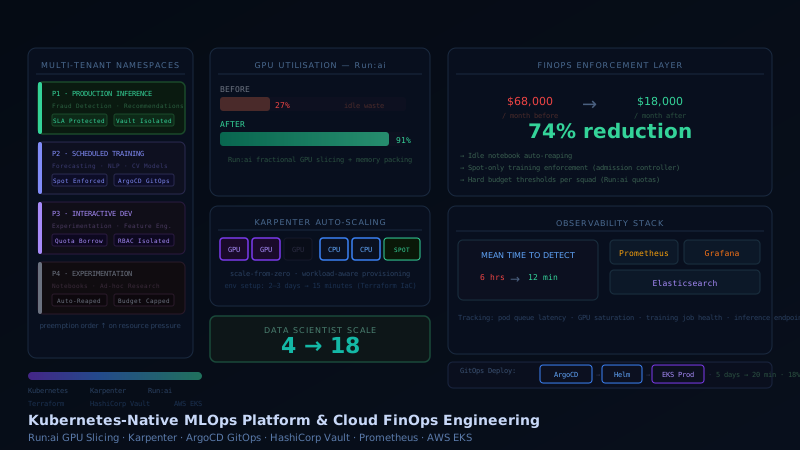
A global enterprise AI platform operating ML workloads across recommendation engines, demand forecasting systems, and fraud detection pipelines needed to scale from 4 to 18 data scientists without GPU spend spiralling out of control. GYSP engineered a Kubernetes-native, multi-tenant MLOps platform with Run:ai fractional GPU virtualisation, Karpenter dynamic compute provisioning, and a full FinOps enforcement layer that cut monthly GPU infrastructure spend from $68,000 to $18,000 while driving average GPU utilisation from 27% to 91%.
Industry
Enterprise Technology
Key Result
27% → 91% GPU Utilisation via Run:ai Fractional Slicing
Primary Service
MLOps Engineering
Core Stack
AWS EKS, Kubernetes, Karpenter
The Challenge
The client had outgrown their ad-hoc ML infrastructure. With only 4 data scientists when the engagement began, workloads had been provisioned manually and informally: dedicated GPU instances left running overnight, no isolation between teams, training jobs and production inference sharing the same nodes without priority controls. As headcount scaled toward 18, this model collapsed. Idle GPU nodes were consuming $68,000 per month regardless of actual workload. Environment setup for a new project required 2–3 days of manual provisioning. Deployment of a trained model to production demanded 5 days of coordination, manual scripting, and environment alignment, with an 18% failure rate. When incidents occurred (GPU memory saturation, queue starvation, node failures), the team had no visibility into pod-level telemetry, and the mean time to detect a problem was 6 hours. Multi-tenant resource competition between squads was escalating: a high-priority production inference job would be starved by an experimental notebook running an uncapped training job on the same pool. With 18 data scientists operating simultaneously across competing workloads, the existing infrastructure had no mechanism to enforce priorities, allocate fairly, or control spend at the team level.
Our Solution
GYSP designed and delivered a Kubernetes-native MLOps platform on AWS EKS, treating the infrastructure as a first-class engineering product rather than a configuration exercise. Infrastructure automation began with comprehensive Terraform modules authored from scratch: dedicated GPU node pools, CPU-only nodes for lighter workloads, spot-instance templates for cost-efficient training jobs, and network perimeter definitions. Environment provisioning time compressed from 2–3 days to 15 minutes. For dynamic compute, Karpenter replaced static node group management with workload-aware auto-scaling, provisioning GPU and CPU nodes from zero based on live queue demand and eliminating idle baseline capacity entirely. GPU virtualisation was delivered through Run:ai integration, enabling fractional GPU allocation and memory packing at the pod level. Rather than reserving a full GPU per workload, Run:ai orchestrated concurrent job sharing across the same hardware, driving average GPU utilisation from 27% to 91%. Multi-tenant resource governance was formalised through a four-tier priority scheduling system: P1 Production Inference (highest, protected), P2 Scheduled Training Runs, P3 Interactive Development, P4 Experimentation Notebooks, with dynamic quota borrowing between tiers to eliminate starvation while preserving production SLAs. Model deployment pipelines were standardised on ArgoCD and Helm, replacing manual scripts with immutable declarative GitOps workflows. Deployment time fell from 5 days to 20 minutes; failure rate dropped from 18% to 4%. Secret management and multi-tenant isolation were enforced at namespace level using HashiCorp Vault with custom RBAC policies per data science squad and secure runtime parameter injection. Full-stack observability was built with Prometheus, Grafana, and Elasticsearch, tracking pod queue latency, GPU saturation, training job status, and inference endpoint health, reducing MTTD from 6 hours to 12 minutes. FinOps controls were institutionalised at platform level: automated idle-notebook reaping, spot-only enforcement for training workloads, and hard budget thresholds per squad, cutting monthly GPU spend from $68,000 to $18,000.
Most enterprise AI spend underperforms. Benchmark yours.
Key Deliverables
- Architected production-grade multi-tenant MLOps platform scaling ML workloads (recommendation engines, forecasting systems, fraud detection pipelines) from 4 to 18 data scientists
- Authored comprehensive Terraform IaC modules from scratch covering dedicated GPU pools, CPU nodes, spot-instance templates, and network perimeters, compressing environment setup from 2–3 days to 15 minutes
- Implemented Karpenter for dynamic workload-aware compute provisioning on Kubernetes, scaling active GPU and CPU nodes from zero based on live queue demand to eliminate idle resources
- Integrated Run:ai GPU virtualisation to orchestrate fractional GPU allocation and memory packing at pod level, driving average GPU utilisation from 27% to 91%
- Instituted priority-based multi-tenant scheduling (P1 Production Inference through P4 Experimentation Notebooks) with dynamic quota borrowing to permanently eliminate resource starvation
- Built immutable ArgoCD + Helm GitOps deployment pipelines replacing manual scripts: deployment time from 5 days to 20 minutes, failure rate from 18% to 4%
- Enforced strict namespace isolation, custom RBAC, and HashiCorp Vault secret management across individual data science squads
- Deployed full-stack observability (Prometheus, Grafana, Elasticsearch) tracking pod queue latency and GPU saturation, reducing Mean Time to Detect from 6 hours to 12 minutes
- Executed aggressive FinOps controls: idle-notebook reaping, spot-only training enforcement, and hard budget thresholds, cutting monthly GPU infrastructure spend from $68,000 to $18,000
Services Delivered
- MLOps Engineering
- Kubernetes Platform Engineering
- Cloud FinOps
- Infrastructure as Code
Tech Stack
This engagement used AWS EKS, Kubernetes, Karpenter, Run:ai, Terraform, and 8 additional tools.
Frequently Asked Questions
How does Run:ai fractional GPU slicing work and why does it matter for MLOps platforms?+
Run:ai virtualises GPU hardware at the driver level, allowing multiple workloads to share a single physical GPU with guaranteed memory and compute allocations per pod. Without fractional slicing, a workload that uses 30% of a GPU's memory occupies the entire card, leaving 70% idle. Run:ai's memory packing schedules multiple concurrent jobs onto the same GPU simultaneously, with each job isolated to its allocated fraction. For an MLOps platform running a mix of large training jobs, lightweight inference endpoints, and interactive notebooks, this means the same GPU fleet handles far more concurrent workloads, driving utilisation from 27% to 91% in this engagement without adding a single GPU node.
What is Karpenter and how does it differ from the standard Kubernetes Cluster Autoscaler?+
Karpenter is a workload-aware node provisioner for Kubernetes that provisions nodes directly in response to pod scheduling requirements, rather than scaling predefined node groups. The standard Cluster Autoscaler reacts to pending pods by scaling existing node groups up or down, but the node type is constrained to what the group was originally configured for. Karpenter reads each pending pod's resource requests (GPU type, memory, CPU) and provisions the most cost-efficient matching instance directly from the cloud provider, including spot instances, without requiring pre-configured groups. For a mixed ML workload environment with GPU training jobs, CPU inference, and light notebook sessions, Karpenter's ability to provision exactly the right instance for each workload, and scale to zero between runs, is what eliminates idle baseline spend.
How did you implement FinOps controls that actually enforce budget limits rather than just alert on overruns?+
Alerting alone changes nothing: engineers acknowledge alerts and keep running their notebooks. The controls we implemented operated at the platform layer, not the reporting layer. Idle notebook reaping automatically terminates Jupyter sessions after a configurable inactivity window, reclaiming GPU allocations without requiring any engineer action. Spot-only training enforcement is baked into the Kubernetes admission controller — training job pods that request on-demand GPU instances are rejected at scheduling time, not flagged in a dashboard afterwards. Hard budget thresholds per squad are enforced through Run:ai's quota system: when a squad exhausts its allocation, new pods queue rather than provisioning new capacity. These controls are structural constraints, not recommendations — they operate whether or not anyone is watching the spend dashboard.
How does the P1–P4 priority scheduling system prevent production inference from being starved by training jobs?+
Each workload is assigned a priority class at submission time: P1 for live production inference endpoints, P2 for scheduled training runs, P3 for interactive development sessions, P4 for exploratory notebooks. The Kubernetes scheduler honours these priorities at the preemption level: if a P1 inference pod needs GPU capacity and the cluster is saturated, P4 pods are preempted first, then P3, and so on, freeing resources for the highest-priority workload. Dynamic quota borrowing allows lower-priority tiers to use unutilised capacity from higher-priority quotas during off-peak hours, but that borrowed capacity is reclaimed immediately when the owning tier needs it. The result is that production inference SLAs are protected by the scheduler itself, not by manual intervention or over-provisioning.
Work with GYSP
Similar Enterprise Technology challenge?
Get a free technical brief: architecture options, cost estimates, and a delivery timeline scoped to your challenge.
- 48-hour turnaround
- Senior engineers only
- No commitment required
Or call: +1 (929) 588-8364
More Enterprise Technology Case Studies
 Enterprise Technology
Enterprise Telecom Giant
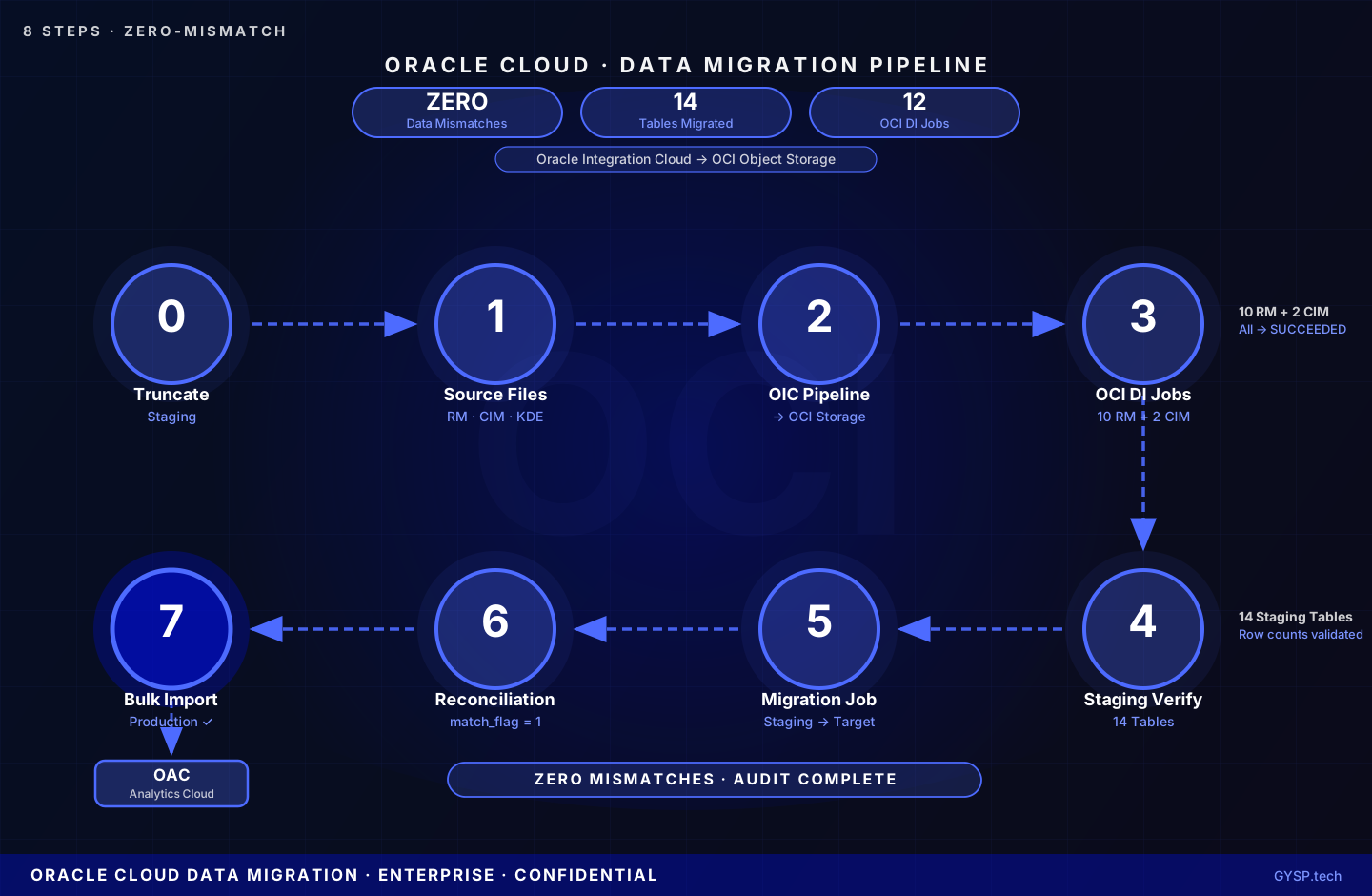
A confidential enterprise client engaged GYSP as a dedicated Oracle resource to architect and execute an 8-phase Oracle Cloud data migration, moving Revenue Management and Customer Information Management data through a validated pipeline, achieving zero data mismatches across 14 staging tables.
 Enterprise Technology
Global Professional Services Firm
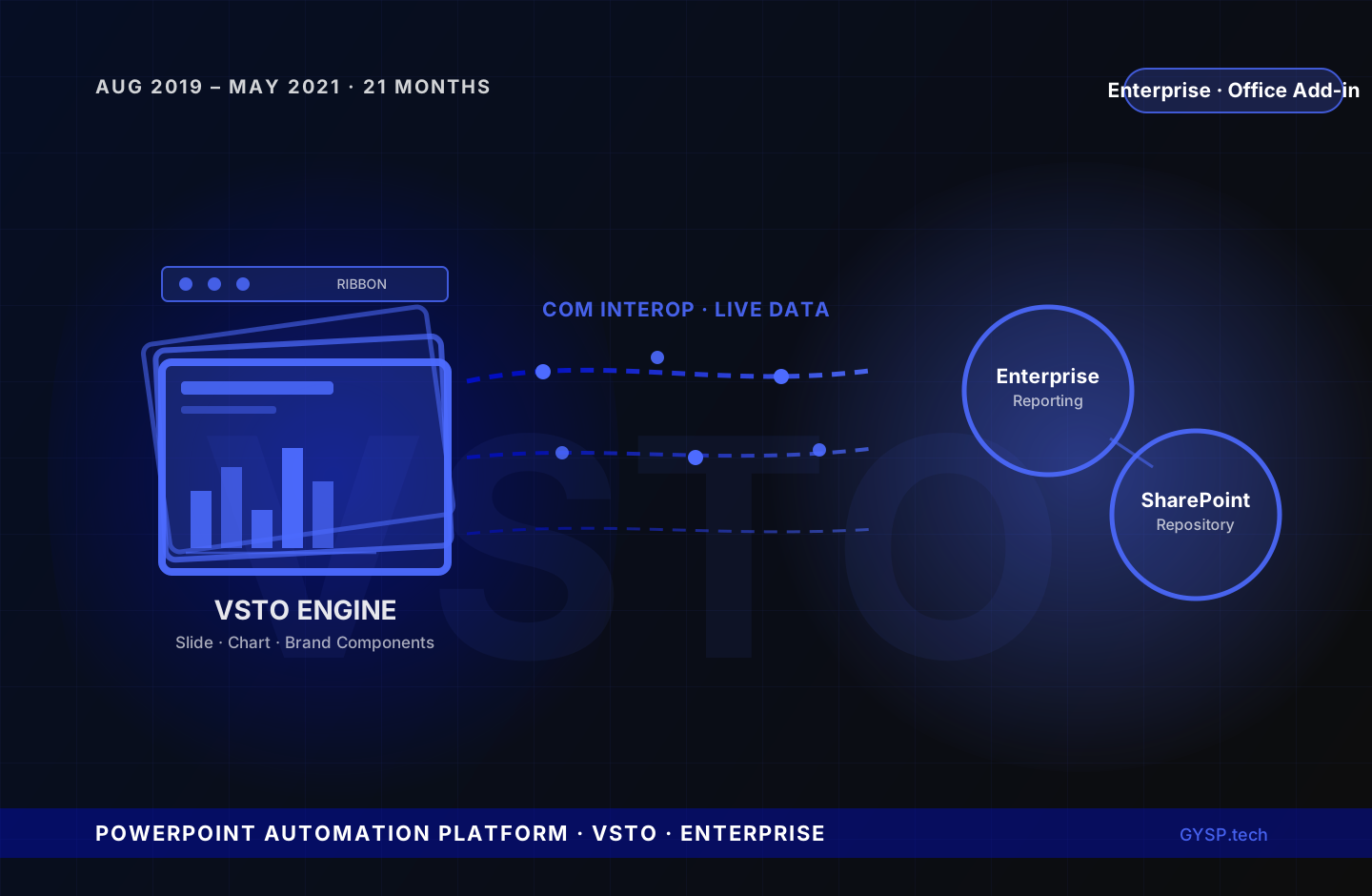
Business teams were losing hours per proposal manually rebuilding slides, charts, and formatting from scratch. GYSP built a native PowerPoint automation platform that generated branded, data-accurate decks directly inside the tool teams already used every day.
 Enterprise Technology
Confidential Global Enterprise Client
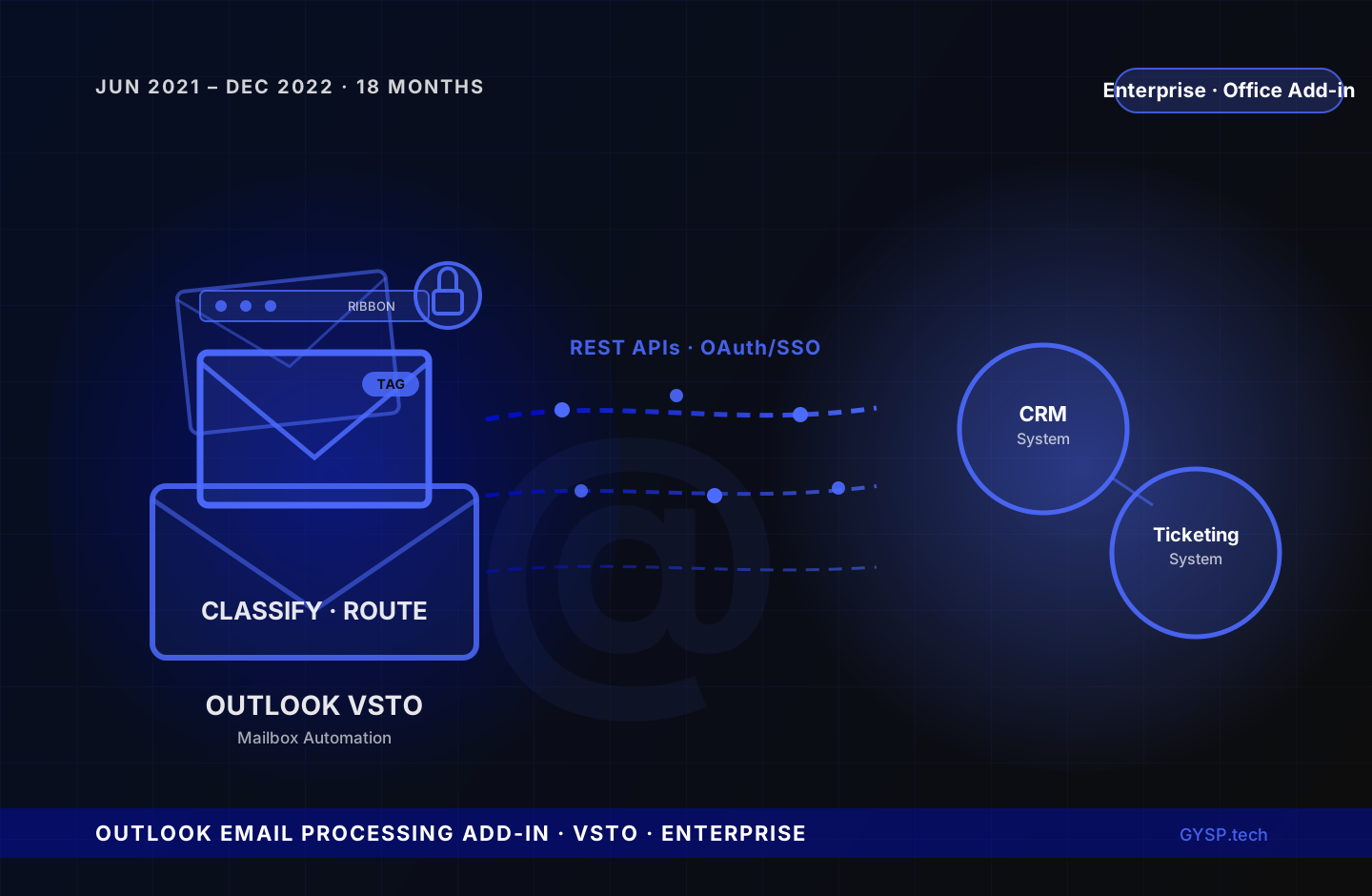
Inboxes were the bottleneck, with every incoming email requiring manual triage, attachment handling, and ticket creation before any real work began. GYSP built an Outlook VSTO Add-in that classified, routed, and processed emails automatically, secured with OAuth and enterprise SSO.
