Energy Infrastructure & Services Provider
An energy infrastructure and services company was running financial and operational reporting through a cycle of manual extractions, transformations, and handoffs from Oracle Fusion — slow, error-prone, and dependent on IT for every update. GYSP built an Oracle Autonomous Data Warehouse from scratch, automated the full BICC extraction pipeline, and eliminated every manual touch-point from the reporting loop.
The Challenge
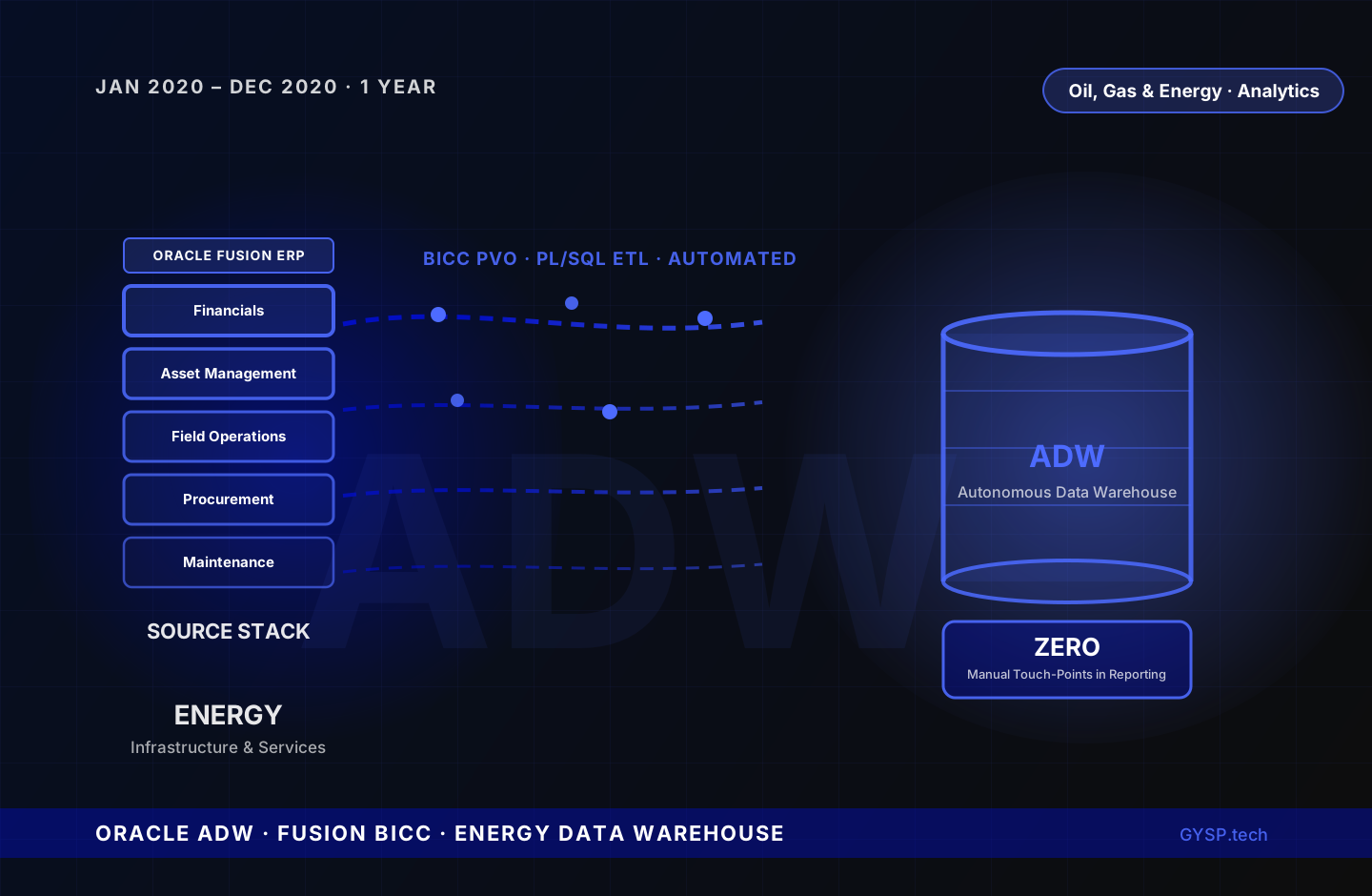
Energy infrastructure and services companies manage complex, highly siloed asset data across field operations, maintenance, procurement, and financial planning — each domain feeding into Oracle Fusion ERP, but with no unified, query-optimised layer sitting beneath it for reporting. Extracting data for financial and operational reports required manual intervention at multiple points in the cycle: pulling data from Fusion, transforming it to the reporting schema, loading it into a destination, and repeating that process whenever anything changed. The latency this created was structural — not a bandwidth problem but a design problem where human touch-points were embedded into every data movement step. The energy asset data itself compounded the difficulty: multi-dimensional matrices across asset classes, service lines, and geographic territories that were highly siloed within Fusion and needed significant rationalisation before they could be surfaced as a coherent, structured reporting layer. Without a cloud data warehouse purpose-built to absorb this complexity, analysts remained dependent on IT for every new report request.
Our Solution
GYSP designed and built an Oracle Autonomous Data Warehouse (ADW) cloud-native framework from scratch, using Oracle Fusion as the foundational source application stack. Oracle BICC (Business Intelligence Cloud Connector) PVO extraction pipelines were mapped and automated to pull structured data directly from Oracle Fusion's public view objects into the ADW, replacing manual export steps with a fully automated, scheduled extraction layer. Custom PL/SQL ETL scripts were authored to handle the complex schema transformations required to move from Fusion's source model into the ADW's reporting-optimised structure — covering the field operations, maintenance, procurement, and financial data domains that constituted the full reporting scope. End-to-end data pipelines were engineered to remove every human manual touch-point from the financial and operational reporting cycle: from BICC extraction through PL/SQL transformation, ADW loading, and report-ready data presentation. The complex, siloed energy service asset data matrices were deconstructed domain by domain and translated into a structured, relational, high-performance ADW database layer — making multi-dimensional energy asset data consistently queryable at warehouse performance, without the latency of manual preparation.
Facing a similar challenge? Get a no-commitment technical brief.
Get free briefKey Deliverables
- Oracle Autonomous Data Warehouse (ADW) framework designed and built from scratch using Oracle Fusion as the foundational source application stack
- BICC PVO extraction pipelines mapped and automated to pull structured data directly from Oracle Fusion into ADW — replacing manual export steps with fully scheduled extraction
- Custom PL/SQL ETL scripts authored to handle complex schema transformations across field operations, maintenance, procurement, and financial data domains
- End-to-end data pipelines engineered to remove every human manual touch-point from the financial and operational reporting cycle
- Complex, siloed energy service asset data matrices deconstructed and translated into a structured, relational, high-performance ADW database layer
- Financial and operational reporting latency eliminated through full pipeline automation — no manual extraction, transformation, or loading steps remaining
Services Delivered
- Cloud Data Warehouse
- ETL Pipeline Engineering
- Oracle Fusion Integration
- Reporting Automation
Tech Stack
Frequently Asked Questions
What is Oracle Autonomous Data Warehouse (ADW) and why was it chosen for energy reporting?+
Oracle Autonomous Data Warehouse is a cloud-native data warehouse service that handles its own tuning, scaling, and maintenance. For an energy infrastructure company running Oracle Fusion ERP, ADW is the natural warehouse destination because it integrates natively with Oracle's data extraction tooling (BICC), supports complex PL/SQL transformation logic directly, and scales to handle the high-volume, multi-dimensional data typical of energy asset portfolios without manual database administration.
What is BICC PVO extraction and how does it work with Oracle Fusion?+
Oracle BICC (Business Intelligence Cloud Connector) is Oracle Fusion's native data extraction service. It extracts data through PVO (Public View Objects) — structured views of Fusion's underlying data model that are published for external consumption. GYSP mapped the relevant PVOs for each reporting domain and configured BICC to extract that data on a scheduled, automated basis into the Oracle ADW, replacing the manual exports that had previously been the only way to get Fusion data into a reporting layer.
How did custom PL/SQL ETL scripts handle the energy asset data complexity?+
Oracle Fusion's source schema is designed for transactional processing, not analytics — the data structures that make it efficient as an ERP are not the same structures that make it efficient for multi-dimensional reporting. PL/SQL ETL scripts handled the transformation between these two paradigms: restructuring the siloed, domain-specific data from Fusion's operational schema into the ADW's reporting-optimised relational model, with specific scripts for field operations, maintenance, procurement, and financial planning data domains.
What does eliminating manual touch-points from a reporting cycle achieve?+
Every manual step in a reporting pipeline is a source of latency, inconsistency, and human error. When data has to be manually extracted, transformed, and loaded before a report can be produced, the report is already out of date by the time it's ready — and the cycle must repeat for every update. Fully automated pipelines produce current data on a scheduled basis without human intervention, so financial and operational reports reflect the latest state of the Fusion system rather than the last time someone ran the manual export.
Work with GYSP
Want results like these?
Get a free technical brief — architecture options, cost estimates, and a delivery timeline tailored to your challenge.
- 48-hour turnaround
- Senior engineers only
- No commitment required
Or call: +1 (929) 588-8364