AI/ML Development
Production AI, not proof-of-concept
We build AI systems that ship, scale, and stay reliable in production. From RAG applications and agentic workflows to MLOps pipelines and AI infrastructure, engineered for enterprise, not just demos.
What We Deliver
Core Capabilities
- RAG Applications & Enterprise Knowledge Bases
- Agentic Workflows & AI Orchestration
- MLOps — Model Training, Deployment & Monitoring
- AI Infrastructure — Vector DBs, GPU Compute & Serving Pipelines
- LLM Integration & Fine-Tuning
- Generative AI Products — Copilots, Chatbots & Automation
- LLM & AI Inference Cost Optimisation
Ready to get started?
Get a free technical brief — architecture options, timelines, and cost estimates delivered within 48 hours. No commitment required.
- 01Submit your challenge≈ 1 min
- 02Receive your Technical BriefWithin 48h
- 03Discovery call — no obligationOptional
Or call us: +1 (929) 588-8364
By the Numbers
What clients achieve with GYSP
the baseline we target before any AI application goes live, not demo accuracy
on target processes after agentic workflow deployment in production
demo-to-production gaps closed by design, not discovered by users
Are your AI costs compounding or producing?
12 questions. ~5 minutes. Get a dollar estimate of recoverable AI spend — prompt bloat, idle GPU clusters, context inefficiency, and model selection mismatches identified by category.
Proven Results
AI/ML Case Studies
 HealthTech
Global Life Sciences & Healthcare Platform
A life sciences platform needed to automate regulatory document auditing, process multi-terabyte genomic datasets, and ingest live medical device streams, all in production, all at the same time. GYSP built the full stack: LLMOps multi-agent pipelines, distributed Spark genomics, and real-time Flink sensor ingestion.
 Enterprise Technology
Global Enterprise AI Platform
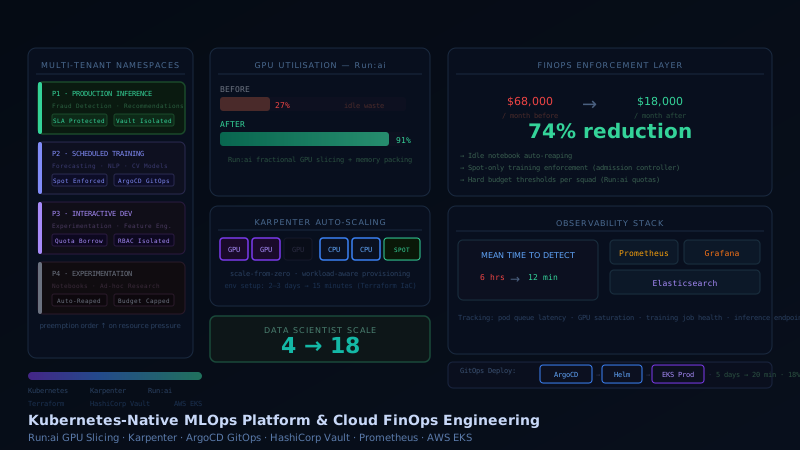
A global enterprise AI platform operating ML workloads across recommendation engines, demand forecasting systems, and fraud detection pipelines needed to scale from 4 to 18 data scientists without GPU spend spiralling out of control. GYSP engineered a Kubernetes-native, multi-tenant MLOps platform with Run:ai fractional GPU virtualisation, Karpenter dynamic compute provisioning, and a full FinOps enforcement layer that cut monthly GPU infrastructure spend from $68,000 to $18,000 while driving average GPU utilisation from 27% to 91%.
 Energy
Global Energy Trading Group
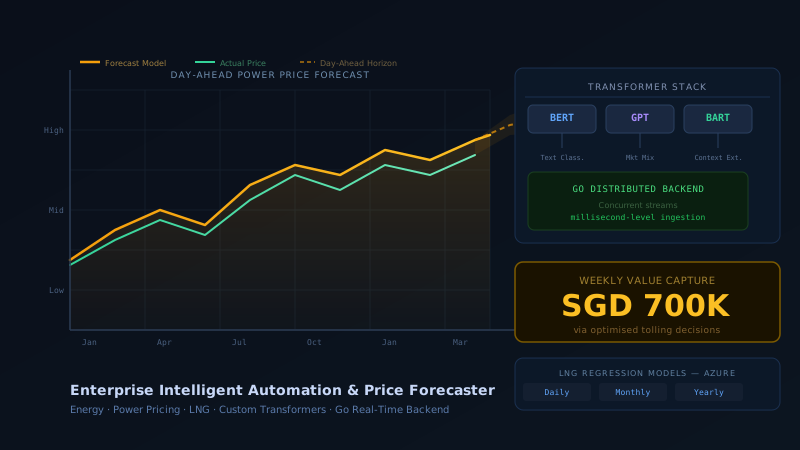
An energy trading group needed to turn power and LNG price signals into optimised decisions: fast enough to matter, accurate enough to trust. GYSP built the forecasting engine and real-time infrastructure behind SGD 700K in weekly value capture.
Client Voices
What our clients say
“Team GYSP helped us take an idea and turn it into a trading tool traders actually love. Their forecasting engine, risk-reward dashboards, and clean UX made strategy testing faster and decision-making easier. We've seen higher engagement and trust from our user base thanks to their precise execution.”
“We were drowning in unstructured freight documentation. PDFs, emails, contracts in three languages. GYSP built a RAG pipeline that extracts, classifies, and routes everything automatically. What two full-time staff handled daily now runs in 35 minutes with 93% accuracy. The ROI was clear by end of the first week in production.”
“We needed to replace a 15-year-old rules engine with a production-grade ML risk model. GYSP rebuilt the entire MLOps pipeline — feature engineering, training, deployment, and automated retraining — and gave us explainability tooling our actuaries could use in regulatory submissions. Underwriting speed improved 3x in the first quarter.”
FAQs
Common questions
Everything buyers typically ask before starting a ai/ml engagement.
Ask us anythingHow do you ensure AI systems work in production, not just demos?
We build for production from day one, with rigorous evaluation frameworks, load testing, fallback handling, monitoring pipelines, and a defined accuracy threshold (85%+ on production corpora) before any system goes live. Demo performance and production performance are measured separately.
What's the typical timeline for building a RAG application?
A well-scoped RAG application, ingestion pipeline, retrieval layer, evaluation framework, and a chat interface, typically takes 8–12 weeks from kick-off to production-ready. Complex enterprise knowledge bases with multiple data sources take 12–20 weeks.
Do you fine-tune foundation models or use them out of the box?
Both, depending on the use case. Most enterprise applications achieve strong results with prompt engineering and RAG before fine-tuning is needed. We recommend fine-tuning only when the base model consistently fails on domain-specific tasks where retrieval alone isn't sufficient.
How do you handle data privacy when building AI systems that process sensitive data?
We design for data minimisation from the start, using on-premise or VPC-deployed models where required, strict PII handling in ingestion pipelines, role-based access to vector stores, and audit logging throughout. Compliance requirements (HIPAA, GDPR, financial data) are scoped before architecture is finalised.
What does an agentic workflow actually look like in practice?
An agent is a loop: perceive input → reason → select tool → execute → observe result → repeat. We build these with defined tool sets, guardrails, memory management, and human-in-the-loop escalation for edge cases. In practice, a customer query arrives, the agent classifies it, retrieves context, drafts a response, checks it against policy, and either sends or escalates.
Let's build something together
Get a free technical brief on your ai/ml challenge — architecture, timeline, and cost estimate in 48 hours.
Get Free Technical Brief