Government of India — National Statistical Survey
AEM Forms National Survey Platform — 36 Indian States
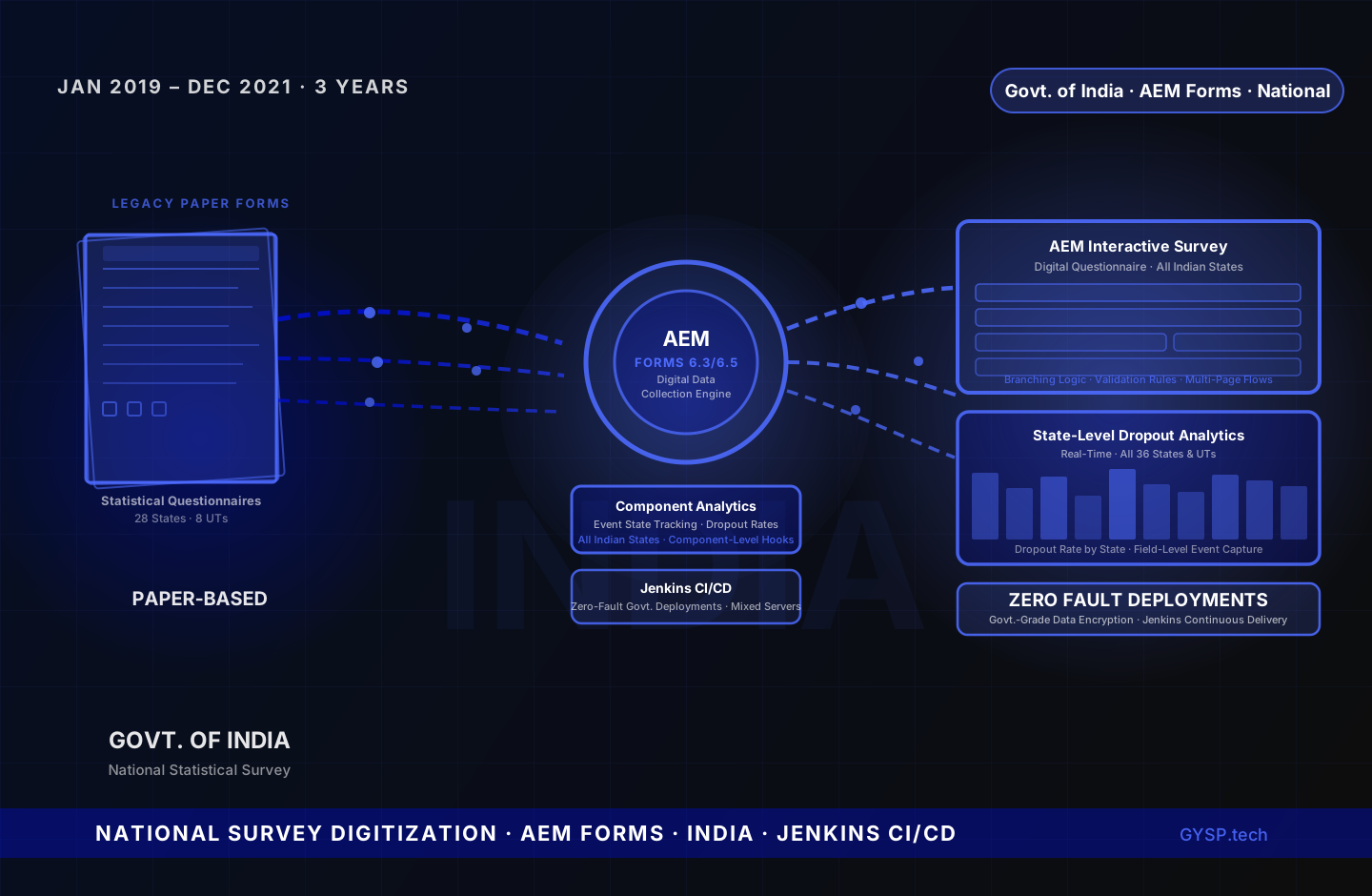
A national government statistical survey programme needed to move its mission-critical paper-based questionnaire infrastructure to a secure, scalable digital platform spanning all Indian states. GYSP transformed legacy paper forms into interactive AEM Forms instruments, programmed component-level analytics tracking for dropout and event monitoring across every state, and sustained zero-fault continuous delivery via Jenkins automation over a 3-year programme.
Industry
Government & Public Sector
Key Result
All States AEM Forms Digital Survey Deployed Across All Indian States
Primary Service
AEM Forms Development
Core Stack
Adobe Experience Manager (AEM) 6.3, Adobe Experience Manager (AEM) 6.5, AEM Forms
The Challenge
India's national statistical surveys relied on paper-based questionnaires distributed across all 28 states and 8 union territories, a data collection model that was slow, error-prone, expensive to process, and unable to provide real-time insight into survey completion rates or data quality. Digitizing mission-critical surveys at this scale introduced challenges beyond converting paper forms to digital equivalents. AEM Forms had to support the full complexity of statistical questionnaire logic, branching rules, validation dependencies, multi-page flows, while remaining accessible across the range of devices and connectivity conditions present across Indian states. Form-level analytics had to be built at the AEM component level (not as a reporting overlay) to capture granular user event states and dropout patterns by geography, enabling the programme to identify where respondents abandoned forms and make targeted improvements. Government data collection mandates required strict data encryption at rest and in transit across a mixed server environment. Continuous delivery via Jenkins had to meet a zero-fault deployment standard, a failed deployment in a national government context carries accountability that commercial software does not.
Our Solution
Transformed paper-based national statistical questionnaires into interactive, secure digital data collection instruments using Adobe Experience Manager (AEM) Forms on AEM 6.3 and 6.5. Programmed specialised analytics tracking hooks at the AEM Form component level, capturing user event states (focus, blur, field interactions, step completions) and dropout rates at each form segment across all Indian states, feeding real-time analytics enabling survey quality monitoring and completion rate optimisation. Built and maintained Jenkins-based continuous delivery pipelines supporting zero-fault government deployments across mixed server environments. Implemented strict data encryption patterns meeting government data protection mandates for statistical survey data collected from Indian citizens at national scale.
Delivery friction compounds fast. Quantify yours in 5 min.
Key Deliverables
- Transformed legacy paper-based national statistical questionnaires into interactive digital data collection instruments using AEM Forms on AEM 6.3/6.5, deployed across all Indian states
- Programmed specialised analytics tracking hooks at the AEM Form component level, capturing user event states and dropout rates across all Indian states for real-time survey quality monitoring
- Built and maintained Jenkins continuous delivery pipelines ensuring zero-fault government deployments across mixed server environments throughout the 3-year programme
- Implemented strict data encryption patterns at rest and in transit meeting government data protection mandates for national statistical survey data
- Sustained production AEM Forms environments across a 3-year programme, supporting ongoing national survey cycles, form updates, and government compliance requirements
Services Delivered
- AEM Forms Development
- Form Analytics Engineering
- Jenkins CI/CD
- Government Data Encryption
Tech Stack
This engagement used Adobe Experience Manager (AEM) 6.3, Adobe Experience Manager (AEM) 6.5, AEM Forms, Jenkins CI/CD, Form Analytics, and 2 additional tools.
Frequently Asked Questions
What is Adobe Experience Manager (AEM) Forms and why is it used for large-scale government data collection?+
AEM Forms is Adobe's enterprise form management platform. It provides a visual authoring environment for complex, multi-step form workflows with conditional logic, validation rules, document generation, and data submission capabilities. Governments use AEM Forms because it handles the complexity of statistical questionnaires (branching questions, mandatory field logic, multi-lingual support) while integrating with enterprise backend systems. For a national survey programme, AEM Forms' ability to render the same form consistently across different devices and connectivity conditions, from urban broadband to lower-bandwidth state-level networks, and to capture partial submissions and resume incomplete surveys, makes it suitable for reaching diverse respondent populations across all Indian states.
What does tracking at the AEM Form component level mean, and why does it matter for a national survey?+
Standard web analytics (like Google Analytics) can tell you that a user left a webpage, but not which specific form field or question caused them to abandon a survey. Component-level tracking in AEM Forms involves programming custom event listeners directly into individual form components, input fields, radio button groups, date pickers, dropdown menus, that fire analytics events when users interact with, skip, or abandon specific questions. For a national statistical survey, this granularity is essential: if respondents in multiple states consistently abandon at a specific question, that signals the question is confusing, the field validation is too strict, or the form logic has a usability problem. Without component-level data, you can only observe that drop-off occurred; with it, you can diagnose exactly why and fix it.
What does zero-fault deployment mean in a government context, and how did Jenkins automation deliver it?+
Zero-fault deployment means that no production deployment introduces a broken form, data loss, or service interruption, in a government context, a survey platform failure affects real citizens attempting to submit statistical data, creates audit questions about data integrity, and can disrupt a time-bound national programme. Jenkins continuous delivery automation achieved this by running automated build, test, and validation pipelines before any deployment reached production: every AEM Forms package was built consistently, validation checks confirmed form rendering and submission paths, and mixed-server deployments were managed through staged rollout configurations. Human deployment errors, inconsistent packaging, missed environment configurations, skipped validation steps, were eliminated from the release process entirely.
What data encryption requirements apply to national government survey data in India?+
National statistical survey data collected from Indian citizens falls under government data protection policies, data must be encrypted at rest (stored data on servers is encrypted at the storage layer) and in transit (all form submissions use HTTPS/TLS, preventing interception during transmission). For a mixed server environment running AEM Forms, implementing these controls consistently requires encryption configuration at multiple layers: web server TLS termination, application-level submission encryption, and storage-layer encryption on the servers holding collected survey data. Additionally, access to collected survey data must be controlled through authenticated, audited access paths, preventing unauthorised access to respondent data at any point in the pipeline.
Work with GYSP
Similar Government & Public Sector challenge?
Get a free technical brief: architecture options, cost estimates, and a delivery timeline scoped to your challenge.
- 48-hour turnaround
- Senior engineers only
- No commitment required
Or call: +1 (929) 588-8364
