Global Fintech Platform
Multi-Cluster Fraud Detection Platform — 92% Accuracy, 30% Cloud Cost Reduction
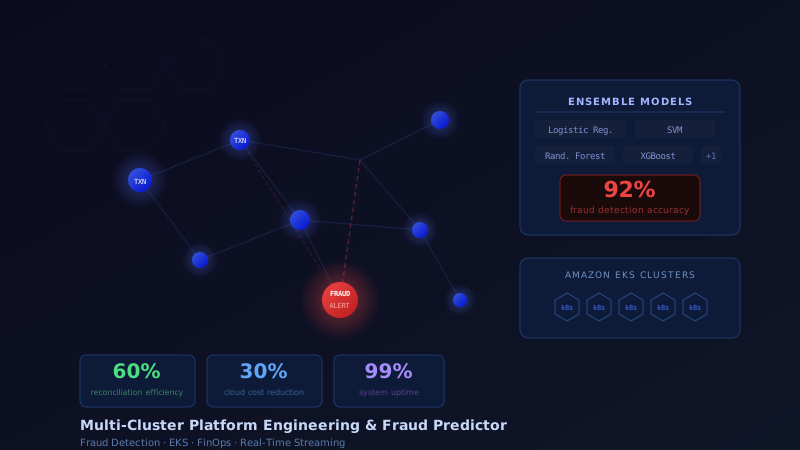
Fraud was being caught too late, reconciliation was a manual bottleneck, and cloud costs across staging and production had no governance. GYSP rebuilt the platform from the data layer up: predictive ensemble models in production on EKS, 92% accuracy, 30% less cloud spend.
Industry
FinTech
Key Result
92% Fraud Detection Accuracy Across Ensemble Models
Primary Service
AI/ML Development
Core Stack
Python, Scikit-learn, XGBoost
The Challenge
A fintech platform processing high volumes of financial transactions had three compounding problems. First, its data ledger architecture was not designed for analytical workloads: transactional reconciliation required full table scans and manual intervention, making the process slow, error-prone, and increasingly unscalable as transaction volumes grew. Second, fraud detection was reactive rather than predictive — by the time irregularities were caught, damage had already occurred and the investigation trail was cold. The platform had no trained classification system capable of identifying anomalous patterns in real time across a live transaction stream. Third, cloud infrastructure costs had grown without systematic governance: staging and production environments had accumulated configuration drift, over-provisioned resources, and no FinOps discipline applied across tiers, resulting in spend that had no relationship to actual load.
Our Solution
GYSP rearchitected the data ledger with a new indexing layout optimised for transactional workloads, boosting reconciliation efficiency by 60% without any disruption to data integrity. On top of the improved data foundation, an ensemble fraud detection system was engineered using five complementary classification algorithms, Logistic Regression, SVM, Random Forest, XGBoost, and AdaBoost, each contributing independent signal to a combined model that achieved 92% accuracy on test data. The ensemble architecture was specifically chosen to reduce false negatives by leveraging the differing sensitivities of each algorithm against different fraud pattern types. The predictive models were integrated directly into production infrastructure via Amazon EKS, with auto-scaling Kubernetes clusters ensuring the fraud scoring layer could handle peak transaction loads without manual intervention. A real-time streaming architecture sustained 99% system uptime across intensive processing periods. In parallel, GYSP conducted a FinOps audit across all staging and production deployment configurations, eliminating over-provisioned resources, rationalising instance sizing, and applying cost governance across both tiers — cutting total cloud infrastructure spend by 30%.
Most enterprise AI spend underperforms. Benchmark yours.
Key Deliverables
- New data ledger indexing layout boosting transactional reconciliation efficiency by 60% while preserving strict data integrity
- Ensemble fraud detection system combining Logistic Regression, SVM, Random Forest, XGBoost, and AdaBoost for 92% classification accuracy
- Real-time fraud monitoring architecture handling intensive transaction stream processing loads at production scale
- Auto-scaling isolated production clusters on Amazon EKS (Kubernetes) running live predictive model inference
- 99% system uptime sustained across peak transaction volumes through resilient streaming infrastructure design
- FinOps audit across staging and production deployment tiers cutting total cloud infrastructure spend by 30%
- Multi-cloud configuration governance eliminating resource drift between staging and production environments
Services Delivered
- AI/ML Development
- Cloud & DevOps Engineering
- Data Engineering
Tech Stack
This engagement used Python, Scikit-learn, XGBoost, Amazon EKS, Kubernetes, and 4 additional tools.
Frequently Asked Questions
Why use an ensemble of five models rather than a single fraud detection algorithm?+
No single classification algorithm detects all fraud pattern types equally well. Logistic Regression captures linear decision boundaries efficiently. SVMs handle high-dimensional feature spaces with strong generalisation. Random Forest reduces overfitting through feature bagging. XGBoost and AdaBoost sequentially correct the errors of prior models, making the combined ensemble particularly effective against the varied and evolving pattern types seen in financial transaction fraud. Running five algorithms and combining their outputs reduces both false positives (legitimate transactions flagged as fraud) and false negatives (fraud that passes through undetected) compared to any single model.
How was the fraud detection model deployed into live transaction processing on EKS?+
The trained ensemble models were containerised and deployed as microservices on Amazon EKS, with auto-scaling Kubernetes clusters configured to expand inference capacity during peak transaction loads. Each incoming transaction was scored in real time by the fraud scoring service, which returned a risk classification and confidence score before the transaction completed processing. The EKS deployment was designed with isolated production clusters to ensure the fraud detection workload could not be affected by other platform services competing for compute resources.
What did the FinOps audit cover and how was 30% cost reduction achieved?+
The FinOps audit examined deployment configurations across all staging and production environments, analysing instance sizing against actual utilisation, identifying over-provisioned resources that had accumulated through configuration drift, and reviewing reserved versus on-demand capacity allocation across both tiers. Savings came from three sources: rightsizing instances to match observed load profiles, converting consistently-used on-demand resources to reserved capacity, and eliminating staging environment resources that had been provisioned at production scale without justification. No functionality was removed — the reduction came entirely from eliminating waste.
How was 99% uptime maintained during intensive transaction processing loads?+
The real-time fraud monitoring architecture was built with resilience as a first-class concern. Auto-scaling Kubernetes deployments ensured processing capacity expanded ahead of load spikes rather than reacting to them. The streaming pipeline was designed with backpressure handling so that burst transaction volumes were queued and processed without data loss rather than dropped under load. Health checks, pod restart policies, and multi-availability-zone deployment across EKS nodes meant individual node failures did not cause service interruptions visible to the transaction processing layer.
Work with GYSP
Similar FinTech challenge?
Get a free technical brief: architecture options, cost estimates, and a delivery timeline scoped to your challenge.
- 48-hour turnaround
- Senior engineers only
- No commitment required
Or call: +1 (929) 588-8364
More FinTech Case Studies
 FinTech
Global FinTech SaaS Company
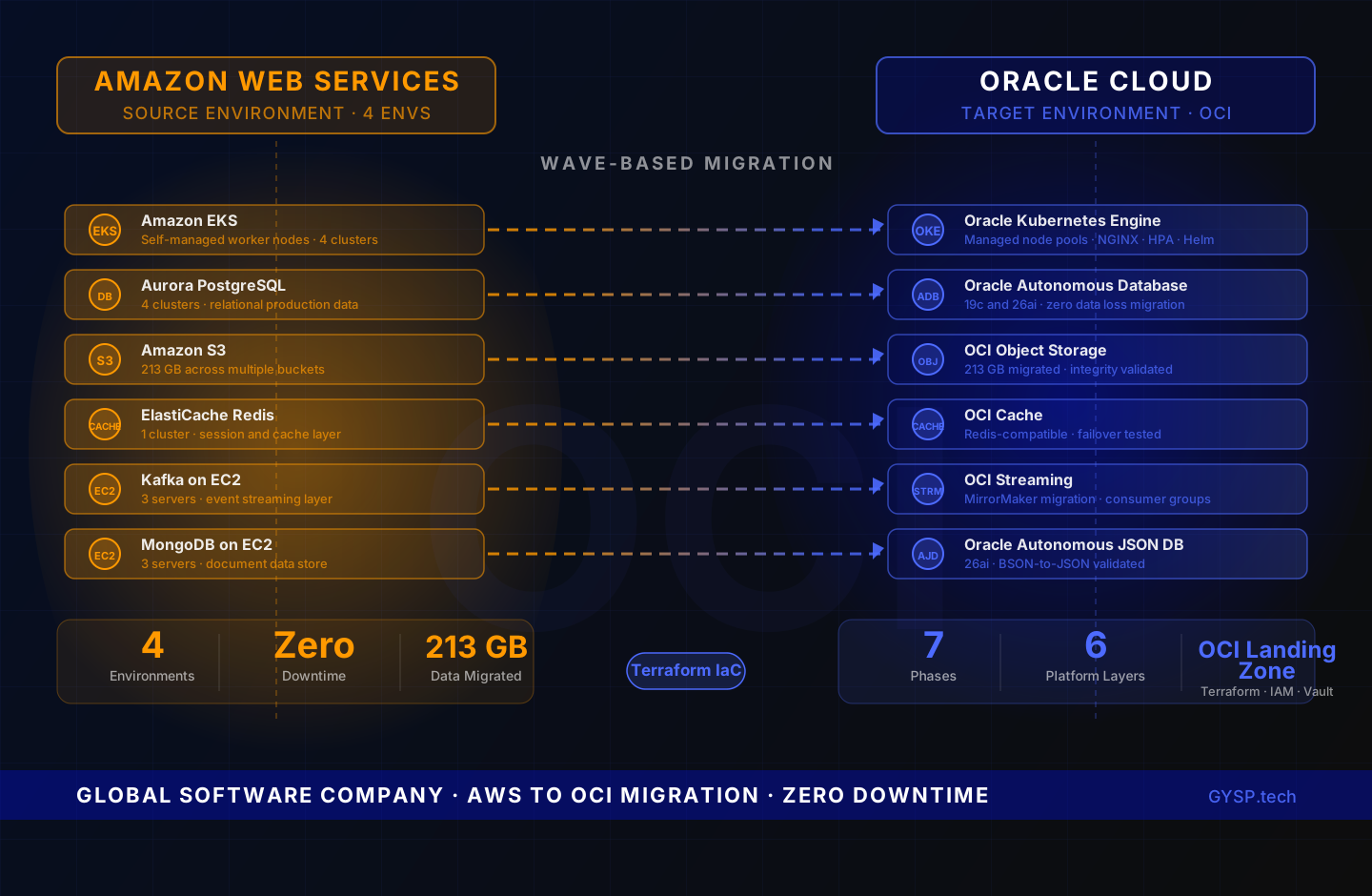
A global software company running business-critical workloads across four AWS environments needed a full-stack migration to Oracle Cloud Infrastructure: containers, databases, messaging, caching, and object storage, without disrupting production operations.
 FinTech
DotPe
Growing transaction volumes, three active compliance frameworks, and a full AWS-to-GCP migration, all without a single major service outage. The stakes were high for this fintech platform.
 FinTech
Options Trading Platform
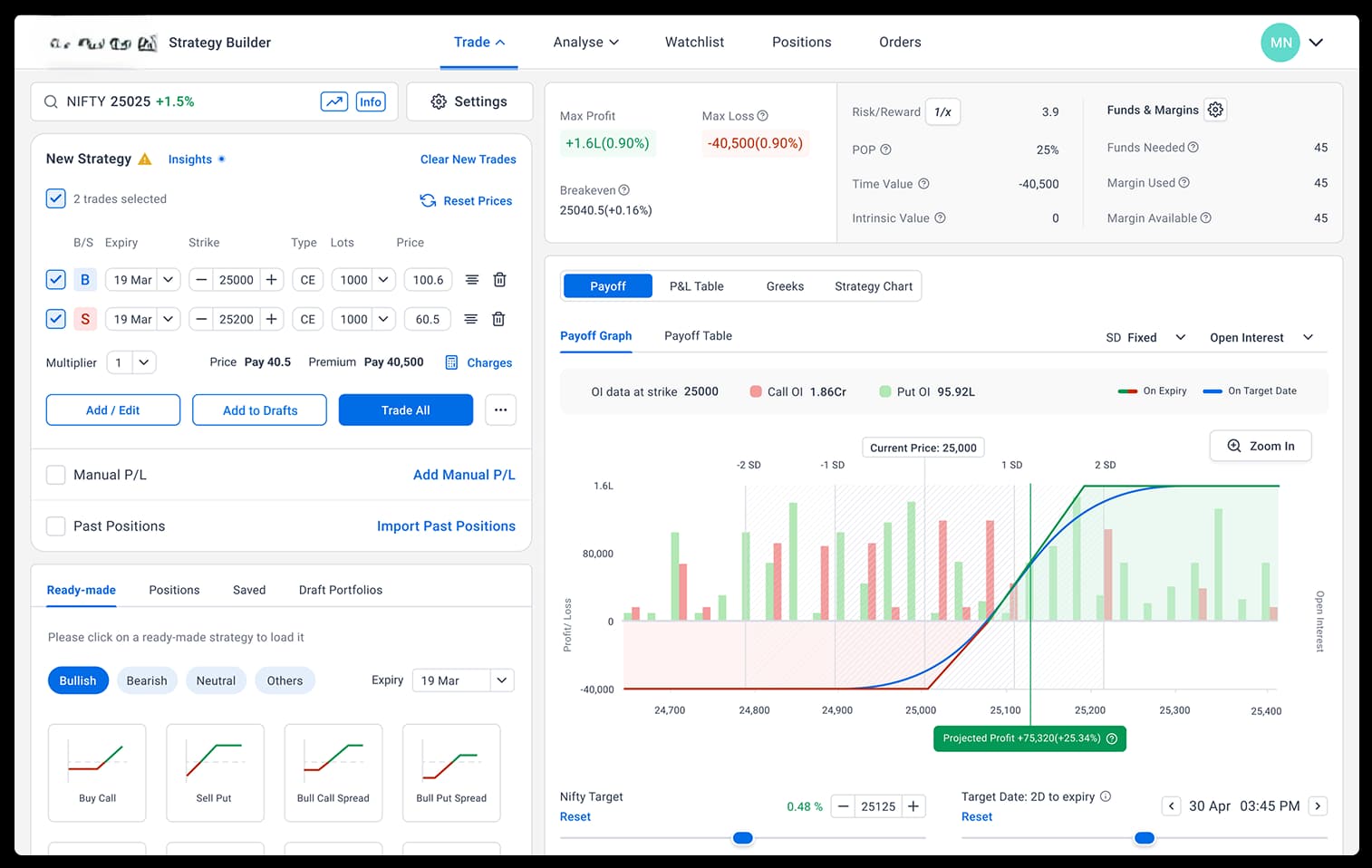
Retail traders were making high-stakes decisions with manual calculations and static charts. They needed the kind of strategy tools professional desks take for granted, built for the masses.
