
What you'll take away
The dashboard looks great. Sessions are up 34% year-over-year. Organic traffic grew 12% last quarter. The new paid campaign is generating impressions in the millions. The marketing team is hitting every metric they were given.
Pipeline is flat. Sales is generating its own leads through outbound calls and network referrals, the same way it did before the digital marketing function was built. The CMO and the VP of Sales are having the same conversation they had twelve months ago, and it is not going well.
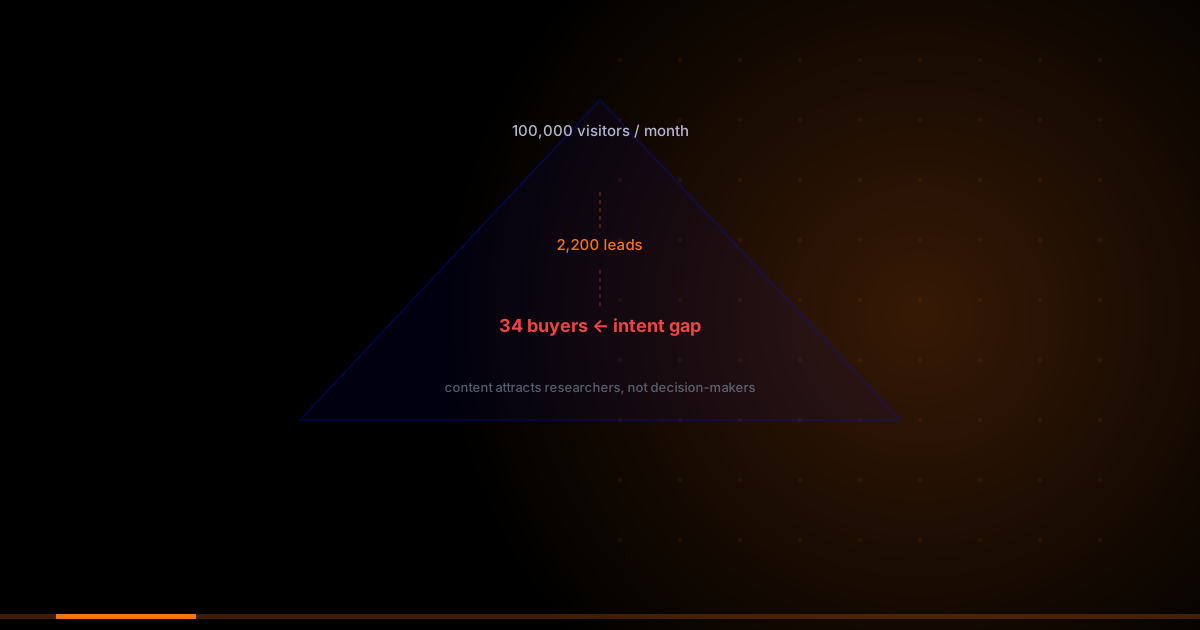
This is the intent gap: the distance between the traffic your marketing generates and the buyers who are actually ready to evaluate a solution. Most B2B digital marketing operates on an implicit assumption that visibility creates pipeline, that if you get enough people to your website, some fraction will convert. That assumption is wrong, and the cost of maintaining it is a significant portion of your marketing budget with very little to show for it.
The Intent Spectrum — Where Your Buyers Actually Live
Buyer intent is not binary. It exists on a spectrum from passive awareness through active evaluation to decision readiness. A prospect reading a thought leadership article about cloud architecture is at one end of that spectrum. A prospect actively comparing vendors for a six-figure cloud consulting engagement is at the other. The marketing content, channels, and offers appropriate for each are completely different and most B2B marketing budgets are skewed heavily toward the awareness end of the spectrum, generating traffic from audiences who are nowhere near a purchasing decision.
Awareness-Stage Signals
Awareness-stage prospects are encountering the problem domain for the first time or building general knowledge. They consume blog posts, industry reports, and educational content. They follow LinkedIn influencers in the space. They attend webinars out of curiosity. They are not evaluating vendors. Converting them to qualified pipeline requires months of nurturing and the conversion rate from awareness touch to sales conversation is typically below 0.5% for B2B technology buyers.
Consideration-Stage Signals
Consideration-stage prospects understand the problem and are building a solution hypothesis. They are reading comparison articles, watching product demos, downloading implementation guides. They are asking specific questions about ROI, implementation risk, and integration complexity. This is the stage where most B2B buyers first engage with vendors and where most marketing content is absent, because depth and specificity are harder to create than awareness content.
Decision-Stage Signals
Decision-stage prospects are shortlisting vendors, preparing business cases, and scheduling calls. They are reading case studies, checking reference customers, and evaluating pricing structures. They have internal buying committee conversations happening in parallel. At this stage the content that matters is not thought leadership, it is proof: specific outcomes, credible references, and a clear answer to the question 'why you and not your competitor?'
Gartner research shows that B2B buyers spend only 17% of their total buying journey with vendor sales representatives. The other 83% is spent researching independently, which means your digital content is doing sales work whether you design it to or not.
Why Most B2B Marketing Lives at the Wrong Stage
Awareness content is easier to justify and easier to create. A blog post about industry trends generates impressions and social shares, metrics that look good in monthly reports. An in-depth ROI calculator for a specific use case generates fewer impressions but attracts a much smaller, much more qualified audience of prospects who are actively building a business case. The problem is that marketing organisations are typically measured on the easy metrics, traffic, impressions, MQL volume, rather than on pipeline contribution and closed revenue.
This misalignment between marketing incentives and commercial outcomes is the root cause of the intent gap. When you measure marketing by sessions, you build marketing for sessions. When you measure marketing by pipeline, you are forced to confront the question of whether the traffic you are generating could ever convert.
The Four Intent Signals Most B2B Teams Are Missing
- Technographic intent: a prospect's technology stack is one of the strongest buying signals available. A company running AWS infrastructure and recently hiring Terraform engineers is a higher-intent prospect for cloud consulting than one still running on-premise. Technographic data from providers like Bombora, BuiltWith, or HG Insights surfaces these signals before the prospect has engaged with your brand at all.
- Hiring signals: when a company posts three senior data engineering jobs in two months, they are building a capability, or struggling to. Both are buying signals for data services. LinkedIn job postings, Glassdoor data, and specialised tools like Textkernel track these signals at scale.
- Content depth signals: a prospect who reads four articles about RAG architecture and spends eleven minutes on a case study is a fundamentally different signal than one who bounced after thirty seconds. Most marketing teams track page views, not engagement depth and build content strategies around the wrong audience.
- Intent network data: third-party intent platforms aggregate content consumption patterns across thousands of B2B websites and identify accounts spiking in research activity for specific topics. A company whose employees are reading multiple cloud migration comparison articles in the same week, across multiple sites, is an active research signal, even if they have not visited your site yet.
Account-Based Marketing: Aligning Channels to Intent
Account-based marketing (ABM) is not simply targeted advertising. Done correctly, it is the organisational practice of aligning sales and marketing activity around the accounts most likely to buy and coordinating every channel (content, paid, email, events, outbound) to move those specific accounts through the buying journey.
The ABM model inverts the traditional demand generation funnel. Instead of casting wide and filtering down, you define the ideal customer profile (ICP) at account level, identify the active buying signals in that account population, and deploy coordinated content and outreach to specific decision makers in those accounts. The result is a smaller addressable audience and dramatically higher conversion rates: ABM campaigns typically generate 35–50% higher average deal values compared to non-ABM campaigns (Demand Gen Report, 2024).
Tier 1: Strategic Accounts
Strategic accounts, typically 10–25 named companies representing your highest-value potential contracts, warrant fully bespoke ABM treatment: custom research reports, personalised outreach, executive-to-executive contact programmes, and direct sales alignment. The investment per account is high, but the deals are significant enough to justify it.
Tier 2: Priority Segments
Priority segments, accounts that match your ICP and are showing intent signals but are not named strategic targets, warrant programmatic ABM: intent-triggered paid campaigns, persona-segmented content sequences, and coordinated SDR outreach triggered by intent score thresholds. Tools like 6sense and Demandbase automate much of the identification and targeting logic for this tier.
Tier 3: Broad ICP
Broad ICP accounts warrant traditional demand generation: quality content that attracts and educates, strong organic search presence, and efficient paid targeting by industry and job function. The goal is to generate the first intent signal, the first piece of content consumption, that moves an account from invisible to known.
Paid Channel Alignment: Stop Bidding on Awareness Keywords
One of the most common sources of B2B advertising waste is bidding on awareness-stage keywords with decision-stage offers. A prospect searching for 'what is cloud migration' is at the beginning of their educational journey. Serving them an ad for a 'Free Cloud Migration Assessment' generates clicks from people who are nowhere near ready for an assessment and high CPLs for leads that go nowhere in sales.
Paid channel effectiveness in B2B comes from matching the offer to the intent signal. Decision-stage keywords, 'cloud migration vendor comparison', 'managed kubernetes provider', 'best devops consulting firm', should get your highest-value offers: case studies, specific ROI benchmarks, and direct calls to action. Awareness keywords should get gated educational content or nothing at all, since the conversion economics rarely justify the spend.
Validated Outcomes
Gartner's research on B2B buyer journeys documented that the average enterprise buying committee now involves 6–10 stakeholders and consumes 27 distinct pieces of content before making a vendor selection. The implication for digital marketing strategy: campaigns optimised for single-touch MQL generation are structurally misaligned with how enterprise buying decisions actually happen. The companies consistently winning enterprise deals are running account-level intent programmes that identify buying committee activity across multiple touchpoints, not single-contact lead generation funnels optimised for CPL.
GYSP's digital marketing engagements for B2B technology clients consistently find the same misalignment: 60–70% of paid spend is directed at awareness-stage audiences with decision-stage offers, producing high click-through rates and low pipeline conversion. Reallocating that spend to decision-stage keyword targeting and account-based retargeting, serving case studies and specific outcome content to companies showing buying committee signals, typically improves pipeline-qualified lead volume by 2–3x with the same total budget.
Attribution: Measuring What Actually Drives Pipeline
Last-click attribution, crediting the final touchpoint before a conversion, systematically undervalues the channels that create initial intent and overvalues the channels that simply capture it. A prospect who first engaged with an industry report eighteen months ago, attended a webinar eight months ago, read three case studies last month, and then clicked a paid search ad and converted, that paid ad is credited with a closed deal that the earlier touchpoints enabled.
B2B organisations serious about closing the intent gap need multi-touch attribution models that distribute credit across the buying journey, or position-based attribution that separately values journey initiation and journey close. The data reveals which channels are actually building pipeline versus which are merely present at the moment of conversion and it almost always justifies a significant reallocation of budget away from bottom-funnel capture and toward mid-funnel nurture.
GYSP's Digital Marketing practice builds intent-aligned demand generation programmes: ICP definition, intent signal architecture, ABM campaign management, and attribution modelling that makes the pipeline contribution of digital marketing legible to leadership.
“Most B2B companies are not losing the digital marketing game because they are bad at execution. They are losing because they are executing the wrong strategy, optimising for the metric that is easy to measure rather than the metric that actually matters.”
— Aniruddha, Head of Digital Growth & VA — GYSP.tech