What you'll take away
The legal team's discovery request turned up something uncomfortable: employees had been pasting portions of acquisition target due diligence documents into ChatGPT to get summaries. The documents contained information protected by NDA. The model provider's data usage policies at the time meant the company couldn't guarantee that information hadn't been used for training. The acquisition was still live.
This is not a hypothetical scenario. It's a composite of incidents reported across multiple industries as consumer AI tools became ubiquitous in the workplace before enterprise governance caught up. The tools are powerful, employees are using them to get work done faster, and in the absence of policy, the path of least resistance is to paste whatever is convenient, including data that the company has significant obligations to protect.
The Actual Exposure Types
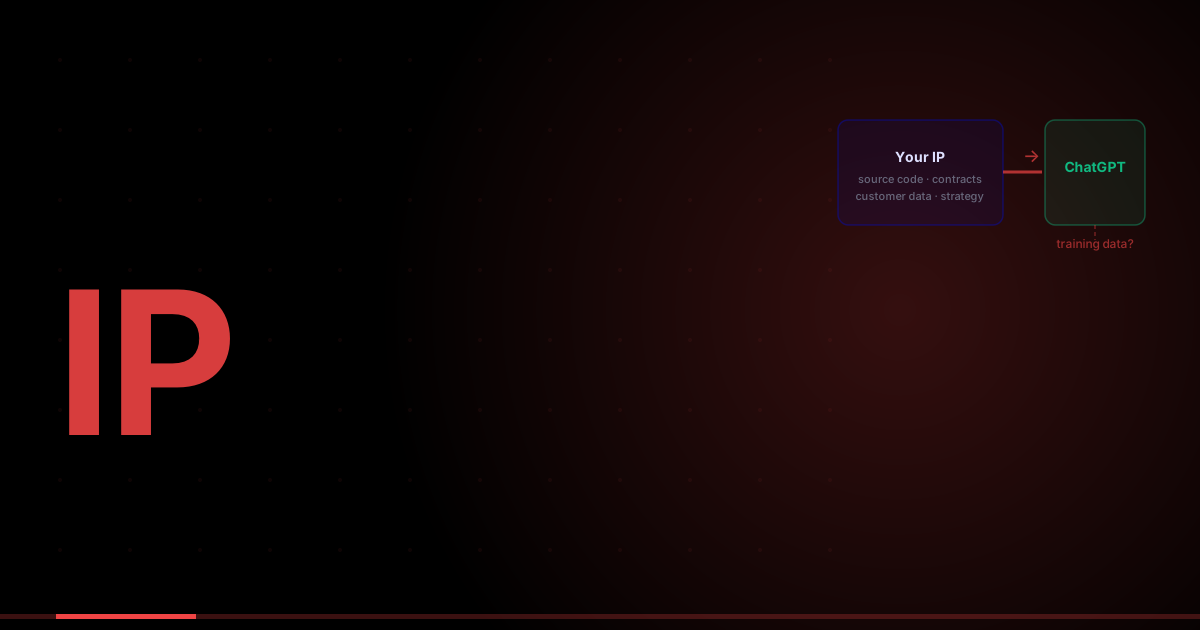
Intellectual Property Leakage
Source code, product designs, unpublished research, competitive intelligence, and unreleased financial data fed into public AI tools may be stored, analysed, or used by the provider. Even providers that commit to not using business data for training retain the data during the session and are subject to data requests from legal and governmental authorities. Code submitted to an AI coding assistant that contains novel algorithms or implementation approaches represents IP exposure that is difficult to quantify but real.
Confidentiality Obligation Breach
Customer data, partner data, employee data, and data shared under NDA are subject to confidentiality obligations that don't disappear because an employee found a convenient way to process them. Submitting customer records to a third-party AI tool without appropriate data processing agreements may breach contractual obligations with customers, regulatory requirements under GDPR or similar frameworks, and industry-specific regulations like HIPAA in healthcare or PCI DSS in payments.
AI-Assisted Insider Threat Vectors
An employee who wants to exfiltrate data has a new, convenient mechanism: paste it into an AI tool, have it summarised or transformed, copy the output. Traditional data loss prevention tools that monitor for bulk data transfers may not detect semantically equivalent data that has been transformed. A comprehensive AI governance policy needs to include this use case alongside the inadvertent data exposure scenarios.
The governance gap that most organisations are in: employees are using public AI tools for work tasks, the IT and security teams are aware of this, no formal policy exists, and therefore the de facto policy is 'anything goes.' This is not a deliberate decision, it's the absence of one, which creates the same exposure as explicit permission without any of the controls.
The AI Governance Framework That Works
Data Classification First
The foundation of any functional AI governance policy is data classification: a clear taxonomy of data sensitivity (Public, Internal, Confidential, Restricted) with specific guidance on what can and cannot be submitted to external AI tools at each level. Without this taxonomy, policy statements like 'don't share sensitive data' are unactionable, employees can't make good decisions if they don't have a shared definition of what sensitive means.
Approved Tool Registry
Establish a list of AI tools that have been reviewed and approved for use with specific data classifications, with the appropriate data processing agreements in place. For most enterprises, this means an enterprise tier of major AI providers (OpenAI Enterprise, Microsoft Copilot for M365, Claude for Enterprise) with data residency guarantees and no training data rights, approved for use with Internal data. External or unapproved tools are restricted to Public data only.
Technical Controls That Reinforce Policy
Policy without technical enforcement is aspirational governance, not actual governance. DLP (Data Loss Prevention) rules that detect and block submission of classified data to unapproved AI endpoints provide a technical backstop. Network proxy policies that block access to unapproved AI tools from corporate networks remove the most common accidental-exposure paths. Browser extensions or endpoint agents that prompt users before pasting large amounts of text into AI tools add a friction point that catches inadvertent sharing.
Validated Outcomes
Samsung's 2023 ChatGPT data leak, where engineers pasted proprietary semiconductor source code and internal meeting notes into ChatGPT within weeks of the company lifting its AI tool ban, became the canonical enterprise case study for what happens when AI governance is reactive rather than proactive. Samsung's initial response was to ban AI tools entirely; the ban lasted months before being reversed with a controlled programme of approved tools and DLP controls. The episode was publicly estimated to have required significant legal and security remediation resources and demonstrated that blanket bans simply redirect usage to shadow channels rather than eliminating it.
GYSP's AI governance engagements complete policy development and approved tool selection in 2–4 weeks, and DLP configuration rollout in an additional 2–4 weeks depending on existing Microsoft 365 or Google Workspace tooling. Clients who implement a governance framework before an incident, rather than after, consistently report that the controlled rollout produces higher employee AI adoption than the uncontrolled alternative would have, because approved tools with enterprise data agreements provide capabilities (longer context, API access, custom GPTs) that consumer free tiers do not.
Enabling Productivity Safely
The goal of AI governance is not to prevent employees from using AI, the productivity benefits are real and significant, and teams that can't use AI tools will be less productive than teams that can. The goal is to channel AI usage through approved tools with appropriate data handling agreements, and to make the approved path easy enough that employees don't feel the need to circumvent it.
GYSP's Cyber Security practice has developed AI data governance frameworks for enterprises across financial services, healthcare, and professional services. The implementation is typically faster than clients expect: two to four weeks for policy development and approved tool selection, followed by a DLP configuration rollout and user training programme.
“The worst AI governance policy you can have is no policy, because the absence of a decision is itself a decision, it's 'yes to everything.' The second worst is a policy so restrictive that nobody follows it. The goal is a framework that enables the productivity benefits while managing the specific risks that matter for your data environment.”
— Dhaval S, Network & Security Lead — GYSP.tech