Data Architecture Consulting
One governed data layer your BI, ML and product teams all trust.
Data architecture consulting services that design and implement data lakehouse patterns, data mesh architectures and enterprise data integration frameworks. We build on Databricks and Delta Lake for unified batch and streaming, with dbt for transformation governance — giving every team one consistent, queryable data layer.
What We Deliver
Core Capabilities
- Data Architecture Assessment & Blueprint
- Data Lakehouse Design (Databricks, Delta Lake)
- Real-Time Streaming Architecture (Kafka, Flink, Kinesis)
- Data Mesh Architecture & Domain Modelling
- Medallion Architecture (Bronze, Silver, Gold)
- Enterprise Data Integration Framework
- Data Governance & Lineage Integration
Ready to get started?
Get a free technical brief — architecture options, timelines, and cost estimates delivered within 48 hours. No commitment required.
- 01Submit your challenge≈ 1 min
- 02Receive your Technical BriefWithin 48h
- 03Discovery call — no obligationOptional
Or call us: +1 (929) 588-8364
By the Numbers
What clients achieve with GYSP
after migrating from ungoverned data lake to Delta Lake lakehouse with proper partitioning and Z-ordering
after medallion architecture replaced ad-hoc lake ingestion with structured Bronze, Silver and Gold quality gates
after data mesh implementation with federated governance — each domain owns its data products independently
Proven Results
Data Architecture Case Studies
 FinTech
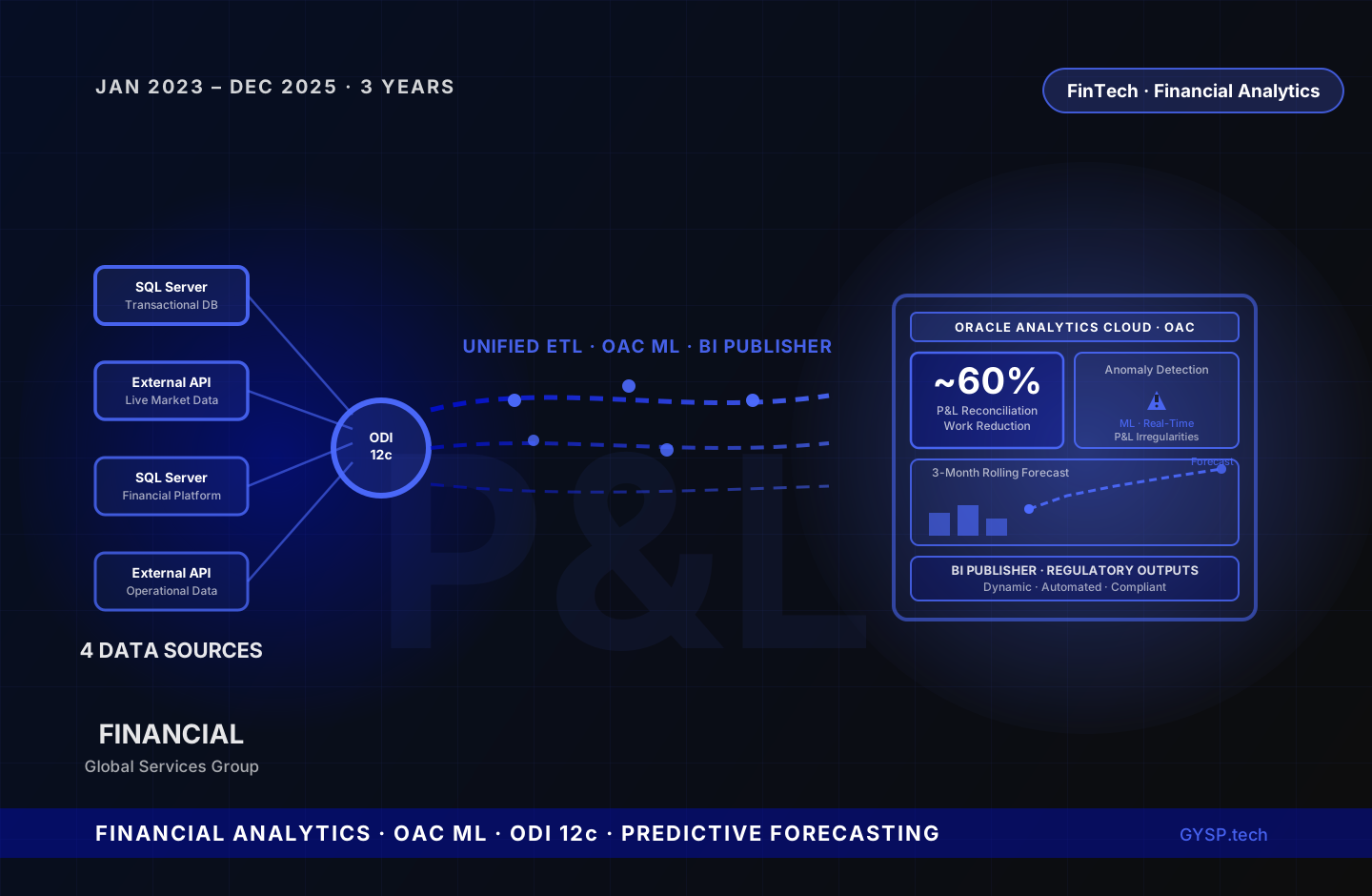
Global Financial Services Group
A global financial services group was spending significant analyst bandwidth on manual P&L reconciliation across 4 disparate data systems, with no anomaly detection, no forward-looking forecast, and regulatory reports still produced from static spreadsheets. GYSP unified the data layers on ODI 12c, reduced reconciliation work by 60%, deployed OAC ML anomaly detection on live P&L pipelines, and built rolling 3-month commercial forecasting, all within a single integrated analytics architecture.
 Oil, Gas & Energy
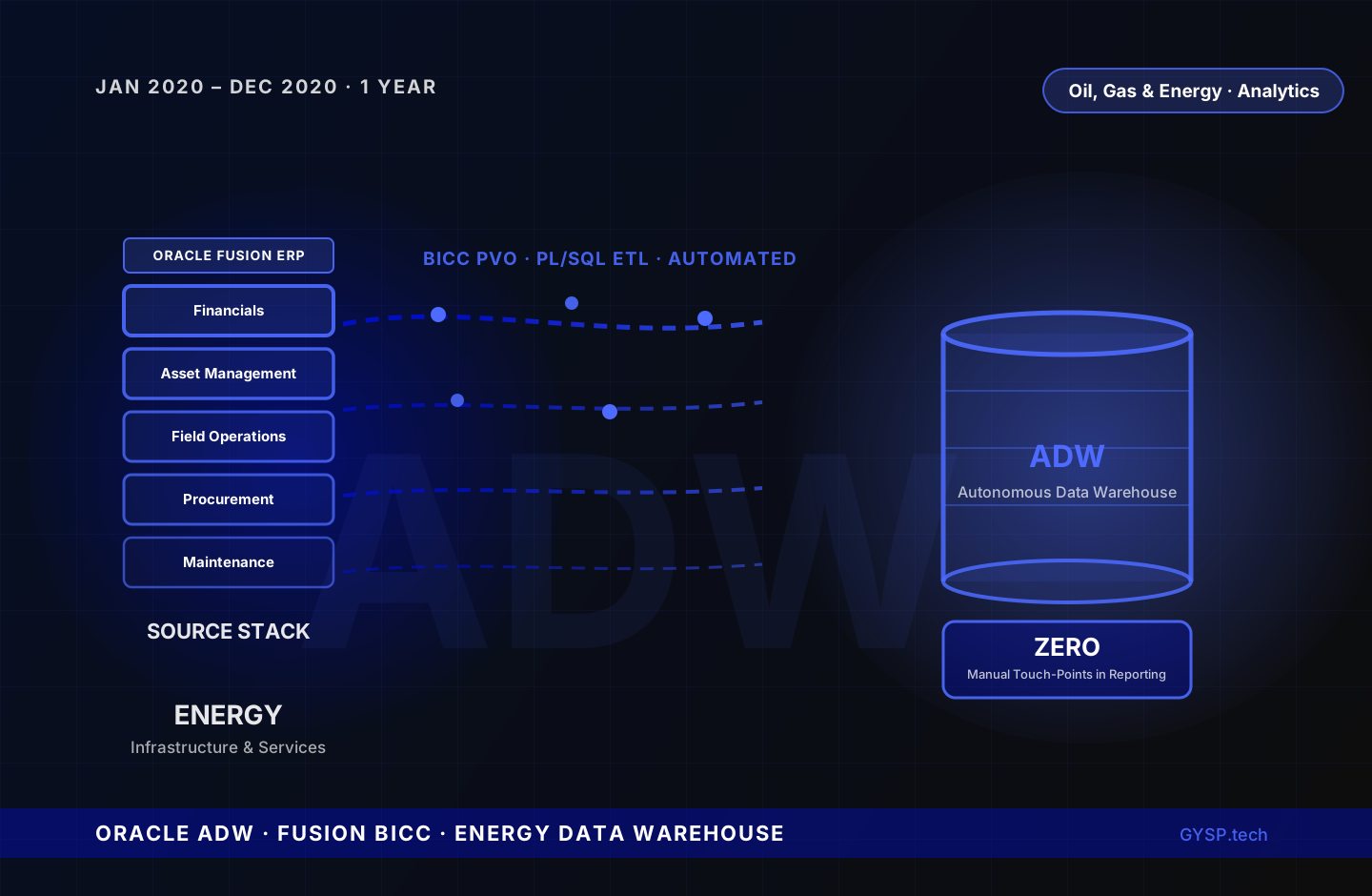
Energy Infrastructure & Services Provider
An energy infrastructure and services company was running financial and operational reporting through a cycle of manual extractions, transformations, and handoffs from Oracle Fusion, slow, error-prone, and dependent on IT for every update. GYSP built an Oracle Autonomous Data Warehouse from scratch, automated the full BICC extraction pipeline, and eliminated every manual touch-point from the reporting loop.
 Automotive
Cars24
Scaling India's largest digital auto marketplace meant modernising cloud infrastructure, real-time data pipelines, and observability, simultaneously, without slowing the product team.
Industry Expertise
Industries We Serve with Data Architecture
FAQs
Common questions
Everything buyers typically ask before starting a data architecture engagement.
Ask us anythingWhat is the difference between a data lake, a data warehouse, and a data lakehouse?
A data lake stores raw, unprocessed data at scale but becomes a swamp without governance. A data warehouse stores structured, processed data optimised for SQL analytics but is rigid and costly to evolve. A data lakehouse (Databricks, Delta Lake) combines both: raw storage flexibility with ACID transactions, schema enforcement and warehouse-style querying — letting analytics and ML workloads run on the same data without duplication.
What is medallion architecture and why does it matter?
Medallion architecture organises data into three quality layers: Bronze (raw ingestion, nothing discarded), Silver (cleansed, conformed and joined), and Gold (business-ready aggregates for BI and ML). Each layer has explicit quality gates so issues are caught early. It replaces the ad-hoc data lake pattern where raw files and analytics tables live together with no clear ownership or quality standard.
When does a data mesh architecture make sense?
Data mesh makes sense when multiple business domains (marketing, finance, logistics) each produce and consume significant data, and a central data team has become a bottleneck. The pattern distributes data ownership to domain teams while enforcing federated governance standards. It is an organisational and architectural decision — not just a technology one — so we always assess whether the team structure supports it before recommending it.
Should we use Databricks or Snowflake for our lakehouse?
Databricks is the stronger choice when ML, data science and streaming workloads need to run on the same data as analytics, or when you need Delta Lake's unified batch and streaming architecture. Snowflake is better when SQL analytics and BI reporting are the primary use case and ML is secondary. Many organisations run both: Snowflake for governed analytics, Databricks for ML feature engineering and streaming.
How long does a data lakehouse implementation take?
A greenfield lakehouse implementation on Databricks with medallion architecture takes 10–16 weeks for a medium-complexity environment. If migrating from an existing data lake or warehouse, add 4–8 weeks for parallel-run validation. We always implement incrementally — Bronze layer first, then Silver and Gold — so early consumers get value before the full architecture is complete.
Let's build something together
Get a free technical brief on your data architecture challenge — architecture, timeline, and cost estimate in 48 hours.
Get Free Technical Brief