National Rail & Logistics Authority
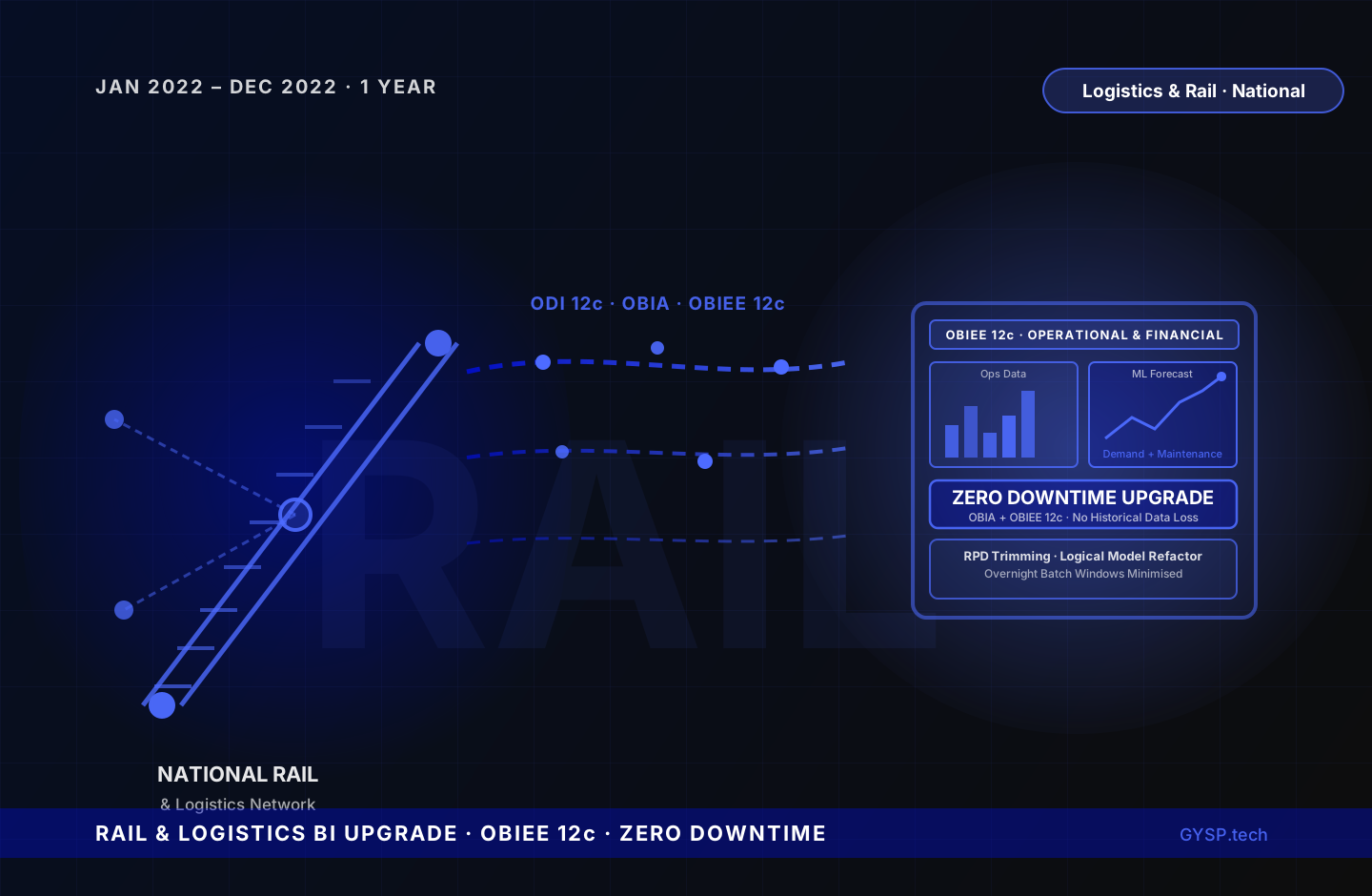
A national rail and logistics authority was running operational and financial analytics on an aging OBIA and OBIEE stack approaching end of supportable version — with Informatica ETL pipelines extending overnight batch windows and no forward-looking ML capability for planners. GYSP executed the full lifecycle upgrade to OBIEE 12c with zero downtime, migrated ETL to ODI 12c, and embedded predictive demand and asset maintenance models into the analytics core.
The Challenge
Upgrading a live BI environment at national transportation scale carries risks that don't exist in typical enterprise projects. Any unplanned downtime cascades immediately into planning failures for schedules, capacity, and resource allocation across the entire national network; any historical data loss breaks the analytical continuity that financial and operational reporting depends on. The existing OBIA and OBIEE stack was approaching the boundary of supportable version, but a migration of this sensitivity required a zero-downtime upgrade path rather than a standard cutover. Beyond the version risk, the Informatica ETL infrastructure powering the stack had accumulated performance debt — overnight batch windows were running long, throttling the freshness of data available for operational planning. The OBIEE metadata repository had grown unwieldy over years of accreted development, with redundant objects inflating processing overhead and compounding batch window duration. And despite the depth of retrospective operational and financial data in the analytics environment, logistics and rail planners had no predictive capability integrated into their dashboards — they were optimising schedules and resource allocation from historical data rather than forward-looking forecasts.
Our Solution
As Principal Consultant, GYSP managed the full upgrade path from legacy OBIA and OBIEE to OBIA and OBIEE 12c standards using a zero-downtime methodology — no business disruption and no historical data loss across the entire national rail environment. Legacy Informatica ETL workflows were assessed for performance and migrated to ODI 12c, eliminating the pipeline bottlenecks that had been extending overnight batch windows and significantly reducing total ETL runtime overhead. The OBIEE metadata repository was refactored through aggressive RPD trimming — removing redundant and unused physical, business model, and presentation layer objects — and logical model modifications that restructured the semantic layer for maximum compute efficiency, further reducing batch window duration and improving query performance across the analyst population. Predictive analytics capabilities were embedded into the centre of the analytics architecture: machine learning models for predictive asset maintenance and passenger demand forecasting were integrated directly into the BI stack, giving logistics and rail planners a forward-looking view alongside their retrospective operational and financial data. Together, the upgraded infrastructure and embedded ML forecasting empowered rail and logistics planners to actively optimise schedules and transit distribution using predictive telemetry — shifting from reactive historical reporting to proactive operational planning.
Facing a similar challenge? Get a no-commitment technical brief.
Get free briefKey Deliverables
- Zero-downtime upgrade of core BI infrastructure to OBIA and OBIEE 12c standards — no business disruption and no historical data loss
- Legacy Informatica ETL workflows migrated to ODI 12c, significantly reducing pipeline runtime overhead and overnight batch window duration
- OBIEE metadata repository refactored via aggressive RPD trimming and logical model modifications to maximise compute efficiency
- Predictive asset maintenance and passenger demand forecasting ML models embedded into the centre of the analytics architecture
- Logistics and rail planners empowered to actively optimise schedules and transit distribution using predictive telemetry
- Retrospective operational and financial analytics combined with forward-looking ML forecasting in a single, upgraded analytics environment
Services Delivered
- BI Stack Upgrade
- ETL Migration
- ML Forecasting Integration
- OBIEE Optimisation
Tech Stack
Frequently Asked Questions
What is OBIA and how does it differ from OBIEE?+
Oracle Business Intelligence Applications (OBIA) is a suite of pre-built analytics applications for specific business domains — supply chain, financials, human capital, and others — built on top of OBIEE as the BI presentation layer. Where OBIEE is the platform (semantic model, dashboards, reporting), OBIA provides pre-built subject areas, ETL mappings, and dashboards for specific domains out of the box. For a national rail and logistics authority, OBIA provides the operational and financial analytics framework that OBIEE surfaces to end users.
What is RPD trimming and how does it improve OBIEE performance?+
The RPD (Repository) is OBIEE's three-layer metadata file — Physical (database connections and tables), Business Model (logical data model and calculations), and Presentation (what users see in dashboards). Over time, RPDs accumulate unused objects from deprecated reports, retired data sources, and abandoned development branches. RPD trimming is the process of systematically identifying and removing these objects. Fewer objects mean fewer joins evaluated at query time, faster metadata parsing, and reduced overhead during overnight batch processing — directly shortening batch windows.
How were ML models for passenger demand and asset maintenance integrated into an OBIEE environment?+
Machine learning models for passenger demand forecasting and predictive asset maintenance were integrated by embedding model outputs — scored predictions, forecasts, and maintenance risk signals — into the data layer that OBIEE's semantic model consumes. Rather than keeping ML predictions in a separate system, the outputs were loaded into the data warehouse alongside operational data, allowing OBIEE dashboards to surface predictive telemetry alongside retrospective metrics in the same analyst interface — giving rail planners a unified view of historical performance and forward-looking forecasts.
Why migrate from Informatica to ODI 12c, and what performance gains does it deliver?+
Informatica processes ETL transformations in its own engine, requiring data to travel between the source database, Informatica's processing layer, and the target. Oracle Data Integrator (ODI) uses an E-LT (Extract, Load, Transform) architecture that executes transformations directly within the database engine, eliminating the round-trip overhead. For a national rail environment running large-scale overnight batch loads, this architectural difference directly reduced total ETL runtime and shortened the overnight batch window.
Work with GYSP
Want results like these?
Get a free technical brief — architecture options, cost estimates, and a delivery timeline tailored to your challenge.
- 48-hour turnaround
- Senior engineers only
- No commitment required
Or call: +1 (929) 588-8364