What you'll take away
The vocabulary of automation has accumulated layers over a decade: RPA, intelligent automation, hyperautomation, AI-powered automation, agentic automation. Each term arrived with vendor marketing, each represented a genuine capability evolution, and each has been used interchangeably by practitioners who conflate the underlying architectures. That conflation is now producing design errors in production systems.
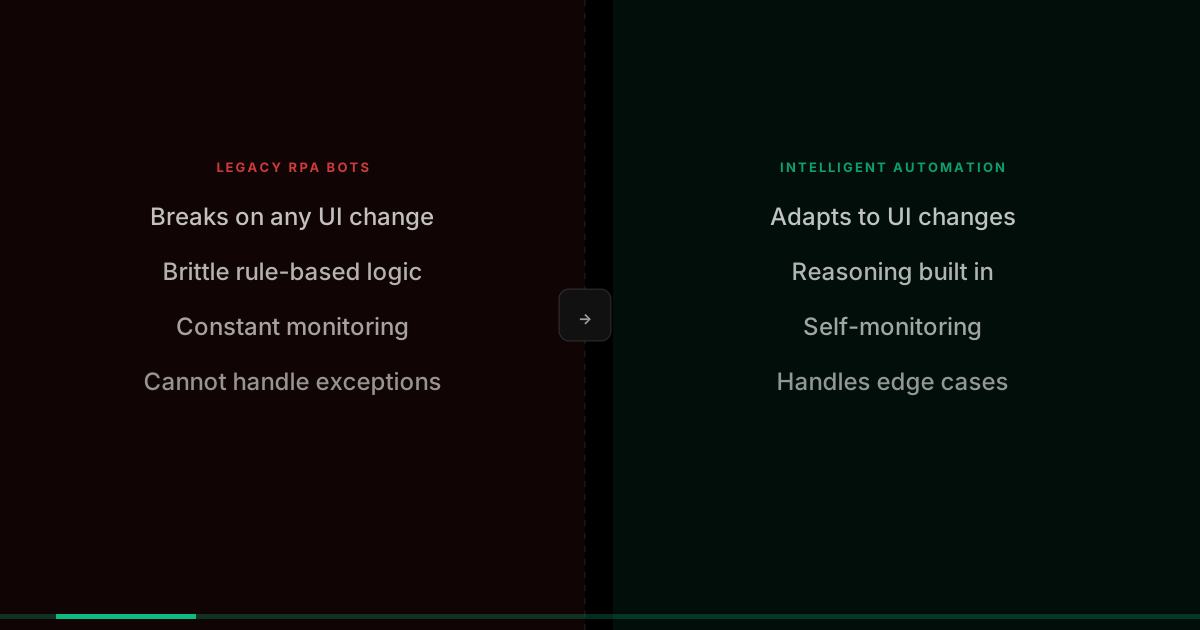
RPA automates by mimicking user interface interactions: clicking, typing, copying. Intelligent process automation replaces UI interaction with API integration and adds AI decision layers for classification and exception handling. AI agents do something qualitatively different: they reason about tasks in natural language, plan multi-step approaches, use tools to take actions, adapt to unexpected states, and recover from failures through reasoning rather than through hardcoded exception paths. These are not points on a spectrum, they are different architectural approaches with different capabilities, failure modes, and governance requirements.
The Three Automation Tiers
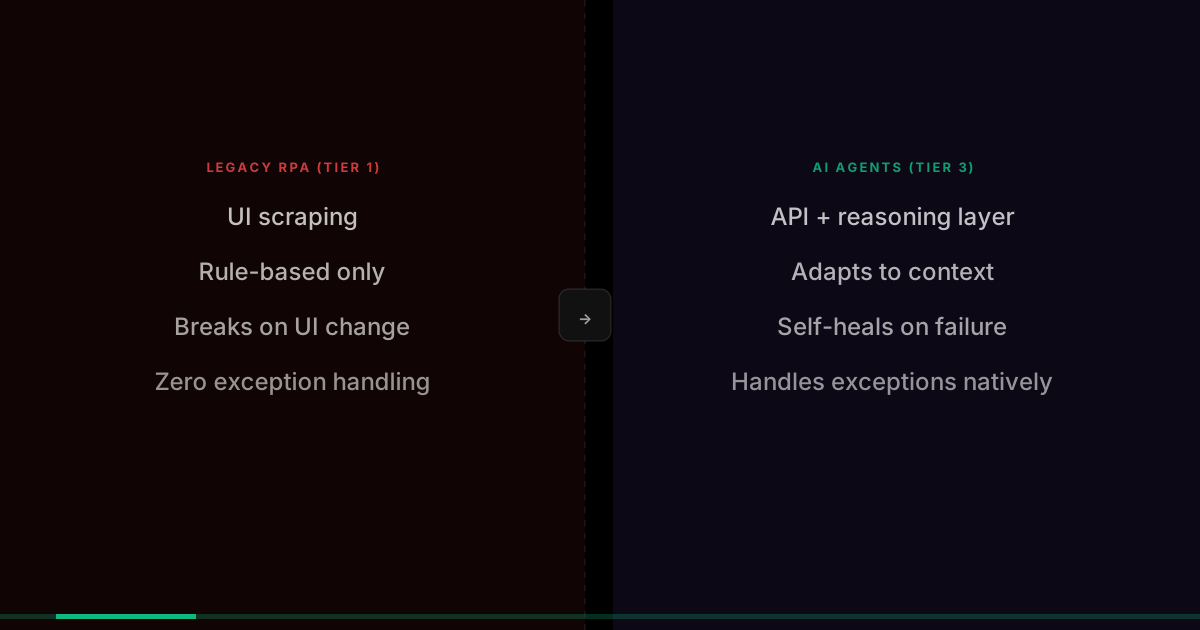
- Tier 1. Rule-based automation (RPA): Scripted interactions against fixed interfaces. Handles high-volume, low-variation, structured-data processes where the happy path is highly reliable. Breaks on interface change. Cannot handle unstructured input. Fastest to deploy for suitable processes.
- Tier 2. AI-enhanced automation (Intelligent Automation): Event-driven, API-first integration with AI decision layers for classification and exception routing. Handles processes with structured inputs but variable decision paths. More resilient than RPA. Still requires explicit coding of decision logic.
- Tier 3. Agentic automation (AI Agents): LLM-based agents with tool access that can reason about task requirements, handle unstructured inputs, plan approaches, adapt to unexpected states, and operate on natural language instructions. Handles high-exception, variable, knowledge-intensive processes that were previously impossible to automate cost-effectively.
What Changes With AI Agents
The capability shift from intelligent automation to AI agents is most significant in three areas. First, agents can handle unstructured input. An intelligent automation workflow for invoice processing requires invoices in a defined format, a deviation requires a human exception handler. An AI agent can read an invoice in any format, reason about which fields map to which business concepts, and extract the required data with explanations. The exception rate on unstructured-input processes drops by 60-80% in validated deployments.
Second, agents can reason through multi-step processes with unclear branching. A compliance check workflow with 47 decision points that required a developer to encode every branch can be replaced by an agent that reasons through the requirements the same way a human analyst would, referencing policy documents, applying context, and making reasoned judgements rather than following an explicit decision tree.
Third, agents can receive instructions in natural language, which means non-technical stakeholders can modify process behaviour through prompt updates rather than requiring a developer to recode decision logic. This significantly reduces the cost of adapting automated processes to business change, one of the largest hidden costs of legacy automation portfolios.
Organisations replacing exception-heavy RPA bots with AI agents on their highest-exception processes report 65-80% reductions in human-handled exceptions within 90 days. The processes with the most exceptions are typically the highest-value targets for agent replacement.
Which Processes Are Ready for AI Agents
Not every automated process benefits from an AI agent, and not every process is ready for one. The highest-value migration targets share several characteristics: high exception rates on the current automated solution, unstructured or semi-structured input formats, frequent process rule changes that require developer involvement, and knowledge-intensive decision paths that are difficult to express as explicit rules.
Processes that should stay as Tier 1 or Tier 2 automation include high-volume, low-variation processes with structured data and predictable decision paths. Replacing a working, stable Tier 1 process with an AI agent adds cost and non-determinism without meaningful benefit. The migration priority should be processes where the current solution is failing, high exception rates, high maintenance cost, frequent breakage, not processes that are already performing reliably.
Bottlenecks erode automation ROI. Find and quantify yours.
The Migration Framework
- 1Audit the existing portfolio: Classify every automated process by tier, exception rate, maintenance cost, and business criticality. Build a heat map of where automation investment is delivering value versus consuming it.
- 2Identify migration candidates: High-exception, high-maintenance processes with unstructured inputs or complex decision logic are the primary targets. Process stability and business criticality determine sequencing, start with high-value, non-critical processes to build confidence before migrating mission-critical workflows.
- 3Design the agent architecture: For each candidate process, define the agent's tool set, decision scope, escalation criteria, and human handoff points. Never design an AI agent to operate without a defined escalation path to human review.
- 4Pilot with shadow mode: Run the AI agent in parallel with the existing automation, comparing decisions and flagging divergences. Build confidence in the agent's behaviour before replacing the production system.
- 5Migrate with monitoring: Deploy the agent to production with comprehensive observability, decision logging, exception tracking, cost attribution, and SLA monitoring. Establish a 30-60 day post-migration review period before reducing human oversight.
- 6Retire the old automation: Once the agent is proven in production, retire the underlying bot or automation workflow, do not run both indefinitely, as this creates two maintenance liabilities.
Validated Outcomes
UiPath's 2024 enterprise automation benchmark report documented customer results from RPA-to-AI-agent migrations across their customer base. The headline finding: processes migrated from rules-based RPA to AI agent handling showed exception rates drop from an average of 18% to under 4%, a 78% reduction, primarily because AI agents could handle the natural language variation and document format inconsistency that RPA bots required explicit rules to manage. Alongside the exception rate improvement, customer satisfaction scores for the same processes increased because exception handling time, which previously required human intervention, was resolved autonomously by the agent in the majority of cases.
GYSP's RPA-to-agent migration engagements apply a shadow mode validation period before production cutover: the AI agent runs in parallel with the existing automation for 2–4 weeks, and every divergence between agent and bot decisions is reviewed and classified. This shadow period builds the confidence baseline for production deployment and typically identifies 5–10 edge cases per process that require agent behaviour adjustment before cutover, edge cases that would have caused production incidents if discovered after live migration.
The Governance Requirements for AI Agents
AI agents in production automation require governance frameworks that legacy RPA and intelligent automation did not need. Agents make decisions and those decisions must be explainable, auditable, and bounded. This means every agent action must be logged with the reasoning that produced it, every tool invocation must be recorded, and escalation criteria must be explicit and enforced at the system level rather than relying on the agent to recognise when to ask for help.
GYSP's Automation & Process Intelligence practice helps enterprises assess their automation portfolio, identify migration candidates, design AI agent architectures for target processes, and implement the observability and governance infrastructure that makes agentic automation auditable in regulated environments.
“The organisations that get the most value from AI agents are not the ones that replace everything at once. They are the ones that identify the two or three processes where the current automation is most painful, highest exception rate, most developer time consumed, and replace exactly those, building the governance muscle before expanding.”
— Aniruddha, Head of Digital Growth & VA — GYSP.tech