What you'll take away
The business case was compelling and the first deployment was a genuine success. Three hundred hours a month of manual data entry eliminated. The project went live in eight weeks. The cost savings were real. The vendor's case study was flattering. The head of IT was promoted.
Four years later, the same organisation employs a team of two full-time 'bot maintainers' who do nothing except fix bots that break every time the upstream application changes its interface. The original cost savings have been largely consumed by maintenance costs. The three hundred hours saved have been replaced by a fragile dependency on a brittle infrastructure layer that the business cannot easily audit, change, or extend.
This is the RPA lifecycle that most large enterprises are currently living through. The early wins were real. The long-term economics are not.
What RPA Actually Automates
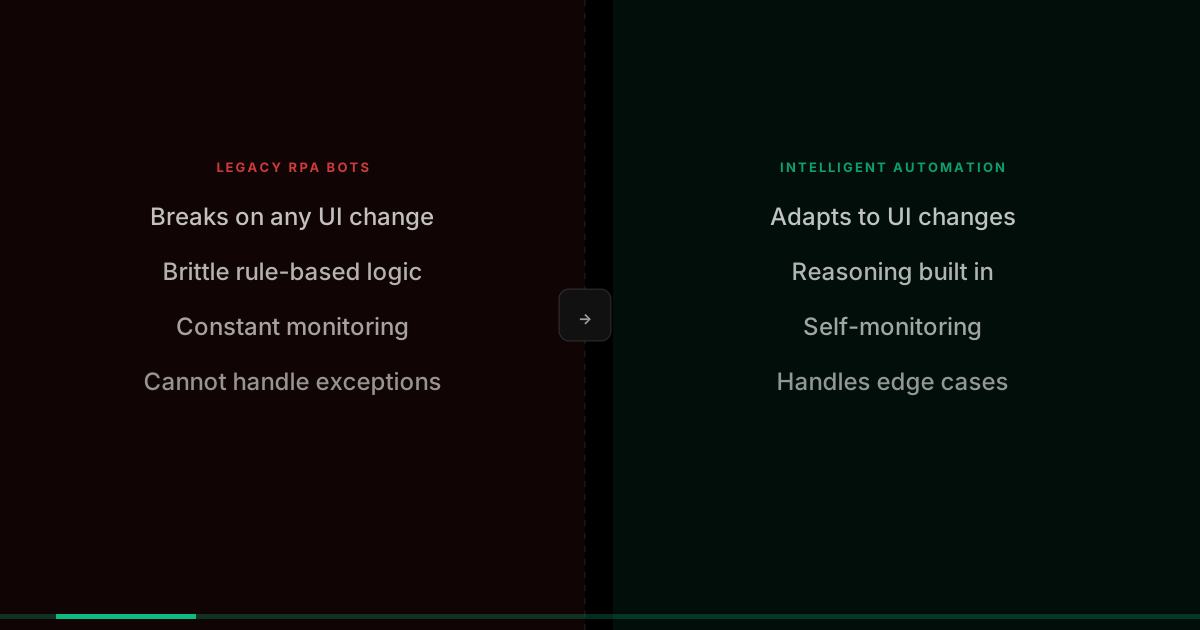
Robotic Process Automation tools work by mimicking human interactions with graphical user interfaces: they click buttons, fill fields, copy data between screens, and follow rule-based decision trees. The technology does not understand the process it is executing, it follows a brittle script against a fixed interface. This is both its strength (any interface can theoretically be automated, no API required) and its fundamental limitation (any interface change breaks the script).
RPA was designed for stable, high-volume, rule-based processes with clearly defined exception handling paths. It delivers value in that narrow context. The problem is that the digital enterprise is not static. Applications change. Vendors release UI updates. Business rules evolve. Regulations require process modifications. And every one of those changes creates a maintenance event for the bots that depend on the changed interfaces.
The Five Failure Modes of Legacy RPA
1. The Maintenance Spiral
Most RPA bots break roughly three to five times per year per process automated, as underlying applications update and change. Each break requires a bot developer to diagnose the failure, understand what changed in the application, and re-map the bot's interaction logic. In a portfolio of fifty bots, which is small by enterprise standards, this generates 150–250 maintenance incidents per year. The original development team is absorbed by maintenance, and new automation projects slow to a crawl because capacity has been consumed by keeping the existing portfolio alive.
2. The Exception Debt Problem
RPA bots handle the 80% case reliably. The 20% of cases that fall outside the happy path, misformatted inputs, unexpected data values, multi-step exception paths, require human intervention. Most RPA deployments accumulate exception debt over time: edge cases that were never automated, exception handling that routes to email inboxes that are poorly managed, and exception volumes that grow as the process scales. The bot is handling volume, but the human exception workload is growing in parallel.
3. The Visibility Gap
RPA bots often run as background processes without meaningful logging, dashboarding, or SLA monitoring. When a bot fails silently, processing nothing because of an upstream error, the business often does not know until a downstream team notices a report is missing or a payment has not been processed. The absence of operational visibility means that RPA portfolios accumulate silent failures alongside the loud ones, creating risks that are difficult to quantify.
4. The Governance Deficit
RPA bots frequently run with broad access credentials, service accounts with administrator privileges, or worse, individual employee credentials, because the process required those permissions. When employees leave, when access policies change, or when an audit requires a review of which systems access what data, the bot portfolio becomes a compliance liability. A bot running with a departed employee's credentials is not a hypothetical risk, it is a common finding in enterprise RPA audits.
5. The Scalability Ceiling
RPA bots scale horizontally by running more bot instances. Each instance consumes a bot licence. In high-volume automation scenarios, the licence cost for scaling RPA to meet peak demand becomes significant and in many cases, the licensing cost at scale exceeds the cost of building a proper integration using APIs or a business process management platform.
Deloitte's 2023 Global RPA Survey found that 63% of RPA initiatives failed to meet their expected cost savings targets within three years. The most common reason cited: higher-than-expected maintenance costs and lower-than-expected bot reliability at scale.
What Intelligent Automation Looks Like
Intelligent process automation (IPA) replaces the UI-scraping, script-following model of RPA with an architecture built around events, APIs, and AI decision layers. The distinction is important: IPA does not automate the manual interaction with a system, it automates the business process by integrating systems at their API layer, not their UI layer.
Event-Driven Triggers
Rather than a bot polling a system on a schedule, intelligent automation is triggered by events: a new record created in a CRM, a document uploaded to a shared folder, an email received with specific attributes, a webhook fired from an external system. Event-driven automation is faster (no polling delay), more reliable (no interface dependency), and more auditable (every trigger is logged at the event source).
API-First Integration
Systems with APIs should be integrated at the API layer, not the UI layer. An API-based integration is faster, more reliable, and vendor-supported in a way that a UI scraper never is. The shift from UI automation to API integration is not a minor technical detail, it is the fundamental architectural change that transforms a brittle bot portfolio into a resilient automation infrastructure.
AI-Powered Exception Handling
Bottlenecks erode automation ROI. Find and quantify yours.
Modern intelligent automation platforms include AI decision layers that can classify exceptions, route edge cases to the appropriate human handler, and learn from historical exception patterns to reduce the exception rate over time. A document processing workflow that previously routed every non-standard invoice format to a human review queue can be augmented with a document AI layer that handles 70–80% of exception cases without human intervention, dramatically reducing the human cost of exception management.
Natural Language Process Modification
AI-native automation platforms are beginning to offer natural language interfaces for process configuration and exception management. Non-technical staff can describe process changes in plain language and have the platform generate updated workflow logic, rather than requiring bot developer involvement for every process modification. This significantly reduces the organisational dependency on specialist RPA developer skills and accelerates the pace at which the business can respond to process change.
The Third Option: AI Agents
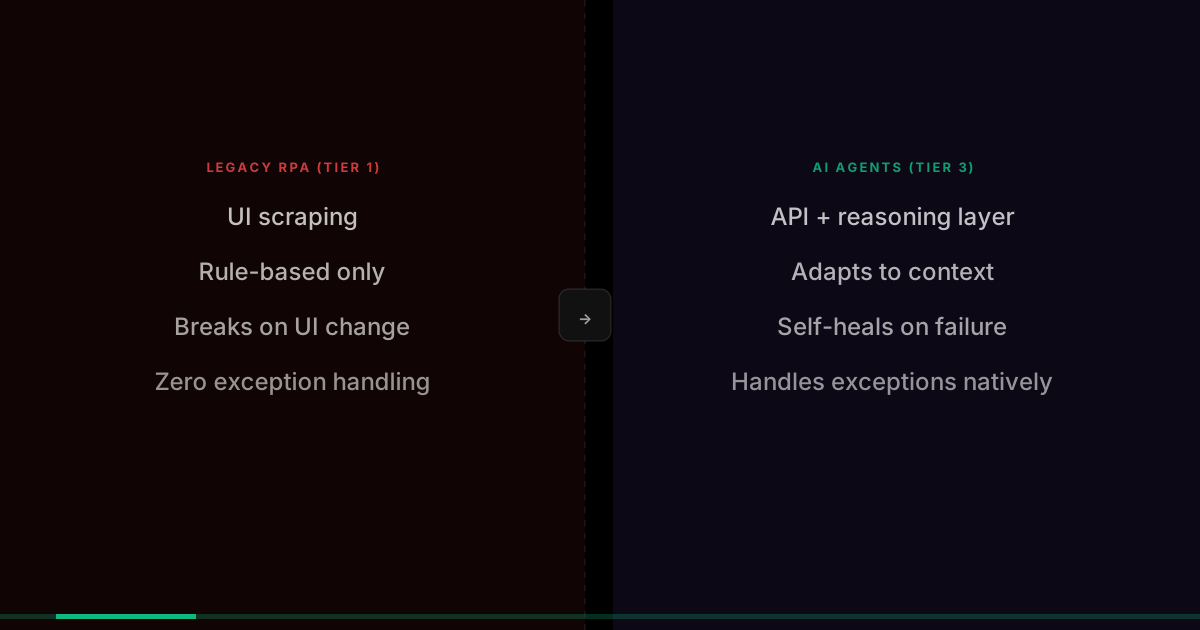
Intelligent process automation addressed the brittleness problem by moving from UI scraping to API integration and adding AI decision layers for exception classification. What it did not address is the exception problem itself, the 20% of cases that require genuine reasoning, context, or access to unstructured information to resolve.
AI agents with tool access address this directly. An AI agent processing invoices does not route exceptions to a human queue, it reasons about why the invoice is non-standard, references the relevant purchasing policy, queries the supplier record for context, and makes a disposition decision with an explanation. The exception handling capability that previously required a human analyst is now automated by a reasoning system.
This is not the same as adding an LLM to an existing RPA workflow as a classification layer. AI agents replace the scripted decision tree with a reasoning model that can handle inputs the script never anticipated, follow policies stated in natural language rather than encoded in conditionals, and explain their decisions in terms that satisfy audit requirements. For processes where the exception rate is the primary cost driver, claims processing, document review, contract analysis, compliance checking, AI agents reduce human intervention rates by 65-80% in validated deployments.
The Bot Audit: Classifying Your Portfolio Across Three Tiers
The path forward is not a wholesale replacement, it is a systematic portfolio classification that identifies which bots belong in which tier of the automation stack:
- 1Retire: Bots built for processes that no longer exist, superseded by newer application features, or handling volumes so low that the maintenance cost exceeds the value they provide. Retire these immediately, they are consuming maintenance capacity that should be directed at higher-value migration.
- 2Stabilise and monitor (Tier 1, keep as RPA): Bots automating stable legacy systems with no API, low change frequency, and low exception rates. These are performing reliably and the cost of migrating them exceeds the value. Improve monitoring, document the process, and revisit when the underlying system changes.
- 3Migrate to API-based integration (Tier 2): Bots automating systems with modern APIs that are consuming significant maintenance capacity because of UI change frequency. These should be rebuilt as API integrations, a one-time migration effort that eliminates the maintenance spiral permanently.
- 4Replace with AI agents (Tier 3): High-exception, knowledge-intensive processes where the current bot is generating significant human-review workload, or where the process requires reasoning about unstructured inputs. These are the highest-value migration targets for AI agent replacement.
Validated Outcomes
Forrester Research published a 2023 Total Economic Impact study on enterprise RPA portfolios, finding that the median enterprise RPA deployment had a maintenance-to-value ratio that deteriorated significantly in years 3–5 as UI dependencies accumulated change debt. The study documented that organisations that had not reassessed their RPA portfolios after year 2 were spending 40–60% of their automation operating budget on maintenance of existing bots rather than building new automation. The organisations that had restructured their portfolios, stabilising low-change bots, migrating high-maintenance bots to API integrations, had reversed this ratio, with over 70% of automation budget directed at new capability rather than maintenance.
GYSP's RPA portfolio audits consistently find the same Pareto pattern: 20% of bots consume 60–70% of total maintenance hours, typically because they automate high-change-frequency UIs or document-heavy processes that generate a high exception rate. Migrating these specific bots, to API integrations for the UI-dependency cases, and to AI agents for the exception-heavy cases, reduces total portfolio maintenance cost by 50–65% while simultaneously improving process reliability for the affected workflows.
The Migration Economics
The business case for portfolio migration becomes compelling when maintenance costs are honestly accounted for. A bot portfolio of fifty processes consuming two full-time maintainers has an annual labour cost of £150–200K, before factoring in licence costs, infrastructure, and the opportunity cost of the automation backlog that maintenance capacity cannot address.
For Tier 2 migrations (RPA to API integration), maintenance overhead reduces by 60-80% once UI dependency is eliminated. For Tier 3 migrations (bot to AI agent), exception handling costs, typically the largest hidden cost in bot portfolios, reduce by 65-80%. The payback period on Tier 3 migration is typically 12-18 months, with ongoing cost advantages accelerating as the agent handles an increasing proportion of what were previously human-escalated cases.
GYSP's Automation & Process Intelligence practice helps enterprises audit their existing RPA portfolio across the three-tier framework, design migration architectures for each tier, and implement AI agent solutions for high-exception processes, managing the migration without disrupting the processes currently running in production. Our AI/ML Development practice provides the agent engineering expertise for Tier 3 migrations.
“The organisations that got the most from RPA built reliable automation for their most stable processes. The organisations that will get the most from AI agents will replace their most unstable automation, the bots that spend more time in the exception queue than in the happy path. That is where the economics are compelling.”
— Aniruddha, Head of Digital Growth & VA — GYSP.tech