What you'll take away
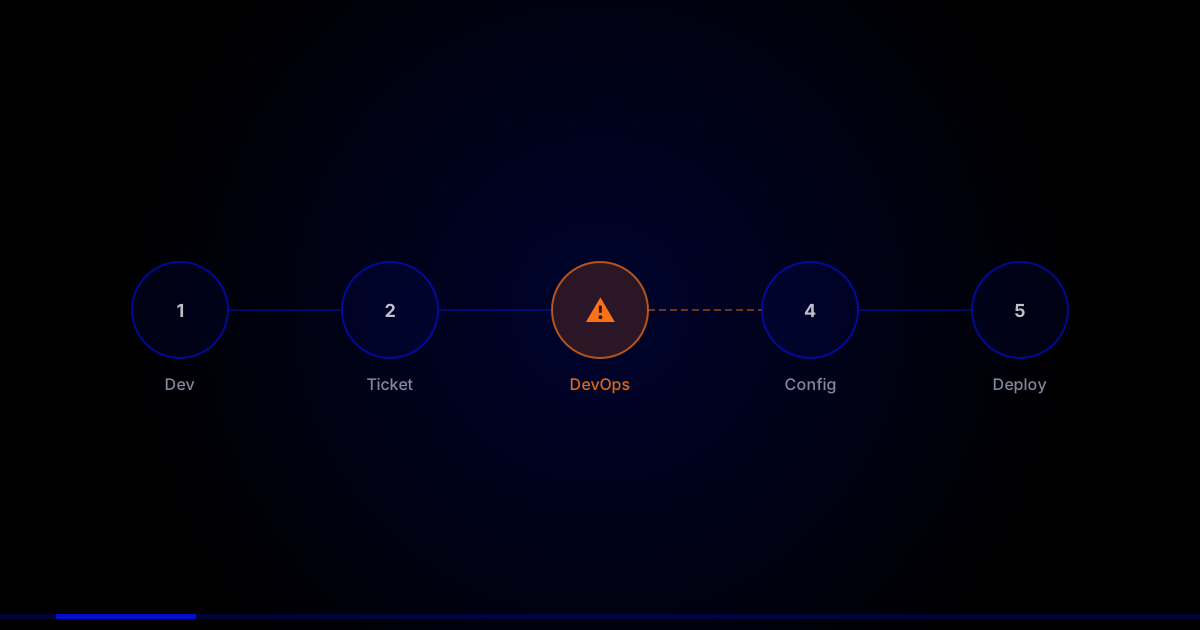
Ask a DevOps engineer at any company above 50 developers what their day looks like and you will hear variations of the same story: a queue of tickets from developers who need a new environment, a Slack backlog of questions about how to configure a pipeline, and a calendar full of access requests, security reviews, and deployment approvals that should not require a specialist.
This is not a DevOps problem. It is a platform problem. When the platform team becomes the only path between a developer and a working production deployment, developer velocity slows, the platform team burns out, and engineering leadership instinctively requests more DevOps headcount, which delays the solution by adding more specialists to a team whose bottleneck is process design, not capacity.
The answer is an Internal Developer Platform (IDP): a curated set of self-service capabilities, environment provisioning, CI/CD templates, deployment pipelines, observability tooling, secrets management, that any developer can use without raising a ticket or asking for help. The platform team builds and maintains the platform. Developers consume it. The bottleneck disappears.
What an Internal Developer Platform Is — And Is Not
An IDP is not a portal. It is not a dashboard. It is not a service catalogue that lists tools you need to request manually. An IDP is a set of self-service primitives that allow developers to go from code to production, or from idea to running environment, without depending on the platform team for each step.
The core primitives most IDPs provide: environment provisioning on demand (developers create dev/staging/preview environments without tickets), application deployment through standardised pipelines (developers deploy without writing pipeline configuration from scratch), secrets and configuration management (developers access secrets through a managed interface without platform team involvement), observability out of the box (every application automatically emits logs, metrics, and traces to a centralised platform), and service discovery and networking (services can find each other through a managed service registry without manual DNS or network configuration).
The Golden Path — Opinionated but Escapable
The most important architectural principle in IDP design is the golden path: the opinionated, recommended way to build, deploy, and operate applications at your organisation. The golden path handles 80-90% of use cases with zero configuration. For the remaining 10-20%, teams can deviate but they must explicitly acknowledge they are leaving the supported path and accept the operational responsibility that comes with it.
Golden path design requires making decisions that some teams will initially resist. Standardising on a deployment tool, a container base image, a log format, a secrets manager. These decisions feel like constraints to experienced developers who have strong preferences. They are actually gifts, because they mean every developer who joins your organisation can be productive from day one without learning your custom deployment setup, and every engineer on-call has a consistent environment to debug at 3am.
A golden path that developers choose because it is genuinely easier than the alternative is an IDP success. A golden path that developers route around because it does not serve their needs is a governance policy that adds friction without delivering value. The difference is in how well the platform team understands developer workflows.
The 4 Metrics That Tell You Your IDP Is Working
DORA metrics (Deployment Frequency, Lead Time for Changes, Change Failure Rate, and Mean Time to Recovery) are the right measurement framework for IDP impact. An effective IDP should improve all four:
- Deployment Frequency. Increases as the friction of each deployment decreases. Teams that deployed weekly should be deploying daily; teams deploying daily should be deploying multiple times per day.
- Lead Time for Changes. Decreases as environment provisioning, pipeline setup, and deployment approval gates are automated. The time from merged PR to production should shrink measurably within 90 days of IDP adoption.
- Change Failure Rate. Should decrease as standardised pipelines include automated testing gates, security scans, and policy checks that catch issues before production.
- Mean Time to Recovery, Should decrease as standardised observability gives every engineer consistent, reliable diagnostics tools, not varying by team based on who built their monitoring stack.
What IDP Implementation Looks Like in Practice
IDP implementation is not a single project. It is an ongoing platform product with a roadmap, a team, and users whose feedback drives iteration. The typical implementation sequence:
29% of cloud spend is wasted on average. Find yours.
- 1Developer journey mapping. Identify the 5-10 most common tasks developers perform that currently require DevOps assistance. These are your first IDP capabilities.
- 2Golden path definition. Make the opinionated technology decisions that the platform will support, with explicit documentation of the rationale and the deviation policy.
- 3Self-service environment provisioning. Implement on-demand environment creation as the first capability. This is usually the highest-pain point and delivers immediate, visible ROI.
- 4CI/CD template library. Create and publish pipeline templates for the most common application types. Developers fork and use; platform team maintains and updates.
- 5Developer portal. Surface IDP capabilities through a portal (Backstage or Port are the dominant tools) that provides a software catalogue, environment management, and documentation in one interface.
Why This Is a Product Problem, Not a Tooling Problem
IDPs fail when they are treated as infrastructure projects. Infrastructure projects have a completion date and a scope. An IDP has neither, it has users, feedback loops, and a product roadmap that evolves as developer needs change. Platform teams that treat IDP as a one-time build without ongoing product management end up with a portal that developers avoid because it does not keep pace with how they actually work.
The most successful IDP programmes treat the platform as an internal product: with a product manager, user research, sprint-based delivery, and developer NPS tracked quarterly. The platform team is a product team whose customer is the engineering organisation.
Validated Outcomes
Spotify's Backstage IDP, now an open-source CNCF project adopted by hundreds of enterprises, was built after Spotify's engineering organisation scaled past 2,000 engineers and deployment bottlenecks began materially slowing feature delivery. The internal metrics Spotify reported after deployment: onboarding time for new engineers dropped by 55%, and the mean time to create a new production-ready service fell from days to under 30 minutes. Backstage demonstrated that developer experience investment has a compounding return, every reduction in friction multiplies across every engineer, every sprint, indefinitely.
In GYSP's IDP engagements, the most consistently measurable early win is deployment frequency. Clients who implement golden path templates and automated environment provisioning see deployment frequency increase by 3–5x within the first 90 days, not because engineers are working harder, but because the platform eliminates the manual coordination overhead that serialises work that should be parallel.
GYSP's Platform Engineering Practice
GYSP's Cloud & DevOps Engineering practice designs and implements Internal Developer Platforms from golden path definition through to developer portal deployment. We start with a developer experience audit, mapping your current deployment workflow, identifying the bottlenecks, and designing the IDP capability roadmap that addresses them in order of developer impact.
“Platform engineering is not about giving developers fewer tools, it is about giving them better defaults. When the right way is also the easy way, compliance becomes a byproduct of convenience.”
— Akshay, Head of Delivery — GYSP.tech