What you'll take away
Your cloud migration went live. Your cloud bill went up. If that sentence describes your last 12 months, lift-and-shift architecture is almost certainly why and the waste is compounding every month you don't address it.
Lift-and-shift migrations move existing applications to AWS, Azure, or GCP without redesigning them for cloud-native architecture. It's the fastest route off on-premise infrastructure. It's also a financial trap: you carry your legacy inefficiencies into a pay-per-use environment where idle capacity isn't a sunk cost, it's a monthly recurring charge.
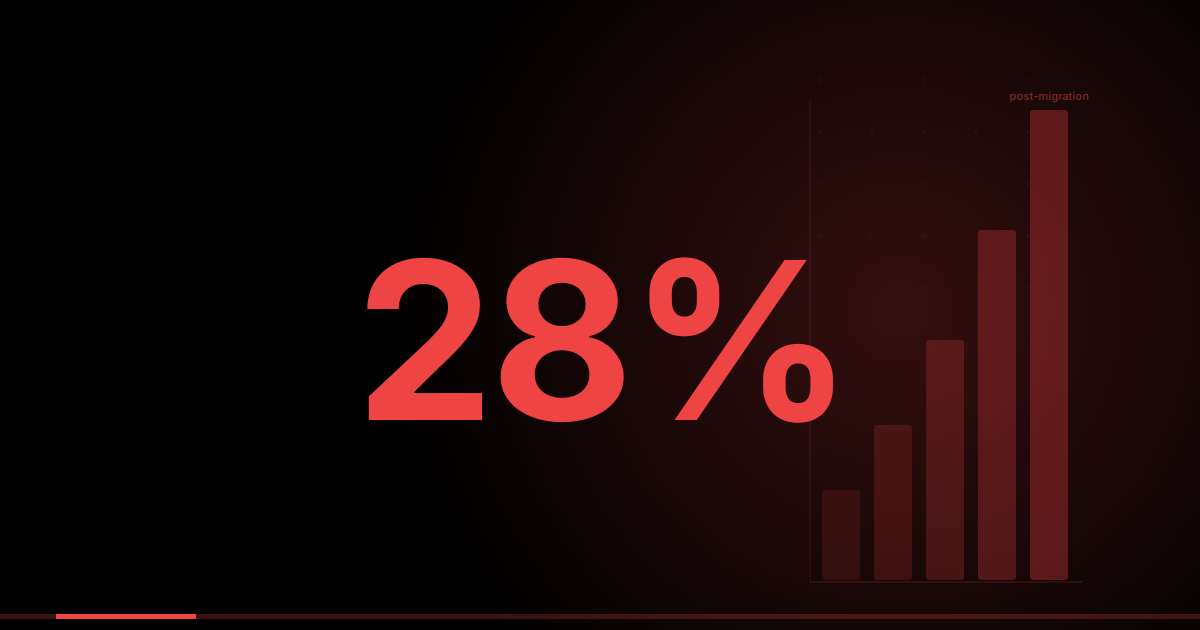
The numbers are consistent across the industry. Flexera's 2024 State of the Cloud Report puts average cloud waste at 28% of total spend. In complex enterprise environments where legacy architecture was migrated without refactoring, that figure climbs above 40%. The waste doesn't show up as a line item labelled 'waste', it hides in over-provisioned compute, idle environments, and storage that nobody remembers provisioning.
Most organisations treat this as the cost of doing business. It isn't. It's a solvable architectural problem, one that a structured FinOps approach consistently resolves to the tune of 20–40% cost recovery within 90 days.
The Anatomy of a Financial Leak
In the rush to execute a migration, most organisations take the path of least resistance: lift and shift. They move existing applications and infrastructure directly into AWS, Azure, or Google Cloud without redesigning for the cloud-native environment.
It's fast. It minimises disruption. And it is a financial trap that compounds every month.
When you lift a legacy architecture and shift it to the cloud, you also lift your legacy inefficiencies. Applications designed for static, always-on data centres don't behave cost-efficiently in a dynamic, pay-per-use environment. The result: you aren't paying for what you *use*, you're paying for what you *provisioned*.
Lift-and-shift migrations typically carry these hidden costs:
- Over-provisioned virtual machines, instances sized for peak load running at 10–20% utilisation for 22 hours of every day
- Idle development and staging environments running around the clock at full production cost
- Data transfer fees between regions and availability zones that were never priced into the original business case
- Storage sprawl, unattached volumes, outdated snapshots, and forgotten backups accumulating charges silently month after month
- No auto-scaling, manual scaling policies copied from on-premise operational playbooks that no longer apply in a pay-per-use environment
Why Most Architectures Stay Broken
The uncomfortable truth is that most organisations don't fix lift-and-shift waste because the problem is invisible until it's expensive. Cloud billing dashboards show total spend, they don't surface *wasteful* spend without deliberate effort to tag, categorise, and attribute costs to business units and product features.
Without that granularity, engineering teams can't connect infrastructure decisions to business outcomes. Finance can't push back because they can't see where the waste lives. And so the bill grows, quarter after quarter, treated as the cost of doing business rather than a solvable architectural problem.
This is where cloud architecture becomes a P&L issue, not just a technical one. In a traditional data centre, idle capacity is a sunk cost. In the cloud, idle capacity is an active, recurring drain. The difference between a 5% infrastructure margin and a 15% one often hides entirely in architectural decisions that were never revisited after the initial migration.
The FinOps Correction: 3 Pillars to Recover 20%+
Addressing the financial drain doesn't require abandoning the cloud. It requires moving from reactive cloud consumption to disciplined Cloud Cost Optimisation, what the industry has formalised as FinOps (Financial Operations). Organisations that apply a structured FinOps maturity framework consistently recover 20% or more from previously wasted cloud budgets. The three pillars that deliver that recovery are:
1. Spend Intelligence — Moving Beyond Monitoring
Most organisations have cloud monitoring tools. Few have *spend intelligence*. The difference: monitoring tells you costs are high. Intelligence tells you *why*, *where*, and *whose decision* caused them.
The mechanism is a granular tagging strategy that attributes every dollar of cloud spend to a specific team, product feature, or environment. Opaque invoices become forensic data. Instead of a monthly bill with no breakdown, you have visibility into which microservice, which team, and which feature is driving cost and whether that cost is generating proportional business value.
Without tagging, you're optimising blindly. With it, you're making surgical decisions. The two-week investment in a comprehensive tagging taxonomy consistently pays back in months.
2. Unit Economics Alignment — The Metric That Changes Behaviour
Stop measuring the *total cost of cloud*. Start measuring *cost per transaction*, *cost per active user*, or *cost per API call*. This shift changes engineering behaviour at scale.
If your user base grows 10%, your cloud costs should grow by *less* than 10%, that's the compound efficiency benefit cloud architecture is supposed to deliver. If costs grow faster than revenue, your architecture is fundamentally broken regardless of what the uptime dashboard says.
The goal is to define a single "North Star" unit metric that connects infrastructure spend directly to business output and make it visible to every engineer who writes code that runs on cloud compute. When engineers see that their service costs £0.003 per request against a target of £0.001, efficiency becomes a first-class engineering constraint, not an afterthought left to Finance.
29% of cloud spend is wasted on average. Find yours.
3. Cloud Cost Culture — Decentralised Ownership
You cannot optimise what only one team watches. If Finance holds the cloud bill and Engineering ignores it, waste accumulates at the pace of every deployment.
The structural fix is integrating cost metrics directly into the deployment pipeline giving engineers real-time visibility into the cost implications of infrastructure decisions before they hit production. This is the shift from centralised cost control (slow, reactive, adversarial) to decentralised cost ownership (fast, proactive, aligned). Efficiency becomes a KPI alongside uptime and delivery velocity, measured through DORA metrics that track speed and quality without trading one off against the other.
Validated Outcomes
This isn't theoretical. GYSP has executed this FinOps correction across enterprise engagements where lift-and-shift waste had been compounding for years.
For OYO, we delivered a 30% cost reduction alongside a 99.98% uptime improvement, achieved by containerising legacy workloads into microservices and tuning Kubernetes auto-scaling to eliminate idle compute spend without sacrificing capacity for demand spikes.
For Cars24, a full AWS-to-GCP migration combined with automated data pipelines resulted in a 40% cost reduction, primarily by eliminating the manual ETL processes and over-provisioned environments that had been inherited from the original migration and left untouched.
In both cases, the waste wasn't obvious from the surface. It was structural, baked into architectures that were never designed for the economics of cloud-native operations.
Your FinOps Readiness Checklist
Before your next infrastructure review, run through these questions honestly:
- Are all cloud resources tagged by team, product, and environment?
- Do you have a defined unit metric that ties infrastructure cost to a specific business output?
- Are development and staging environments automatically shut down outside business hours?
- Is auto-scaling configured for every workload, or are VMs still sized for peak load?
- Do engineers see cost data during development, or only when Finance raises the alarm?
- Has your cloud architecture been reviewed since the initial migration?
If more than two of these are 'no', your architecture is almost certainly leaving 20–30% of your cloud budget on the table every month.
Stop the Haemorrhage
A "successful" cloud migration that drains your budget is a failure in disguise. Moving past the lift-and-shift mentality requires auditing your cloud architecture with cost efficiency as a design constraint, not a post-launch consideration.
GYSP's Cloud & DevOps Engineering practice takes companies from cloud-active to cloud-profitable. Our Cloud Efficiency Assessment identifies exactly where your infrastructure is leaking cash and maps a concrete remediation path, typically recovering 20%+ of wasted spend within the first 90 days.
“Don't guess at your cloud costs. Know exactly where every dollar goes and what it's returning.”
— Ankush, CTO — GYSP.tech
Frequently Asked Questions
What is lift-and-shift cloud migration?+
Lift-and-shift (rehost) migration moves existing applications and infrastructure directly to the cloud without redesigning them for cloud-native architecture. It is the fastest migration approach but carries on-premise inefficiencies into a pay-per-use environment, creating hidden cost overruns that compound month over month.
How much cloud spend is typically wasted after a lift-and-shift migration?+
Industry data shows organisations waste an average of 28% of cloud spend, with complex enterprise environments wasting over 40%. Waste stems from over-provisioned VMs running at 10–20% utilisation, idle staging environments, storage sprawl, and manual scaling policies copied from on-premise operations.
What is FinOps and how does it recover wasted cloud spend?+
FinOps (Financial Operations) is a cloud financial management framework that aligns engineering, finance, and business teams around cost visibility and ownership. It recovers wasted spend through granular tagging, unit economics alignment (cost per transaction), and decentralised cost ownership embedded into the development workflow, typically recovering 20%+ of wasted budget.
How long does a FinOps cloud optimisation engagement take?+
A typical FinOps engagement delivers initial wins within 30–60 days: tagging strategy implementation, identification of idle resources, and reserved instance optimisation. Full optimisation, including architectural changes to eliminate over-provisioning and implement auto-scaling, typically completes within 90 days and delivers 20–40% cost reduction.