AI Agents & Agentic Workflows
Autonomous AI that acts, not just answers.
AI agent development services that build autonomous, multi-agent systems capable of reasoning, tool use, and coordinated task execution. We design agentic workflows with LangGraph, CrewAI, and the OpenAI Agents SDK, built for production reliability and enterprise scale.
What We Deliver
Core Capabilities
- Multi-Agent System Design & Orchestration
- Agentic Workflow Development (LangGraph, CrewAI, AutoGen)
- Tool Integration & API Connectivity
- Human-in-the-Loop Escalation Design
- Agent Memory, State & Context Management
- Production Guardrails & Observability
Ready to get started?
Get a free technical brief — architecture options, timelines, and cost estimates delivered within 48 hours. No commitment required.
- 01Submit your challenge≈ 1 min
- 02Receive your Technical BriefWithin 48h
- 03Discovery call — no obligationOptional
Or call us: +1 (929) 588-8364
By the Numbers
What clients achieve with GYSP
on target processes after agentic workflow deployment, measured across production deployments
scoped to a defined use case with tool integrations, tested against real data before full build begins
every agentic workflow we build has defined escalation paths, audit logging, and override controls before go-live
Proven Results
AI Agents Case Studies
 HealthTech
Global Life Sciences & Healthcare Platform
A life sciences platform needed to automate regulatory document auditing, process multi-terabyte genomic datasets, and ingest live medical device streams, all in production, all at the same time. GYSP built the full stack: LLMOps multi-agent pipelines, distributed Spark genomics, and real-time Flink sensor ingestion.
 Energy
Global Energy Trading Group
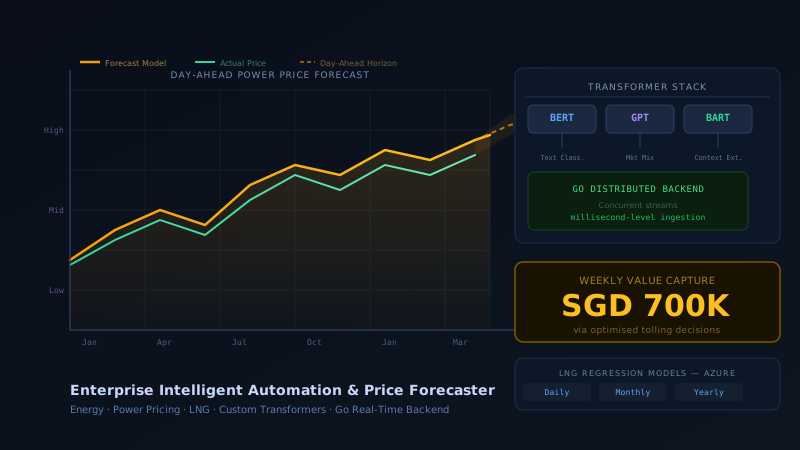
An energy trading group needed to turn power and LNG price signals into optimised decisions: fast enough to matter, accurate enough to trust. GYSP built the forecasting engine and real-time infrastructure behind SGD 700K in weekly value capture.
 Enterprise Technology
Global Consumer Platform
A large consumer platform had no way to predict who would leave, why they were dissatisfied, or where marketing spend was being wasted. GYSP built the analytics engine that answered all three.
Industry Expertise
Industries We Serve with AI Agents
FAQs
Common questions
Everything buyers typically ask before starting a ai agents engagement.
Ask us anythingWhat does an AI agent development services engagement deliver?
We build task-specific single agents, multi-agent systems where specialised agents coordinate on complex workflows, and long-running autonomous agents with persistent memory and state. Common use cases include customer query handling, document processing, research and synthesis, operational monitoring, and multi-step decision workflows across connected systems.
How do you ensure agents are reliable in production?
Every agent we build includes defined tool boundaries, guardrails against hallucination and off-scope actions, human-in-the-loop escalation paths for edge cases, structured audit logging, and a monitoring layer that surfaces failure modes before users encounter them. We do not deploy agentic systems without a tested fallback path.
What frameworks do you use for multi-agent development?
We work with LangGraph, CrewAI, AutoGen, and the OpenAI Agents SDK, selected based on the orchestration complexity and production requirements of each use case. For most enterprise workflows requiring deterministic control flow and audit trails, LangGraph is our default. For collaborative multi-agent patterns, CrewAI and AutoGen are preferred depending on team structure needs.
How is an AI agent different from an RPA or standard automation workflow?
RPA and standard automation follow fixed rules on structured inputs. An AI agent reasons over unstructured inputs, selects from a set of tools, handles ambiguity, and adapts its approach based on intermediate results. Agents are suited for tasks where the input varies, the path is not always predictable, or judgment is required before taking the next step.
What does an AI agent development engagement look like end to end?
Our AI agent development services follow a fixed delivery structure: a use case scoping session to define the agent's goal, tool set, and escalation criteria, then a prototype delivered within 48 hours for validation on real data. After prototype sign-off, we build the full orchestration layer, connect production integrations, implement guardrails and logging, and run load and edge-case testing before deployment. Most engagements from scoping to production take 6–10 weeks.
Let's build something together
Get a free technical brief on your ai agents challenge — architecture, timeline, and cost estimate in 48 hours.
Get Free Technical Brief