What you'll take away
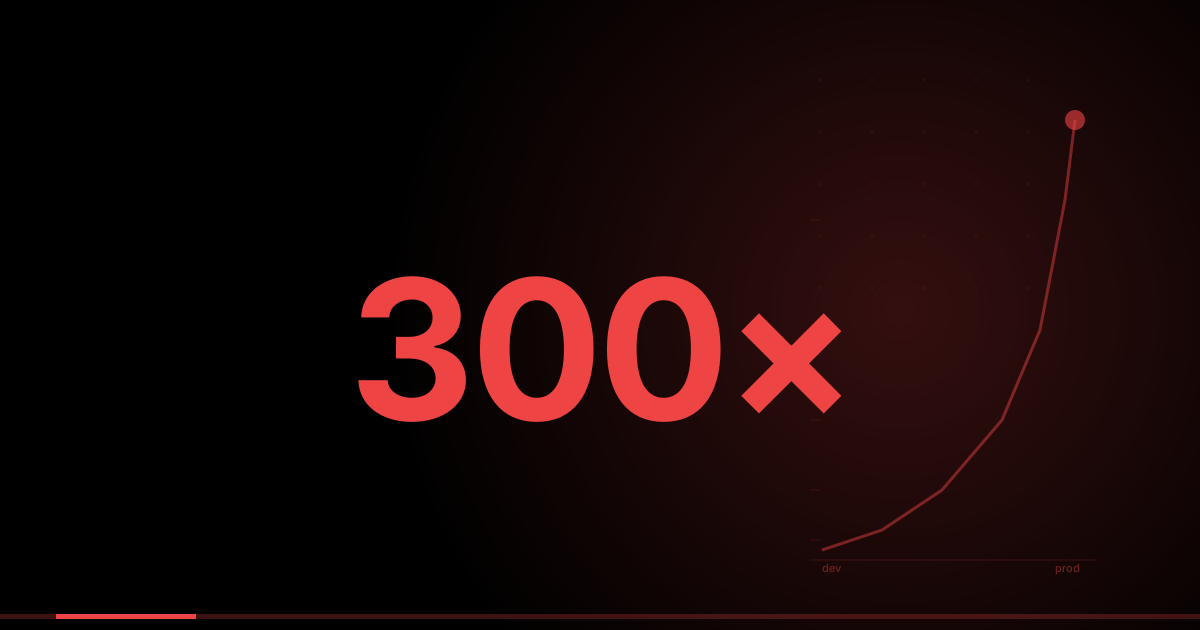
In 2012, organisations started receiving AWS invoices that bore no relationship to what they had budgeted. The pattern was consistent: a workload that cost $200/month in development cost $18,000/month in production. The reasons were also consistent, nobody had designed for scale, nobody had implemented auto-scaling, and nobody had a governance process for catching runaway spend before it became a line item on the CFO's desk.
It took a decade for the FinOps discipline, cloud financial management, reserved instances, rightsizing, unit economics, to become standard practice. AI inference costs are following the same trajectory, compressed into a fraction of the time. The organisations deploying LLM-powered applications in 2025 and 2026 are making the same structural mistakes that cloud teams made in 2012 and the ones who build governance infrastructure now will not repeat a decade of expensive lessons.
The Anatomy of an AI Inference Bill
LLM API pricing is primarily token-based: a charge per thousand input tokens (the prompt, context, and retrieved documents) and a separate, usually higher charge per thousand output tokens (the model's response). The cost of a single query depends on four variables: the model selected, the number of input tokens, the number of output tokens, and whether the input hits a cached prefix.
At development scale, these costs are invisible. A developer running 500 test queries per day against GPT-4o at $5/million input tokens and $15/million output tokens spends roughly $2-3 per day. The cost is irrelevant.
At production scale with 10,000 daily active users, each generating 3 queries per day, with 2,000 input tokens and 500 output tokens per query, the same system costs $165,000 per month. The cost is now a material line item. And most production systems have much higher context windows than that estimate assumes, because production prompts include system instructions, retrieved documents, conversation history, and function schemas that developers never loaded in testing.
A RAG application with a 4,000-token system prompt, 8,000 tokens of retrieved context, and 1,000 tokens of conversation history burns 13,000 input tokens before the user's question is appended. At GPT-4o pricing, that context alone costs $0.065 per query. At 100,000 queries per day, context cost alone is $6,500/day, before any output tokens are counted.
The Five Cost Levers
1. Model Selection and Routing
Not every query requires the most capable model. A customer service bot answering FAQ questions does not need GPT-4o, it needs a model capable of retrieving and reformatting known information, which a smaller, cheaper model handles adequately. Intelligent model routing, classifying queries by complexity and routing simple queries to cheaper models, typically reduces inference costs by 40-60% with negligible impact on answer quality for the routed query classes.
2. Context Window Management
Every token in the context window costs money. System prompts should be audited for token efficiency. Retrieved documents should be chunked and ranked to exclude irrelevant passages before inclusion. Conversation history should be summarised or truncated beyond a configurable depth rather than appended indefinitely. Context window management is typically the highest-value intervention for RAG-based applications, where retrieved context often dominates the input token count.
3. Caching and Request Deduplication
Many LLM applications serve identical or near-identical queries repeatedly. A knowledge base chatbot that receives 'what is your refund policy?' thousands of times per day can serve the vast majority of those requests from a semantic cache rather than making live API calls. Prompt caching, available from Anthropic, OpenAI, and Google for matching prefixes, can reduce input token costs by 80-90% for applications with stable system prompts and high query volume.
4. Prompt Compression
Prompts written for human readability are often much longer than they need to be for model comprehension. Prompt compression techniques, either automated compression models like LLMLingua, or systematic review of verbose prompt sections, typically reduce prompt token counts by 20-40% without degrading output quality for most task types. For long-context applications processing large documents, compression of the document before inclusion can yield even larger savings.
Most enterprise AI spend underperforms. Benchmark yours.
5. Output Control
LLMs tend to generate verbose responses unless constrained. For applications where response length is not a primary quality signal, classification, extraction, structured data generation, explicit output length constraints and structured output formats (JSON schemas) reduce output token counts significantly. Output token costs are typically 3-5× higher than input token costs per token at major providers, making output compression a high-leverage intervention.
Five-lever savings at a glance: (1) Model routing: 40-60% cost reduction by routing simple queries to smaller, cheaper models; (2) Context window management: 20-50% for RAG applications by ranking and trimming retrieved context before inclusion; (3) Caching and deduplication: up to 80-90% on repeated system-prompt prefixes via Anthropic, OpenAI, or Google prompt caching; (4) Prompt compression: 20-40% reduction via LLMLingua or systematic prompt review; (5) Output length control: 15-35% on output token costs, which run 3-5x more expensive per token than input. Implemented together, compounded savings typically reach 40-65% of pre-optimisation inference spend.
Validated Outcomes
Scale AI, which provides data labelling and AI evaluation infrastructure to many of the largest AI-deploying enterprises, published a case study on enterprise AI inference cost trajectories in 2024. The consistent pattern across their customer base: enterprises that deployed AI pilots without inference cost governance saw costs scale non-linearly as usage grew, the same prompt design that cost $200/month in pilot became $8,000/month at a 40x usage multiple because context window growth, conversation history accumulation, and unoptimised model routing multiplied the cost faster than usage. Enterprises that implemented model routing and prompt cost controls before scaling saw costs grow linearly with usage, as intended.
GYSP's inference cost governance implementations typically identify 3–5 optimisation opportunities that collectively reduce production inference costs by 40–65% without user-visible quality reduction: model routing (routing simple queries to smaller models), prompt caching for repeated system prompt prefixes, response length controls, caching for high-frequency repeated queries, and context window management for conversational interfaces. These optimisations require 1–2 engineering sprints to implement and compound in value as usage scales.
Building a Cost Governance Framework
Cost governance for AI inference requires four components that most teams currently lack:
- Cost attribution: Every API call tagged with the product feature, user segment, and business process it serves. Without attribution, you cannot identify which features are generating disproportionate cost.
- Business outcome unit economics: Cost per completed task, not cost per API call. A customer service interaction that costs $0.12 in inference but reduces a human support ticket (worth $8 in support cost) has a fundamentally different business case than one that costs $0.08 and has no measurable outcome.
- Budget alerting and kill switches: Per-feature and per-user rate limits with alerting at defined spend thresholds. Automated circuit breakers that gracefully degrade service rather than allowing unconstrained spend.
- Regular inference cost review: Monthly review of cost per business outcome by feature, trend analysis, and systematic evaluation of model routing optimisations. This is the AI equivalent of the FinOps monthly cloud review.
GYSP's AI/ML Development practice implements inference cost governance frameworks for production AI applications, covering model routing, prompt optimisation, caching architecture, cost attribution instrumentation, and budget governance processes. For organisations earlier in their AI journey, our IT Consulting & Advisory practice offers AI cost readiness assessments that identify governance gaps before production scale exposes them.
“The cloud bill surprised everyone the first time. Then FinOps was invented and the industry learned to govern it. AI inference costs are going to surprise everyone who doesn't build governance infrastructure before they scale. The difference is that AI inference costs can compound faster than cloud did.”
— Ankush, Chief Technology Officer — GYSP.tech