What you'll take away
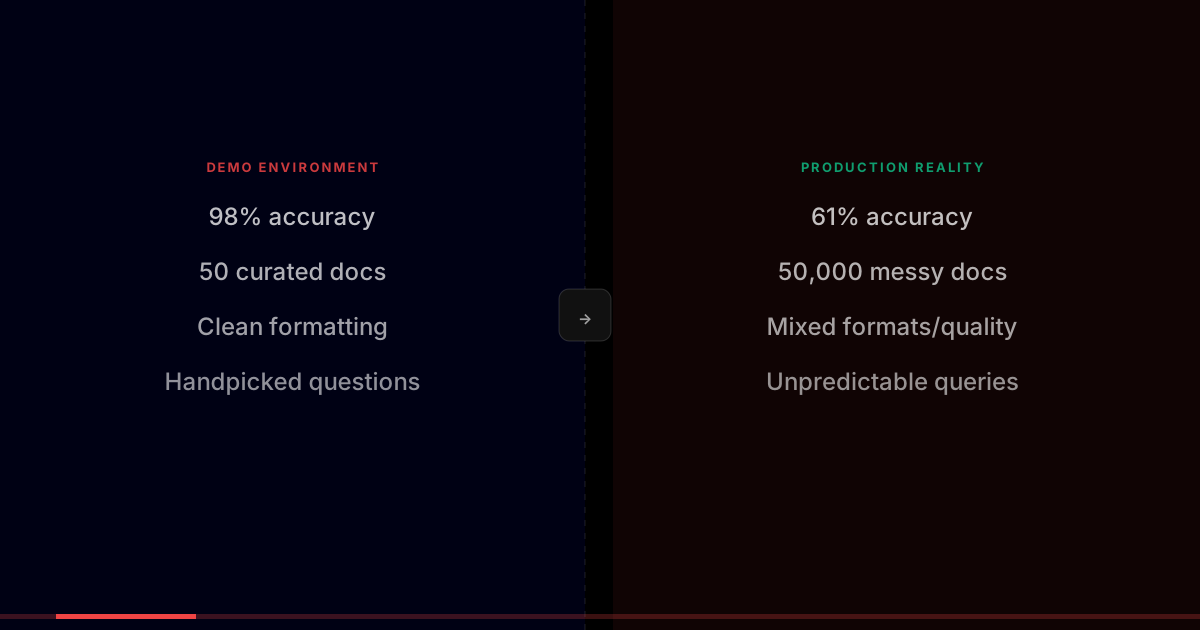
The RAG prototype was genuinely impressive. You fed it your company's documentation, asked ten carefully selected test questions, and got accurate, well-cited answers every time. The demo to the board was a success. Development started in earnest. Three months later, the system is live, and users are reporting that it confidently cites documents it doesn't appear to have retrieved, fails to answer questions about content you know is in the knowledge base, and occasionally contradicts itself within a single response.
This is the production RAG gap: the distance between a system that works on your handpicked test cases and a system that works reliably on the full distribution of real user queries. The gap is not primarily a model quality issue, it's an architecture issue. The components that determine RAG quality in production are the chunking strategy, the retrieval mechanism, the evaluation pipeline, and the feedback loop, and most teams that build RAG prototypes haven't thought carefully about any of them.
Failure Mode 1: Chunking That Destroys Context
The simplest chunking strategy, split documents every N tokens, overlap by M tokens, is also the most common source of retrieval failures in production. When a document is split mid-sentence, mid-table, or mid-code-block to meet a token boundary, the resulting chunks lose the context that makes them interpretable. A chunk that says 'This approach is not recommended for high-traffic scenarios' is unintelligible without knowing what 'this approach' refers to, which was in the previous chunk.
Production RAG systems need document-structure-aware chunking: breaking at natural document boundaries (headings, paragraph breaks, section breaks), preserving entity context across chunk boundaries, and handling structured content types (tables, lists, code blocks) with strategies appropriate to their format. This is more engineering work than fixed-size chunking, but the retrieval quality improvement is substantial.
Failure Mode 2: Retrieval That Finds the Wrong Things
Cosine similarity between query embedding and chunk embedding is the retrieval mechanism in most RAG prototypes. It works reasonably well for queries that use similar vocabulary to the source documents. It fails for queries that ask about concepts using different terminology than the documents use (vocabulary mismatch), queries that require finding documents that are intentionally dissimilar to the query (finding counterexamples or exceptions), and queries where the most semantically similar chunks are not the most relevant ones for the actual question.
- Hybrid retrieval: Combine vector similarity search with keyword (BM25) retrieval, then re-rank the merged results. Keyword search handles vocabulary mismatch; vector search handles semantic similarity. Combined, they cover more failure modes than either alone
- Query rewriting: Use an LLM to rewrite or expand the user's query before retrieval, generating multiple variations that cover different ways the answer might be expressed in the source documents
- Re-ranking: Use a cross-encoder re-ranker (a model that jointly encodes the query and each candidate chunk) to score retrieved chunks for relevance more accurately than the bi-encoder used for retrieval
- Metadata filtering: Allow queries to filter by document type, date, author, or category before performing semantic search, reducing the search space and improving precision
Failure Mode 3: No Evaluation Pipeline
A RAG system without an evaluation pipeline degrades silently. As the knowledge base grows, as documents are updated, as user query patterns evolve, retrieval quality changes in ways that are invisible without systematic measurement. Teams discover quality degradation when users complain, which means they've been serving degraded results for an unknown period before the problem surfaces.
Production RAG requires an evaluation pipeline: a set of representative query-answer pairs (golden dataset) against which retrieval quality is measured regularly. Metrics like Context Precision (are retrieved chunks relevant?), Context Recall (are relevant chunks being retrieved?), Answer Faithfulness (does the answer follow from the retrieved context?), and Answer Relevance (does the answer address the query?) provide a multi-dimensional picture of system quality over time.
The minimum viable RAG evaluation: a golden dataset of 100–200 queries with known correct answers, run against the live system weekly, with alerts when any metric drops more than 5% week-over-week. This doesn't require a sophisticated MLOps platform, it can be implemented in a scheduled script that emails the results.
Most enterprise AI spend underperforms. Benchmark yours.
Failure Mode 4: No Feedback Loop
User feedback on RAG responses, explicit thumbs up/down ratings or implicit signals like whether the user asked a follow-up clarification question, is the highest-signal source of information about where the system is failing. Teams that don't capture and analyse this feedback are flying blind: they know the system is used, but they don't know which queries it handles well and which it handles poorly.
A lightweight feedback mechanism, a binary rating per response, with optional free-text comment, captures enough signal to identify systematic failure patterns. Queries with consistently negative feedback cluster around specific topics or query types that reveal chunking gaps, vocabulary mismatches, or content that isn't adequately represented in the knowledge base.
Validated Outcomes
Cohere, one of the leading enterprise LLM providers, published benchmark research in 2024 comparing naive RAG versus production-grade RAG architectures across a set of enterprise knowledge base use cases. The result: naive RAG (basic chunking, single-stage retrieval, no reranking) achieved 55–65% answer accuracy on complex multi-sentence queries. Adding a reranker and query decomposition improved accuracy to 78–85%. Adding hybrid retrieval (dense + sparse) and context window optimisation pushed accuracy to 88–92%. Each architectural improvement added marginal engineering complexity but compounded quality improvement. The demo-to-production gap is primarily an architecture gap.
GYSP's RAG architecture reviews of existing production deployments consistently find the same improvement opportunities: chunking strategy that ignores document structure, no reranking stage, and no evaluation dataset to detect quality regression. Implementing all three improvements in a structured optimisation sprint typically improves retrieval accuracy by 20–35 percentage points from the naive baseline, a gain that frequently converts a RAG system that was not trusted by users into one that becomes a core operational tool.
The Production RAG Engineering Discipline
GYSP's AI & ML Development practice has deployed production RAG systems across enterprise use cases in financial services, legal, and knowledge management. The pattern we've learned: the teams that build maintainable, high-quality production RAG are the ones that invest in evaluation pipelines and feedback loops from the beginning, not as an afterthought after users start complaining. The demo is easy. Production is an engineering discipline.
“Most RAG systems in production are operating at 60–70% of the quality they could achieve with architectural improvements that cost a fraction of the original build. The gap is almost never the LLM, it's the retrieval architecture and the absence of systematic evaluation.”
— Rahul, AI/ML Delivery Head — GYSP.tech