What you'll take away
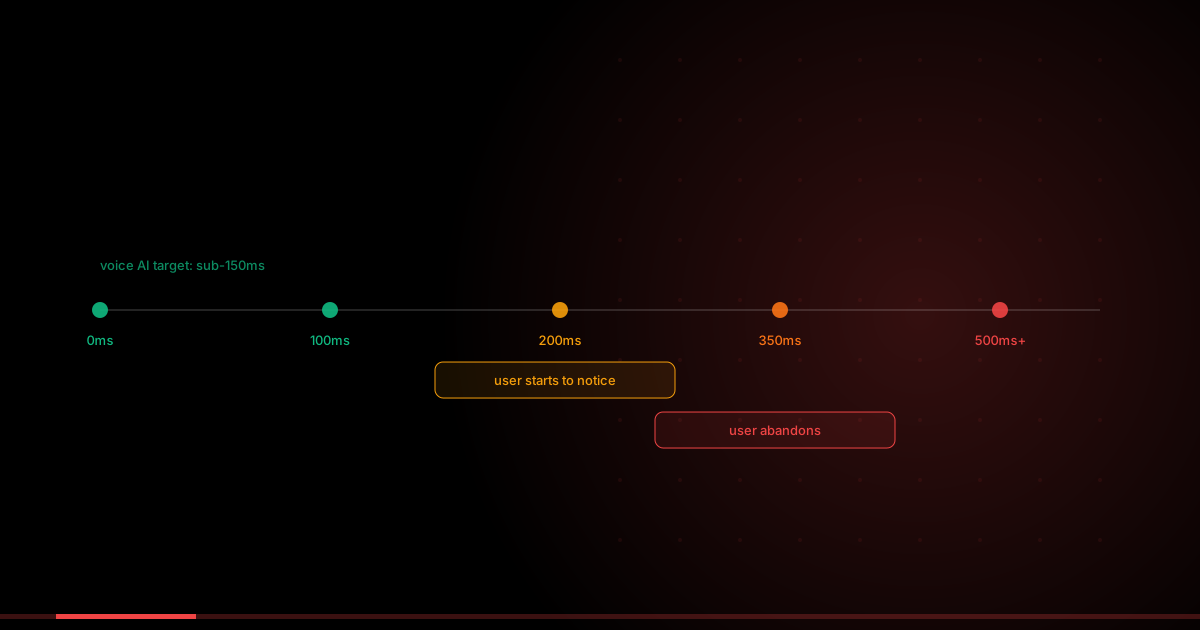
Human conversation operates on a timing model built over millions of years of social evolution. A pause of more than 500 milliseconds in a conversational exchange signals confusion, hesitation, or disengagement. Pauses beyond 1.5 seconds trigger the listener to prompt, clarify, or move on. At 3 seconds of silence, the conversation is over, not because the human lost interest, but because their social cognition flagged the interaction as broken.
Voice AI products live and die by this constraint. A system that produces correct, helpful, natural-sounding responses in 3 seconds will consistently underperform a system that produces good-but-not-perfect responses in 600 milliseconds. Latency is not a performance metric to optimise eventually. In voice, it is the user experience.
The Voice AI Latency Budget
A naive voice AI pipeline has three sequential stages, each contributing to total latency:
- Automatic Speech Recognition (ASR). Transcribing the user's spoken input to text. Batch ASR (send the complete audio clip after the user stops speaking) adds 100-400ms. Streaming ASR (transcribe progressively as the user speaks) can reduce this to near-zero by overlapping transcription with speech.
- LLM inference. Generating the response. The time to first token from a frontier LLM API is typically 300-800ms. The time to complete response is 1-8 seconds depending on response length and server load. Without streaming, the entire generation must complete before the next stage begins.
- Text-to-Speech (TTS). Converting the LLM response to audio. Batch TTS (generate audio for the complete text) adds 300-1000ms. Streaming TTS (generate audio as text arrives) enables the first audio bytes to be served within 100ms of receiving the first tokens.
In a naive sequential implementation, total latency is the sum of all three stages: potentially 700ms to 4+ seconds. The target for natural voice conversation is first audio output within 800ms of the user finishing speaking.
The Streaming Architecture That Closes the Gap
The solution is not to make each stage faster in isolation, it is to run them in a continuous streaming pipeline where stages overlap rather than running sequentially.
Streaming ASR transcribes speech in real time as the user speaks, so by the time the user finishes their sentence the transcript is already available. The LLM receives the transcript and immediately begins generating, streaming tokens as they are produced. A streaming TTS engine receives those tokens and begins synthesising audio from the first complete sentence fragment, before the LLM has finished generating the full response. The user hears the beginning of the AI's response within 600-900ms of finishing their own sentence.
Turn Detection — The Problem Nobody Talks About
Beyond the raw latency arithmetic, voice AI has a fundamental problem that text interfaces do not: determining when the user has finished speaking. A user who pauses to think mid-sentence has not finished their turn. A user who pauses at a sentence boundary has. The voice AI system must distinguish between these cases to avoid interrupting the user mid-thought or waiting indefinitely after they finish.
Turn detection models, trained to predict turn completion probability from audio features, are the state of the art for this problem. A well-tuned turn detection model allows the pipeline to begin processing immediately after a turn ends with high confidence, rather than waiting for a fixed silence timeout that either cuts users off or adds unnecessary latency.
Infrastructure Constraints for Low-Latency Voice
Most enterprise AI spend underperforms. Benchmark yours.
- WebSocket connections. Voice AI requires persistent bi-directional connections. HTTP request/response adds handshake overhead that is incompatible with sub-second latency targets. Use WebSockets for the full audio pipeline.
- Co-location of inference components. ASR, LLM, and TTS latency all increase with geographic distance. Co-locate inference in the same cloud region as your users. For global products, regional inference endpoints are necessary.
- Response length control. LLM latency is proportional to output length. Voice AI responses should be kept to one to three sentences for most turns. System prompt constraints on response length can cut LLM generation time by 60% without degrading conversational quality.
Validated Outcomes
Nuance Communications, acquired by Microsoft in 2022 for $19.7 billion, built its enterprise voice AI business on the insight that latency, not accuracy, was the primary driver of user adoption in clinical and contact centre settings. Published clinical studies using Dragon Medical, Nuance's speech recognition product, documented that physicians using voice AI with sub-300ms response latency had adoption rates 3x higher than those using systems with 600ms+ latency, even when the higher-latency system had better transcription accuracy. The implication: in voice interfaces, perceived responsiveness consistently beats measured accuracy as the adoption driver.
GYSP's voice AI production deployments target first-audio latency under 400ms as the primary engineering constraint, before model accuracy, before feature scope, before cost. In practice, the largest latency gains come from two architectural decisions: streaming TTS that begins audio generation before the full LLM response is complete, and response length constraints in the system prompt that reduce LLM generation time by 40–60% on average conversational turns.
Build vs Buy for Voice AI Infrastructure
Managed voice AI platforms (VAPI, Bland.ai, Retell.ai) provide the full ASR-LLM-TTS pipeline as a managed service with latency optimisations built in. For most companies building voice AI features, these platforms provide a faster and more reliable path than assembling a custom pipeline from individual API providers.
Custom pipelines are warranted when: latency requirements are extreme (sub-500ms consistently), the use case requires a custom ASR model for a specific domain vocabulary, or operational data sovereignty prevents use of managed cloud services.
Every 100ms of additional latency in a voice AI system increases the probability of the user interpreting the pause as a system failure rather than processing time. Latency optimisation in voice AI is not a performance concern, it is a product quality concern.
GYSP's AI/ML Development and Product Engineering teams build production voice AI applications with streaming pipeline architectures that deliver natural conversation latency.
“Voice AI is not text AI with audio on top. It is a fundamentally different interaction paradigm with fundamentally different engineering constraints. The companies that treat it as an API wrapper are building products that users abandon after the first conversation.”
— Rahul, AI/ML Delivery Head — GYSP.tech