What you'll take away
The logic of multi-agent AI is intuitive: complex tasks can be decomposed into subtasks, each handled by a specialised agent, with results synthesised into a coherent output. In a demo environment, with a curated task, this works beautifully. An orchestrator breaks down a research question, dispatches agents to search, retrieve, synthesise, and format, and returns a polished result. The architecture looks inevitable.
In production, the same architecture encounters questions that the demo never had to answer: what happens when one agent fails midway through a multi-step task? How does state persist across agent boundaries? What is the trust relationship between agents, and can one agent be manipulated through the output of another? How does cost scale when 50 user requests each spawn a fan-out of five parallel agent calls? Who is responsible for the output when it is the synthesis of four different model calls?
The answers to these questions are architectural decisions. They must be made before the system goes to production, not discovered after it does.
Why Single-Agent Systems Hit Their Limits
Single-agent systems with tool access are sufficient for a surprising range of tasks and far simpler to build, test, and observe. The case for multi-agent architectures only becomes compelling when a task has characteristics that single agents cannot handle well: tasks that genuinely benefit from parallel execution, tasks that require specialised context windows that would conflict in a single agent, and tasks long enough that a single agent's context window becomes a constraint.
Start with a single-agent architecture. Introduce multi-agent complexity only when you can identify a specific limitation that it solves. Most use cases that are implemented as multi-agent architectures would have been better served, at least initially, by a simpler design.
The Three Core Patterns
Sequential Pipeline
Each agent in the pipeline takes the output of the previous agent as its input. A document analysis pipeline might flow from extraction → classification → summarisation → formatting, with each stage handled by a specialised agent. Sequential pipelines are simple to reason about, easy to observe, and straightforward to debug, error propagation is linear and traceable.
The failure mode is latency accumulation: if each agent call takes 3–5 seconds, a 5-stage pipeline takes 15–25 seconds minimum. Sequential pipelines work well for tasks where quality of output at each stage matters more than end-to-end latency.
Parallel Fan-Out
An orchestrator dispatches multiple independent subtasks to specialist agents simultaneously, then aggregates the results. A competitive intelligence workflow might dispatch simultaneously to a market research agent, a technology landscape agent, a regulatory environment agent, and a financial analysis agent, returning a synthesised report in roughly the time of the slowest agent rather than the sum of all agents.
Parallel fan-out requires careful design of the aggregation step. The orchestrator must handle partial failures (what if two of four agents succeed?), resolve conflicts in overlapping findings, and synthesise outputs that were generated without awareness of each other.
Hierarchical Orchestration
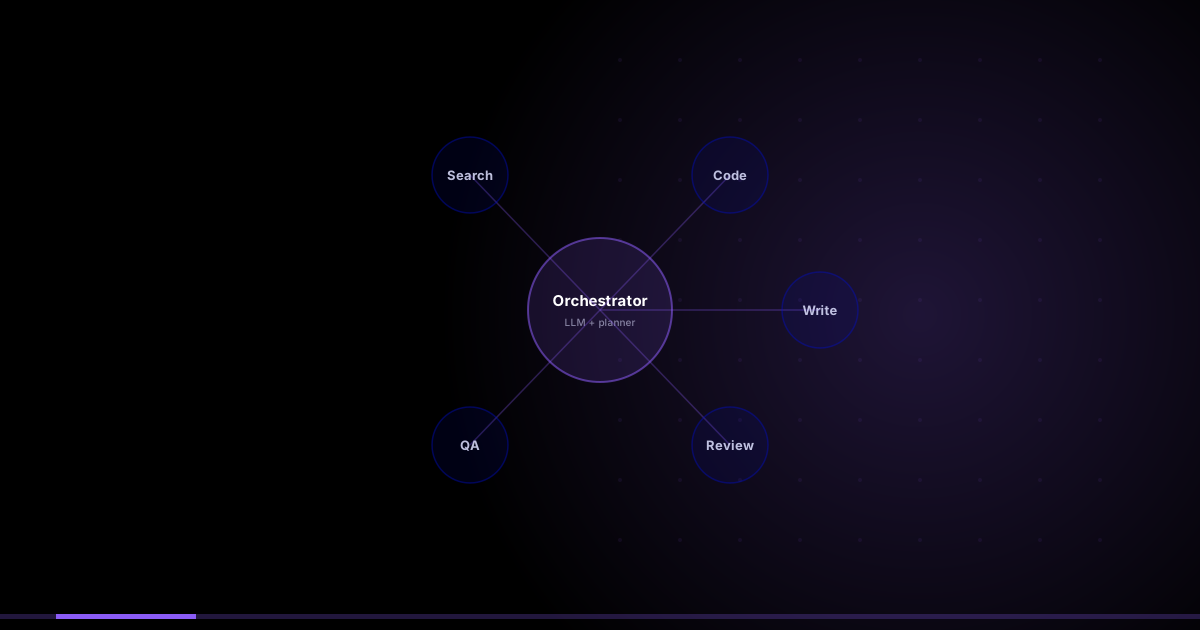
An orchestrator agent plans the overall approach, delegates to specialist agents, evaluates their outputs, and can re-delegate or revise the plan based on intermediate results. This is the most flexible and most complex pattern, it enables adaptive task execution where the plan evolves based on what agents discover. It also introduces the most failure modes and the most cost unpredictability.
Most multi-agent production failures occur not because of a bug in any individual agent but because the system's design did not specify what to do when things go partially wrong. A four-agent fan-out where two agents succeed and two time out has no specified behaviour and the undefined behaviour is usually catastrophic.
The Four Production Pitfalls
1. The State Management Problem
Multi-agent workflows accumulate state across multiple LLM calls, tool invocations, and agent boundaries. That state must be stored somewhere, versioned against concurrent updates from parallel agents, and recovered if an agent fails mid-execution. Most demo multi-agent systems hold state in memory. Production systems need durable state stores, Redis, PostgreSQL, or a purpose-built workflow state backend, with clear ownership semantics for state mutations.
2. The Error Propagation Trap
Most enterprise AI spend underperforms. Benchmark yours.
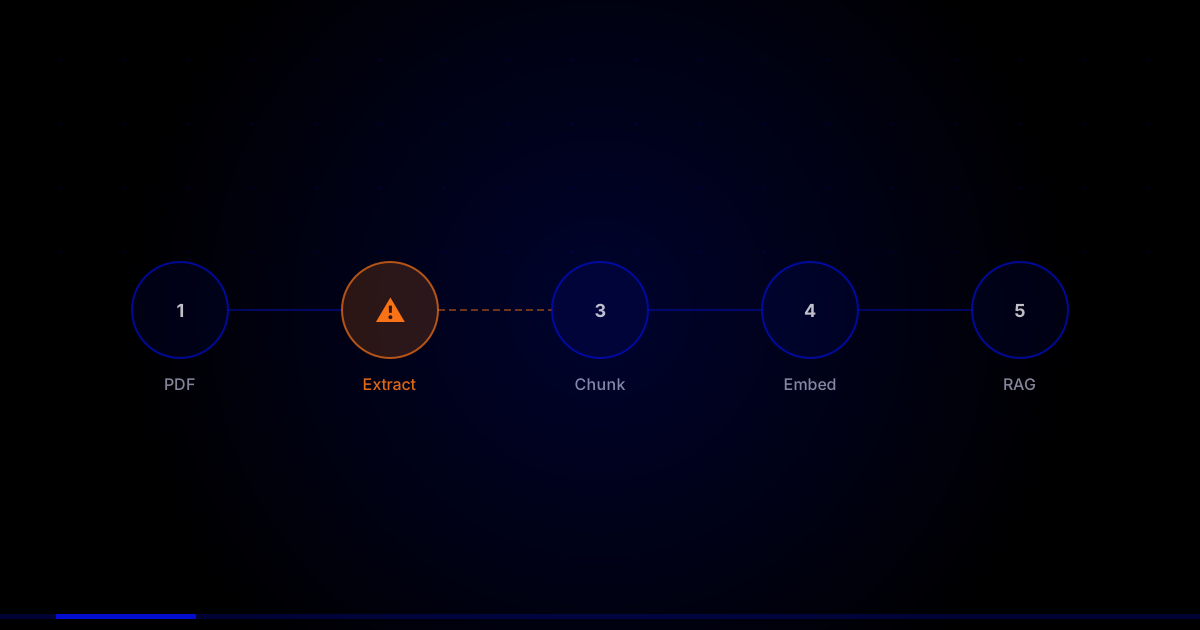
In a sequential pipeline, an error in stage 2 propagates to stages 3, 4, and 5. Unless each stage validates its input and has explicit error-handling logic, downstream agents will attempt to process malformed inputs, producing malformed outputs, potentially without raising any exception. Define explicit error contracts at every agent boundary: what constitutes valid input, what the agent should do if input fails validation, and how errors are communicated back to the orchestrator.
3. The Trust Boundary Problem
In a multi-agent system, agents consume the outputs of other agents. If those outputs are influenced by external data, web pages, documents, database records, API responses, the system has an indirect prompt injection surface at every agent boundary. An attacker who can influence the data one agent processes can potentially inject instructions that affect the behaviour of the downstream orchestrator or other agents. Every agent-to-agent communication channel is a potential attack vector if external data reaches it without sanitisation.
4. The Cost Cascade
A single user request that triggers a hierarchical orchestrator can generate dozens of LLM calls across specialist agents, planning steps, and retry logic. In a high-traffic production system, a poorly bounded multi-agent architecture can generate costs that bear no relationship to the business value of any individual request. Implement per-request cost budgets, agent call depth limits, and circuit breakers that terminate runaway orchestration chains before they exhaust their budget.
Orchestration Frameworks
- LangGraph: Graph-based workflow definition with durable state, human-in-the-loop support, and streaming. Good choice for complex, stateful workflows with explicit control flow requirements. Well-maintained, production-ready.
- AutoGen: Microsoft's multi-agent conversation framework. Strong for agent-to-agent communication patterns. More complex to deploy and observe than LangGraph for non-conversational workflows.
- CrewAI: Role-based agent definition with a higher-level abstraction. Faster to prototype but less control over the underlying execution. Better for content and research workflows than for workflows requiring complex state management.
- Custom orchestration: For workflows with very specific state management, error handling, or cost governance requirements, a custom orchestrator built on top of your model provider's API often provides better control and observability than a framework designed for general use.
Validated Outcomes
Palantir's AI deployment methodology, documented in their investor presentations and engineering publications, emphasises what they call 'human-in-the-loop feedback architecture' as the mechanism that made enterprise adoption of multi-agent workflows achievable in regulated industries. Rather than deploying fully autonomous agent pipelines, Palantir's production deployments route agent actions that exceed a confidence threshold or involve irreversible operations to a human review queue. The result: enterprise customers in defence, healthcare, and financial services, industries that would not accept fully autonomous AI action, adopted multi-agent workflows because the confidence-gated human review gave them the oversight they required. Palantir attributed a significant portion of their enterprise contract growth in 2023 to this architecture pattern.
GYSP's multi-agent production deployments include confidence-gated human oversight as a standard architecture component for any workflow involving external system mutations. The pattern, agent executes read operations autonomously, routes write or irreversible operations through a review queue until the system has demonstrated reliability, has been the decisive factor in enterprise security team sign-off in every regulated-industry engagement GYSP has completed. The initial throughput reduction from the review queue is offset within 4–8 weeks as the queue populates, is reviewed, and the agent earns autonomous execution trust for the reviewed operation categories.
Designing for Observability
A multi-agent system that you cannot observe is a multi-agent system you cannot debug, optimise, or trust. Every agent call should emit structured traces including: the input provided, the tool calls made and their results, the reasoning steps (if using chain-of-thought), the output produced, and the token cost incurred. Aggregate these traces at the workflow level to give a complete picture of execution cost, latency, and failure distribution.
GYSP's AI/ML Development practice designs, builds, and validates multi-agent architectures for enterprise deployments, covering orchestration design, state management, trust boundary analysis, observability instrumentation, and cost governance frameworks. We help teams determine whether a multi-agent architecture is actually warranted for their use case, and if it is, build it to survive the move from demo to production.
“The question that separates a multi-agent architecture that works from one that doesn't is not 'what does the system do when everything works?' It is 'what does the system do when one agent fails, one times out, and one returns an unexpected format, simultaneously?' If you cannot answer that question before deployment, you will learn the answer in production.”
— Rahul, AI/ML Delivery Head — GYSP.tech
Frequently Asked Questions
What orchestration patterns work best for multi-agent AI systems in production?+
Three patterns dominate production deployments: Sequential pipelines are simplest, each agent passes output to the next, making debugging linear and predictable. They suit quality-sensitive workflows where each stage needs to complete before the next begins. Parallel fan-out dispatches multiple agents simultaneously and aggregates results, reducing latency for independent subtasks. Hierarchical orchestration uses a supervisor agent to decompose tasks and assign them to specialised sub-agents, useful for complex, open-ended tasks but expensive to debug. Start with sequential, move to parallel only when latency is a constraint, and introduce hierarchical patterns only when task complexity genuinely requires decomposition.
What are the most common failure modes in multi-agent systems?+
Four failure modes account for most production incidents: Error propagation, a failed agent midway through a pipeline produces a partial or corrupt output that downstream agents process as valid, compounding the error. Context explosion, long agent chains accumulate context that exceeds model limits or degrades output quality. Cost cascades, a single user request fans out into 5–10 model calls, making per-request costs unpredictable and difficult to govern. State management failures, agents that cannot access shared state produce inconsistent outputs, particularly in systems where agents must coordinate on a shared task. Each failure mode has architectural mitigations, but they must be designed in before production, not bolted on after incidents.
How do you make multi-agent systems observable in production?+
Observability in multi-agent systems requires four layers: Trace-level logging that captures every agent invocation with inputs, outputs, latency, and model version, so any output can be reconstructed from its trace. Structured output capture that serialises intermediate agent outputs, not just the final response. Cost attribution per request and per agent so you can identify which agents are responsible for cost spikes. A replay mechanism that lets you re-run a specific trace with modified inputs for debugging and regression testing. Without trace-level logging, debugging a multi-agent failure means reasoning about a black box. Most production incidents in multi-agent systems are only diagnosable with complete traces.
When should you use a multi-agent system instead of a single agent?+
Multi-agent architectures are justified in three scenarios: The task genuinely benefits from parallel execution, independent subtasks that can run simultaneously, where the latency reduction from parallelism outweighs the orchestration overhead. The task requires specialised context that would conflict in a single agent, different agents need different system prompts, tool access, or knowledge bases that cannot be combined without degrading performance. The task is long enough to exhaust a single agent's context window, breaking the task across agents allows each to operate within its effective context limit. If your use case does not meet at least one of these criteria, a single agent with tool access will be simpler, cheaper, and easier to observe.