What you'll take away
Every conversation about platform engineering eventually reaches the same impasse: 'How do we justify the investment?' The platform team is not shipping product features. The engineering infrastructure they are building does not appear on a product roadmap. The value they create, reduced developer waiting time, consistent environments, faster onboarding, fewer production incidents, is diffuse, hard to attribute, and invisible until you try to quantify it.
The impasse has a straightforward resolution: make the absence of platform engineering visible. The costs are real. They are paid by every product engineer, every sprint, whether or not the organisation has chosen to account for them. Building the business case for a platform engineering team starts with counting what is already being spent, just in a form that does not appear on a single budget line.
What a Platform Engineering Team Actually Does
A platform engineering team builds and maintains the internal developer platform, the tools, workflows, and abstractions that product engineering teams use to build, test, deploy, and operate their services. The IDP is the paved road: self-service infrastructure provisioning, standardised deployment pipelines, pre-configured observability, security policy enforcement at the platform level, and a service catalogue that developers can consume without understanding the underlying infrastructure.
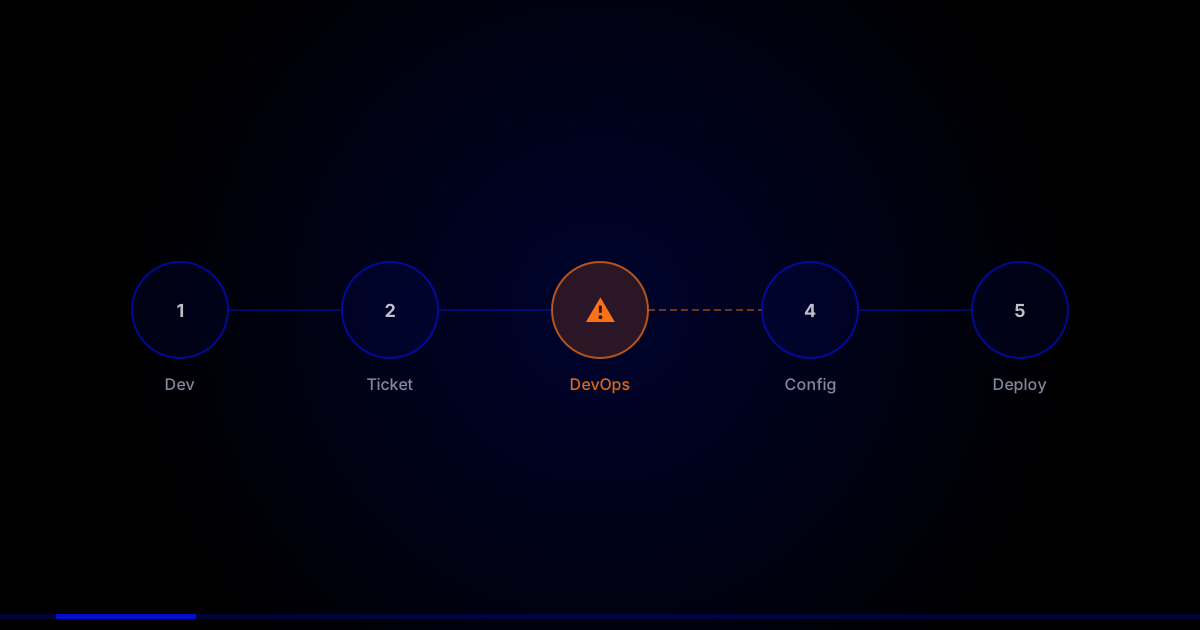
Without a platform team, these services are provided, expensively, by a combination of senior engineers, DevOps tickets, and tribal knowledge. Every product engineer who provisions their own database, configures their own CI pipeline, or spends a day debugging environment differences between local and staging is doing platform work that the platform team should be doing once, correctly, for everyone.
The Cost of Absence
The business case for platform engineering is built from four cost categories that are present in every organisation that lacks one:
- Developer waiting time: The average product engineer without self-service infrastructure spends 4-6 hours per week waiting for environment provisioning, infrastructure changes, or access requests to be processed by an overloaded DevOps team. At 50 product engineers, at an average all-in cost of £90,000/year per engineer, that is £1.0-1.5M per year in time spent waiting rather than building.
- Onboarding drag: A new engineer joining a team without a standardised development environment and documented golden paths takes 2-4 weeks to become fully productive. With an IDP providing pre-configured dev environments and a service catalogue, onboarding reduces to 2-3 days. At 20 new hires per year at £90K salary, the difference is 20-70 productive engineering days per hire, approximately £550K-£1.9M per year in lost onboarding productivity.
- Production variance: When every team manages its own infrastructure configuration, production environments diverge. Divergent environments produce divergent failure modes. The DORA research consistently finds that organisations with standardised deployment processes (what platform engineering provides) have 4× lower change failure rates than those without. A team generating 3 production incidents per month at 4 hours average recovery time, with 6 engineers involved, is spending 72 engineering hours per month on avoidable incidents.
- Security and compliance risk: Ungoverned infrastructure means configuration decisions made by individual product engineers without security review. Platform engineering moves security policy enforcement to the platform level, out of the hands of individual teams and into automated checks that run on every deployment. The cost avoidance of preventing a single major security incident justifies platform investment independently.
Gartner forecast that by 2026, 80% of large software engineering organisations would have a dedicated platform engineering team. The survey data behind that forecast showed the primary driver was not technology preference but competitive pressure: organisations with mature IDPs were deploying 4× more frequently and onboarding engineers 10× faster than those without.
What Constitutes an IDP
A production-ready Internal Developer Platform typically includes:
- Self-service infrastructure provisioning: Engineers request and receive environments, databases, queues, and other infrastructure through a developer portal rather than by opening a ticket. Provisioning is automated, templated, and governed.
- Golden paths and templates: Pre-configured, opinionated project templates for common service types (REST API, event consumer, batch job, ML model serving) that include CI/CD configuration, observability setup, security scanning, and deployment manifests. Engineers start from a golden path rather than building from scratch.
- Internal service catalogue: A searchable directory of all internal services, their owners, their SLOs, their API documentation, and their deployment status. Engineers can understand what exists before building something that already exists.
- Developer portal: Typically Backstage or a commercial equivalent, surfacing the service catalogue, golden paths, environment status, and deployment workflows in a unified interface.
- Policy-as-code: Security and compliance policies enforced automatically at the platform level, image scanning, RBAC enforcement, secret management, and network policy, rather than through manual review processes that create bottlenecks and allow policy drift.
Measuring Platform Engineering ROI
29% of cloud spend is wasted on average. Find yours.
The cleanest ROI framework for platform engineering uses DORA metrics as the primary outcome measure, supplemented by onboarding time and developer satisfaction (SPACE framework):
- Deploy frequency: how often does each team deploy to production? Platform-matured teams target daily or multiple-times-per-day.
- Lead time for change: time from code commit to production deployment. Platform engineering targets under one hour for non-critical path deployments.
- Change failure rate: percentage of deployments causing a production incident. Target under 5% for elite teams.
- MTTR: mean time to recover from incidents. Platform observability investments directly reduce MTTR.
Establish baselines for all four metrics before the platform investment begins. Review quarterly. The ROI calculation becomes straightforward once you assign business value to deployment frequency (faster feature delivery) and cost to change failures and MTTR (engineering time in incidents plus customer impact).
Validated Outcomes
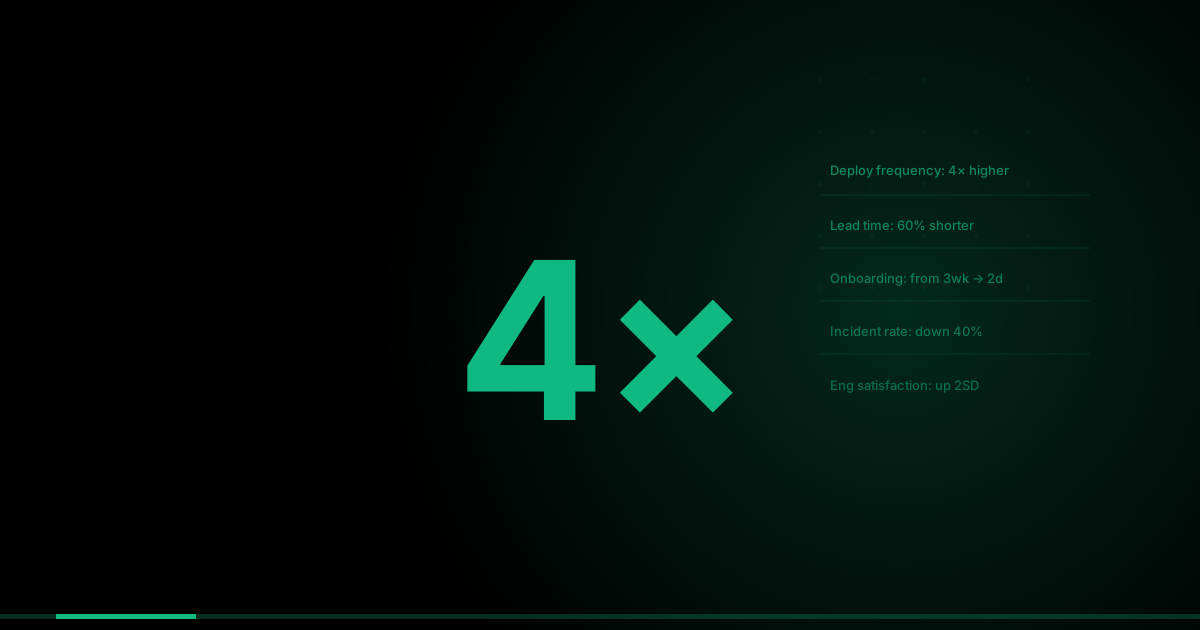
Palo Alto Networks published a case study on their platform engineering investment, documenting that after deploying a Backstage-based IDP with golden path templates, new engineer time-to-first-production-deployment dropped from 3 weeks to 2 days, a 10x onboarding improvement, and deployment frequency across product teams increased by 4x in the first quarter after platform launch. The PALO engineering team attributed the deployment frequency increase not to cultural pressure but to the removal of the practical barriers that had made frequent deployment difficult: environment consistency, automated security scanning at the platform level, and self-service infrastructure that eliminated the DevOps ticket queue.
GYSP's platform engineering engagements begin with a developer waiting time audit: shadowing engineers for a week to document every instance of waiting for infrastructure, waiting for environment access, or debugging environment differences. In every engagement, this audit surfaces 6–10 hours per engineer per week of non-product work, time that the platform will recover. The business case for platform investment becomes straightforward when this figure is multiplied across the engineering organisation: a 50-person engineering team recovering 8 hours per week of waiting time is recovering 20,000 engineering hours per year.
Where to Start
The highest-value first investment is almost always self-service environment provisioning and golden path templates, the two capabilities that eliminate the most developer waiting time and the most onboarding drag. A minimal IDP that provides these two things, with a developer portal surfacing them, delivers measurable ROI within 60-90 days and builds the organisational muscle for expanding platform scope incrementally.
GYSP's Cloud & DevOps Engineering practice designs and implements Platform Engineering programmes from initial IDP architecture through to full golden path libraries, Backstage implementations, and policy-as-code enforcement. We work with engineering leadership to build the business case, establish DORA baselines, and design the implementation roadmap that delivers the fastest measurable return on the platform investment.
“The platform team that cannot answer 'what is the ROI of what we build?' will lose every budget conversation to a product team that can show a shipped feature. The answer to that question is the foundation of every successful platform engineering organisation and it starts with measuring what developer time is currently being spent on instead of shipping product.”
— Ankush, Chief Technology Officer — GYSP.tech