What you'll take away
A company decides to build a GenAI product. The natural instinct: hire a Data Scientist. After all, AI is data science, right? The Data Scientist joins, opens a Jupyter notebook, fits a few models, generates some graphs and three months later, there is still no product. The company is frustrated. The Data Scientist is frustrated. The project is behind.
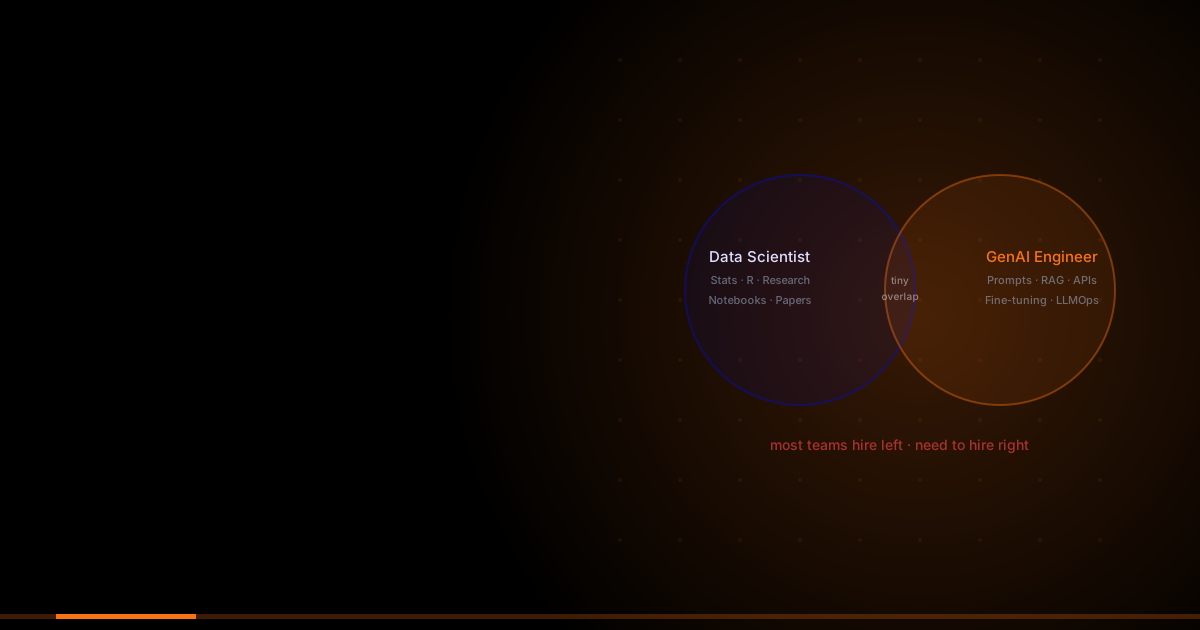
The problem is not the Data Scientist. The problem is the job description. Data Science and GenAI engineering are related disciplines that require almost entirely different skill sets in practice and conflating them is one of the most expensive talent mis-hires in technology right now.
What Data Scientists Actually Do
Traditional Data Science is fundamentally about statistical inference: formulating hypotheses, running experiments, building predictive models from structured data, and communicating findings. The core toolkit is statistics, probability, feature engineering, model training, and data visualisation.
This is genuinely valuable. A Data Scientist is the right hire when you need to build a churn prediction model from your CRM data, analyse which product features correlate with customer retention, or build a recommendation system trained on your historical purchase data. The data exists, the target variable is defined, and the task is supervised learning or statistical analysis.
What GenAI Engineering Actually Requires
GenAI development is a software engineering discipline that builds products on top of pre-trained foundation models. The foundational skill is not statistics, it is systems design. A GenAI engineer spends their time on:
- Prompt engineering and system design, designing the instruction architecture that governs model behaviour across all user interactions. This requires product thinking, UX sensibility, and deep understanding of how language models respond to different instruction patterns.
- RAG pipeline architecture, designing and implementing retrieval-augmented generation systems: document parsing, chunking strategy, embedding selection, vector store configuration, retrieval algorithm selection, reranking, context assembly, and response generation.
- LLM API integration, building reliable, production-grade integrations with LLM APIs: error handling, retry logic, streaming, token budget management, cost monitoring, and model version management.
- Evaluation framework design, defining what constitutes a good response, building automated evaluation pipelines, designing human evaluation workflows, and maintaining quality benchmarks that catch regressions as the system evolves.
- Agent and tool architecture, for agentic AI systems: designing multi-step reasoning flows, tool specifications, state management, and the error handling that prevents agents from taking irreversible wrong actions.
The Roles That Actually Build GenAI
Production GenAI systems are built by a different set of roles than traditional ML systems:
- LLM Application Engineer. A software engineer with strong Python skills and specific expertise in LLM API integration, prompt engineering, and RAG implementation. This is the workhorse role of GenAI product development.
- ML Engineer. Relevant when fine-tuning is required: managing training infrastructure, optimising training runs, evaluating fine-tuned models, and deploying them to production endpoints.
- AI Product Manager. Translating use cases into AI specifications, defining evaluation criteria, prioritising capability improvements, and communicating AI capabilities and limitations to stakeholders.
- Data Scientist. Valuable for evaluation design, A/B testing of AI variants, analysis of model behaviour across user segments, and domain-specific applications where statistical expertise is needed alongside LLM development.
What to Look for When Hiring GenAI Talent
Most enterprise AI spend underperforms. Benchmark yours.
The signal for genuine LLM application engineering experience: can they describe a RAG system they have built from scratch, including the chunking strategy they chose and why, the retrieval algorithm they used, and the evaluation methodology they used to measure quality? Can they explain a prompt engineering decision they made and the reasoning behind it? Have they deployed an AI system to production and operated it, debugging failures, monitoring quality, handling model updates?
The red flag: a portfolio of Jupyter notebooks demonstrating model training, visualisation, and statistical analysis with no evidence of production system design or LLM-specific development experience.
The GenAI talent market is full of Data Scientists who have added LLM keywords to their profiles. The way to distinguish them from genuine LLM application engineers is to ask about production systems they have built and operated, not models they have trained in notebooks.
Validated Outcomes
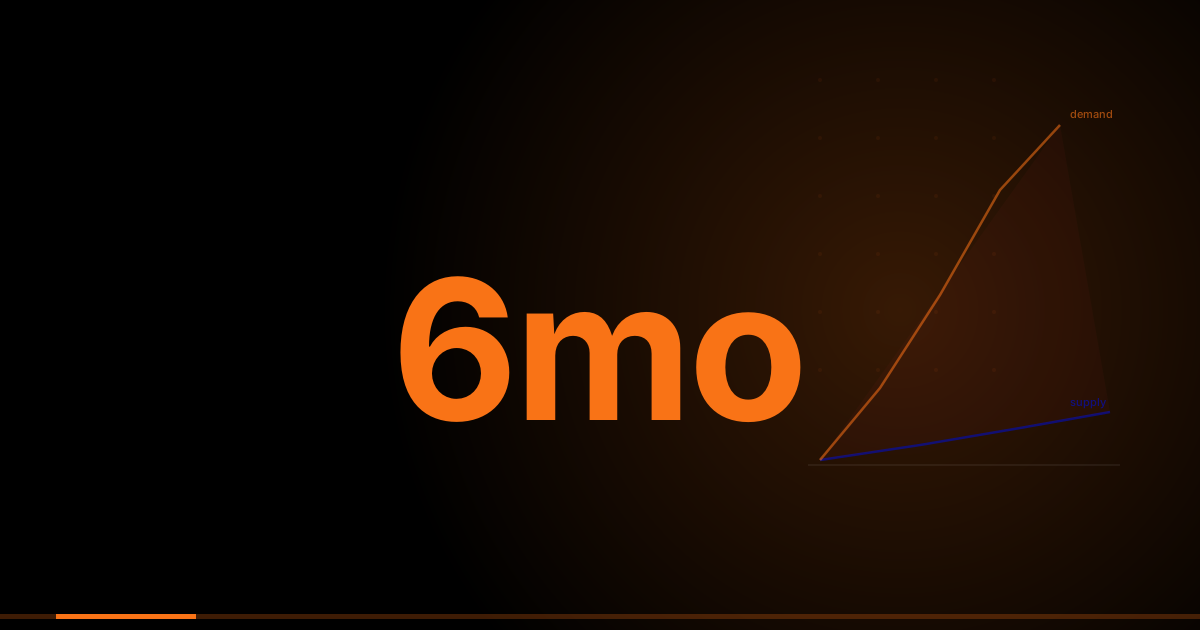
The 2024 State of AI Engineering survey by Latent Space, one of the most cited benchmarks of the GenAI talent market, documented that companies who hired for production LLM engineering skills (RAG architecture, evaluation pipeline design, LLMOps) rather than data science credentials deployed production AI systems at twice the rate of companies that hired based on ML/data science backgrounds and expected them to adapt. The survey found that over 60% of organisations reported being blocked on GenAI deployment by talent gaps and that the most common mistake was hiring data scientists who could prototype but could not ship production systems.
GYSP's augmentation placements for GenAI roles follow a skills assessment that evaluates production system experience explicitly: RAG pipeline construction, evaluation framework design, and LLM observability tooling. Clients who have previously hired data scientists for GenAI roles and encountered the prototype-to-production gap consistently report that the GYSP placement model resolves the delivery velocity problem, typically getting to a production-ready system in half the time of the previous internal hire approach.
GYSP's Staff Augmentation practice places AI engineers who have genuine production LLM development experience, not notebook scientists who learned to call the OpenAI API.
“When a company posts a Data Scientist job for a GenAI project and hires a strong Data Scientist, both sides have been set up to fail. The company expected software product development. The Data Scientist expected model training. Neither got what they were hired for.”
— Rahul, AI/ML Delivery Head — GYSP.tech
Frequently Asked Questions
What skills does GenAI engineering require that differ from data science?+
GenAI engineering requires LLM application development (prompt engineering, chain orchestration, evaluation), RAG architecture (chunking, embedding, retrieval, reranking), and AI evaluation design (deterministic testing, LLM-as-judge). Traditional data science expertise in statistical modelling, feature engineering, and ML training is minimally relevant to these production tasks.
What roles actually build GenAI products in production?+
GenAI products are built by LLM engineers (application integration, prompt design, evaluation), RAG engineers (retrieval architecture, vector databases, document ingestion pipelines), and ML/MLOps engineers (model serving, latency optimisation, monitoring). Data scientists are valuable for analytics and model evaluation, not the primary builders of GenAI applications.
Should we hire GenAI engineers or use staff augmentation?+
Most enterprises benefit from a hybrid: one or two full-time AI engineers for architectural ownership, augmented by experienced GenAI engineers for initial builds and capability transfer. Pure hiring is slow (18+ month timelines for AI roles are common); pure augmentation does not build lasting internal capability.
How do you evaluate a GenAI engineer's competence in an interview?+
Evaluate through practical assessment: ask candidates to design a RAG architecture for a specific document type, explain chunking strategy trade-offs, and walk through a production failure they have debugged. Competent GenAI engineers speak to chunking, retrieval, reranking, evaluation scoring, and latency, not just model capability.