What you'll take away
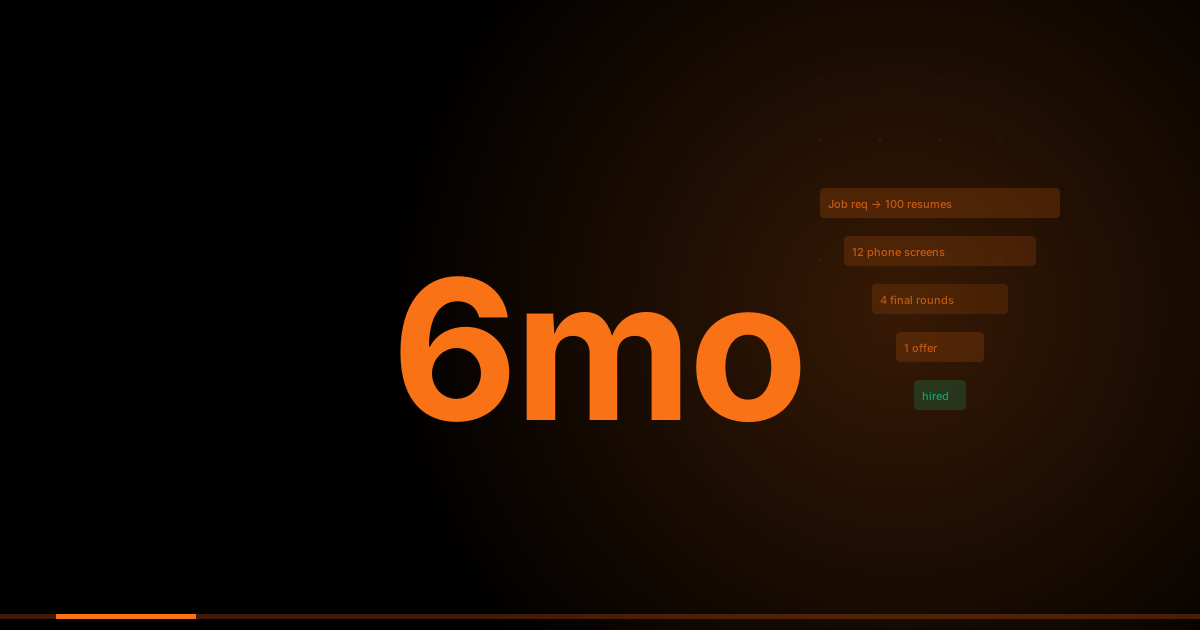
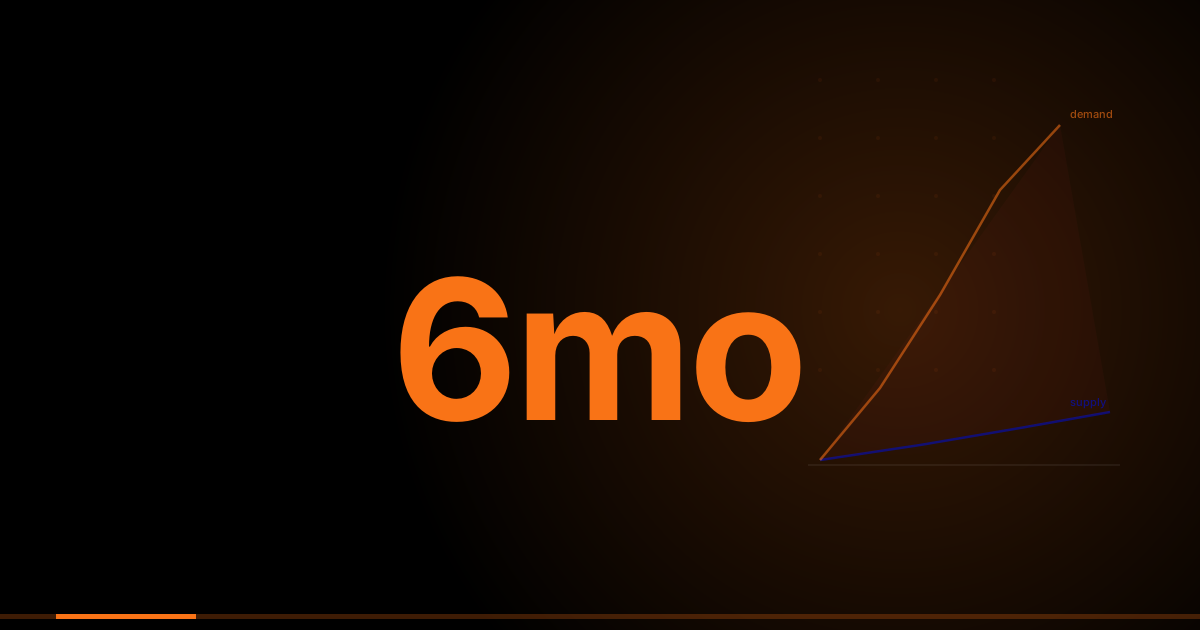
LinkedIn's 2024 Jobs on the Rise report listed AI Engineer, Prompt Engineer, and ML Operations Engineer among its fastest-growing roles globally. Demand for these skills has grown faster than any previous technology specialisation. Supply has not kept pace. The result is a talent market where qualified AI engineers command salaries at the senior software engineer ceiling, hiring timelines run to four to six months even with strong employer brands, and many candidates who claim AI engineering experience have built one or two proof-of-concept applications and little else.
Companies that are waiting to build their AI capabilities until they have hired the perfect senior AI engineer are making a strategic error. The twelve to eighteen months they spend waiting represent a compounding competitive disadvantage in a capability race where first-mover advantage is real. The companies that are deploying production AI in 2025 and 2026 are not the ones with the best full-time AI hiring, they are the ones that solved the talent problem more creatively.
Why Traditional Hiring Fails for AI Engineering
AI engineering is not a single discipline. It spans machine learning research (understanding model architecture and training dynamics), ML engineering (building the infrastructure to train, deploy, and monitor models in production), LLM application development (building applications on top of foundation models using RAG, fine-tuning, and prompt engineering), and AI/ML operations (the infrastructure and tooling that keeps production AI systems reliable and observable).
A job description for an AI Engineer that requires strong Python, ML engineering experience, LLM application development, and MLOps expertise is asking for a T-shaped specialist who represents approximately 2% of the senior engineering population. The hiring timeline for this profile, even with competitive compensation, consistently runs to four months minimum at companies without top-tier employer brands. At companies outside major tech hubs, it can run to a year or more.
The opportunity cost of that timeline is not abstract. An AI initiative that would reduce customer churn by 15% if deployed this quarter, delayed by twelve months waiting for the perfect hire, has a very calculable cost that most organisations are not tracking against their hiring timeline.
The Three Talent Models That Work
Model 1: Staff Augmentation with Specialised AI Teams
Partnering with a specialist AI engineering practice provides access to a team, ML engineers, LLM application developers, MLOps engineers, who have production AI delivery experience across multiple client environments. Unlike hiring a single AI engineer, a team brings the complementary skills that production AI requires: the ML researcher who understands model selection, the MLOps engineer who builds the monitoring infrastructure, and the software engineer who integrates the AI capability into the existing product.
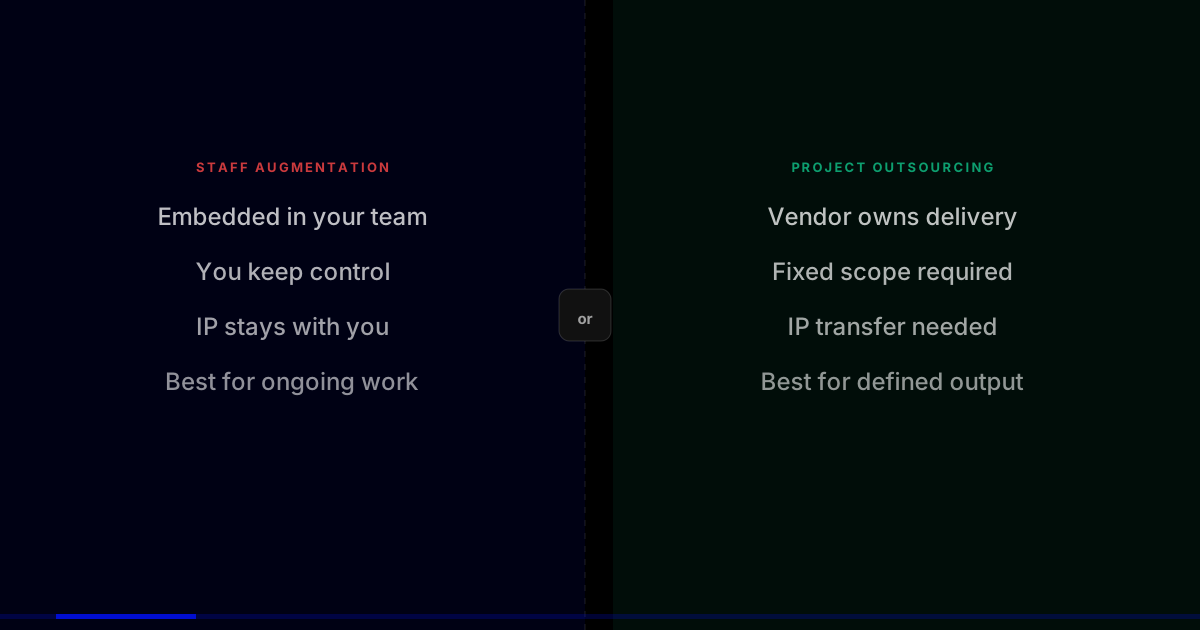
Staff augmentation is not outsourcing. The team works within your engineering organisation, on your infrastructure, with your product team, and transfers knowledge throughout the engagement. When the engagement ends, your internal team has observed production AI delivery firsthand and is positioned to extend the capability independently.
The GYSP model for AI engineering augmentation: a dedicated AI pod (typically an ML engineer, an LLM application developer, and a part-time MLOps engineer) embedded with your engineering team for the duration of the AI delivery programme. This brings three to six months of delivery capacity that hiring alone would take twelve months to assemble.
Model 2: Upskill and Specialise Existing Engineers
For companies where embedding external teams is not culturally compatible, the fastest path to in-house AI capability is structured upskilling of existing senior software engineers. Modern LLM application development, building on foundation models using LangChain, LlamaIndex, or direct API integration, is accessible to strong Python engineers with appropriate training and tooling.
The realistic upskilling timeline: six to eight weeks of structured training plus hands-on project work to reach production-capable LLM application development. This is not a deep ML research programme, it is applied AI development on top of existing foundation models. A senior software engineer who understands API integration, data pipelines, and production software practices can be productive in LLM application development within two months with the right learning structure.
The limitation: upskilled engineers can build production LLM applications effectively. They cannot replace the domain expertise of ML engineers when the use case requires custom model training, complex embedding architectures, or production-scale model serving infrastructure.
Model 3: Hybrid — External for Research, Internal for Production
The most effective long-term talent model for most enterprise AI programmes: external AI specialists for the research and architecture phase (what approach, what models, what training strategy, what infrastructure), and internal engineers, trained and embedded during the external team engagement, for production development, maintenance, and iteration.
The external team solves the cold-start problem: the first six months of an AI programme are the hardest and highest-stakes, and specialist experience compresses the timeline and reduces the failure rate dramatically. The internal team inherits a working system with documentation, transfer knowledge, and the experience of having built it alongside the external team.
What to Look for in an AI Engineering Partner
- Production references, not demos. Ask for examples of AI systems they have deployed in production, with measurable business outcomes. Proof-of-concept and demo experience does not translate to production AI engineering capability.
- MLOps and observability expertise. A team that can build an LLM application but cannot monitor its performance, detect drift, and manage model versioning in production is an incomplete capability.
- Domain experience in your industry. AI for healthcare requires different expertise and different compliance awareness than AI for e-commerce. Domain-relevant experience reduces the learning curve and the risk of technically correct but commercially impractical solutions.
- Knowledge transfer as a programme deliverable. The engagement should be designed to leave your internal team more capable, not more dependent. Knowledge transfer milestones, documentation standards, and paired working arrangements should be contractually defined.
The AI talent shortage is real but not permanent. In three to five years, AI engineering skills will be far more widely distributed. The companies that will have the competitive advantage at that point are the ones that deployed production AI in 2025 and 2026, not the ones that waited for the talent market to normalise.
Validated Outcomes
Stripe's AI engineering build-out is one of the most documented cases of the hybrid talent model working at scale. When Stripe accelerated AI integration across its payments and fraud detection infrastructure, the company combined a small core of specialist AI researchers with a much larger group of software engineers who received targeted AI upskilling. Stripe's published engineering blog documented that this model allowed them to deploy production LLM features 3x faster than a comparable team built entirely from specialist AI hires would have enabled, given hiring timelines. The constraint was never the technology, it was the time required to assemble the team.
GYSP's embedded AI engineering engagements follow the same model. Clients who deploy GYSP AI engineers alongside their existing software engineering team consistently report two outcomes: first, the production AI capability is delivered within the project timeline rather than waiting for permanent hires; second, the internal team exits the engagement with demonstrably higher AI engineering capability than when it started, because knowledge transfer is designed into the engagement structure from day one.
GYSP's Staff Augmentation and AI/ML Development practices provide AI engineering teams that embed with your organisation, deliver production AI capabilities, and transfer expertise throughout the engagement.
“Waiting for the perfect AI hire while your competitor deploys production AI is not a conservative strategy. It is an aggressive choice to cede ground in a capability race. Solve the talent problem with the models available, not the model you would prefer.”
— Dhaval Rana, Founder & CEO — GYSP.tech