What you'll take away
Private equity firms have become sophisticated consumers of technology due diligence. Most deals above £10M now include some form of technical assessment. Legal and financial DD is handled by experienced advisors who know what questions to ask. Technology DD is frequently handled by advisors who know what to look for in the obvious places and miss the findings that actually destroy deal value post-close.
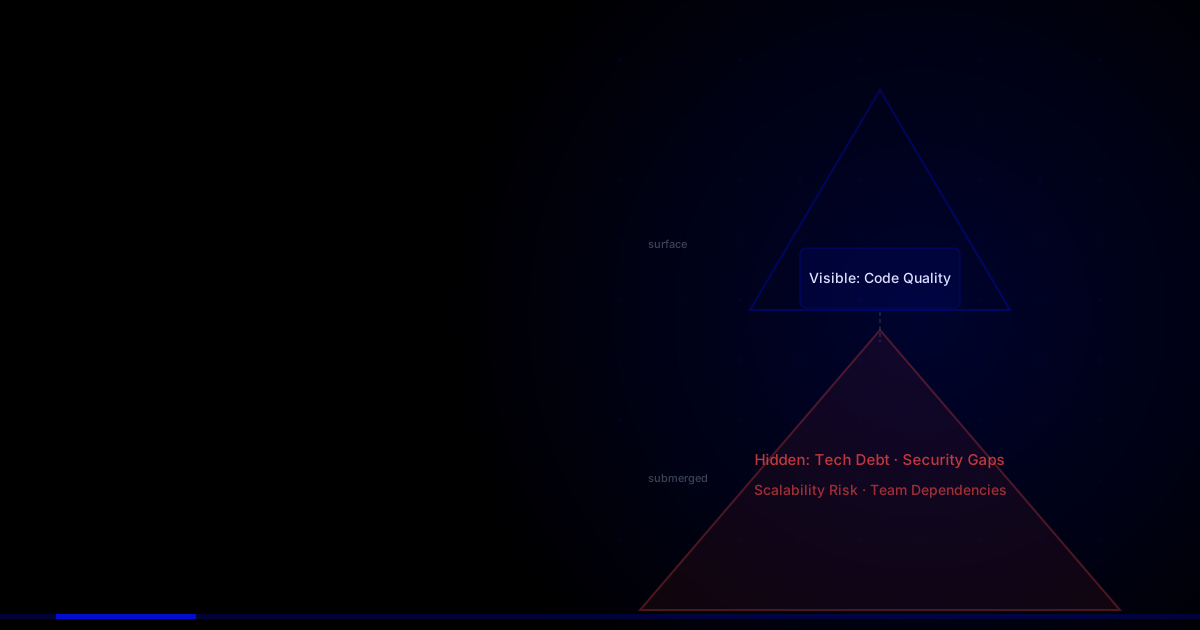
The obvious findings are always there: security gaps, outdated dependencies, incomplete documentation. These are important and should be surfaced. But they are also discoverable from surface-level assessment and rarely represent the deal-defining risk that technology due diligence is supposed to identify. The findings that matter, the ones that affect EBITDA, integration timeline, and management team retention, require deeper investigation into five dimensions that standard tech DD consistently underweights.
Dimension 1: Architectural Debt Quantification
Every technology business carries architectural debt, decisions made under time or resource pressure that will cost more to fix later than they saved at the time. Standard tech DD identifies that architectural debt exists. The dimension that matters for deal valuation is quantifying what it will cost to address it and when that cost will materialise.
A monolithic architecture in a SaaS business may be entirely appropriate today. If the company's growth trajectory requires ten-fold scale in three years, the cost to decompose that monolith, in engineering time, in delivery disruption, in infrastructure investment, is a real liability that should affect valuation or be reflected in the post-close investment plan. The question is not 'is the architecture good?' but 'what will it cost to make it fit for the next chapter of this business, and when?'
Architectural debt quantification requires engineers who have built at scale to review not just the current architecture but the growth plan. A platform built for 500 concurrent users that the investment thesis assumes will serve 50,000 concurrent users in three years has a very different architectural debt profile than a platform with a similar technical surface area but a more modest growth plan.
Dimension 2: Key Person Dependency Mapping
The most consistently underestimated risk in technology due diligence is key person dependency in the engineering team. When a single engineer, or a small group of engineers, holds the tribal knowledge that makes a critical system function, the technical asset you are acquiring has a concentration risk that does not appear on any balance sheet.
Key person dependency assessment requires going beyond the org chart to identify: which engineers are the only people who can safely deploy to production, which engineers own the architecture of the revenue-critical systems, which engineers have the customer relationships that affect product direction, and what the retention picture looks like post-acquisition. A company where the senior engineering team leaves within twelve months of close, a common outcome in PE acquisitions where equity incentives disappear, may have acquired a technology platform with no one left who knows how it works.
Dimension 3: Licensing and Intellectual Property Risk
Software licensing risk in technology acquisitions is more complex than licence compliance alone. Three specific risks are consistently underexamined:
- Open-source licence obligations. GPL and AGPL licences impose copyleft obligations that can affect the acquirer's ability to commercialise modified versions of GPL-licensed components. A SaaS business built on AGPL-licensed components may have source code disclosure obligations that the target company was unaware of. Open-source licence audit requires scanning the full dependency graph, not just reviewing the obvious direct dependencies.
- Third-party SaaS dependency at scale. Pricing for business-critical SaaS products often changes materially at enterprise scale. A target company using Salesforce, HubSpot, Twilio, or Stripe at startup pricing may face 3-5x price increases as they hit enterprise tier thresholds post-acquisition. These pricing step-changes are predictable and should be modelled into the integration cost plan.
- IP ownership ambiguity. Code written by contractors, offshore development partners, or freelancers without clean IP assignment agreements creates ownership uncertainty. In an acquisition, IP ownership uncertainty is a legal risk that can delay close and create post-close litigation exposure.
Dimension 4: Cloud Cost Trajectory Analysis
Cloud cost is one of the most manipulable line items in a software business's P&L at acquisition time. A company that defers cloud cost optimisation investments, purchases Reserved Instances on an annual cycle, and manages infrastructure manually presents a cloud cost trajectory that looks stable at point-in-time analysis and accelerates rapidly post-close.
Technology due diligence should include a cloud cost architecture review that models the cost trajectory under the investment thesis's growth assumptions. A cloud infrastructure that costs £30,000 per month today and scales linearly with transaction volume will cost £300,000 per month at 10x volume, a material EBITDA impact that should be reflected in the financial model if the investment thesis depends on that growth.
Cloud cost red flags in DD: no auto-scaling on variable workloads, Reserved Instance coverage below 60% of stable baseline, no FinOps programme or cost allocation tagging, and cloud spend growing faster than revenue over the last 24 months.
Dimension 5: Regulatory and Compliance Posture
Technology businesses operating in regulated sectors (FinTech, Healthcare, EdTech, LegalTech) carry compliance obligations that become the acquirer's liability at close. Standard legal DD covers the obvious compliance disclosures. Technology DD should go deeper: assessing whether the technical implementation of compliance controls is actually adequate, not just whether the certifications are current.
SOC 2 Type II certification means an auditor reviewed the company's controls over a specific period. It does not mean those controls are adequate for the acquirer's compliance posture, or that they will remain adequate as the technology scales. A FinTech target with PCI-DSS SAQ-D compliance that the acquirer intends to grow into full PCI-DSS Level 1 scope has a compliance remediation programme ahead of it that should be costed and planned pre-close.
Validated Outcomes
Vista Equity Partners, one of the largest software-focused PE firms, is publicly documented as having a formal technology operations capability (Vista Consulting Group) that performs deep tech DD on every target acquisition. The rationale, as documented in multiple published case studies: portfolio companies where pre-acquisition technology risk was accurately assessed and priced into deal structure had post-close EBITDA performance 25–35% better than deals where technology assumptions were carried forward unchecked from the management team's own projections. The lesson for any PE firm without a Vista-scale tech operations capability: third-party technology DD is not a cost, it is deal structure insurance.
In GYSP technology DD engagements, the most common finding that materially affects deal pricing is undisclosed technical debt in the core product architecture. In over 60% of SaaS DD engagements, GYSP identifies at least one architectural issue not disclosed in the information memorandum that adds $500K–$2M in estimated remediation cost. The second most common finding: cloud cost structures that, when modelled at post-acquisition scale, project 40–80% higher than the target's own forward projections assumed.
What a Well-Scoped Tech DD Engagement Looks Like
A technology due diligence engagement that covers all five dimensions typically requires three to four weeks and a team that combines cloud architecture expertise, security engineering, software engineering, and commercial technology experience. The output is not a list of findings, it is a risk-weighted assessment that distinguishes between findings that affect deal valuation, findings that should be reflected in reps and warranties, and findings that should inform the post-close integration plan.
The purpose of technology due diligence is not to find reasons not to do the deal. It is to understand the technology risk accurately enough to price it correctly, structure it appropriately, and plan for it intelligently. A clean bill of health is not the goal, an accurate picture is.
GYSP's IT Consulting & Advisory practice provides technology due diligence for PE firms and strategic acquirers, with specific expertise in cloud-native SaaS, FinTech, HealthTech, and enterprise software businesses.
“The technology risk that kills PE deals post-close is almost never the risk that appeared in the DD report. It is the risk that was not in scope, not examined, or not understood. Thorough tech DD is not due diligence insurance, it is deal architecture.”
— Dhaval Rana, Founder & CEO — GYSP.tech
Frequently Asked Questions
What are the most commonly missed findings in PE tech due diligence?+
The most commonly missed findings are: undisclosed technical debt blocking product roadmap execution, open-source licence violations creating IP ownership risk, cloud cost structures that don't scale with growth, key-person dependency on one or two engineers who haven't been retained, and compliance gaps (SOC 2, GDPR, ISO 27001) that prevent enterprise sales.
What does GYSP assess in a technology due diligence engagement?+
Our tech due diligence covers five dimensions: architecture review (scalability headroom, technical debt, rebuild vs. extend assessment), team assessment (key-person risk, retention risk), licensing audit (open-source licence review, third-party IP audit), cloud cost analysis (spend efficiency, cost scaling model), and compliance assessment (current certifications and gaps).
How long does a technology due diligence engagement take?+
A standard technology due diligence for a PE acquisition typically takes 2–3 weeks: 3–5 days for documentation review and architecture walkthrough, 3–5 days for technical interviews and code review, 2–3 days for cloud cost and tooling analysis, and 2–3 days for reporting. Compressed timelines are possible for smaller targets or where documentation is thorough.
What red flags in a tech stack should stop a PE deal?+
Deal-stopping findings include: unresolvable open-source GPL licence violations on proprietary code, active litigation involving IP ownership, core platform built on deprecated technology with no viable migration path, cloud cost structure where costs scale faster than revenue at every growth scenario, and security breaches that have not been disclosed or remediated.