What you'll take away
Every major manufacturer has an Industry 4.0 roadmap. Digital twins, predictive maintenance, real-time quality monitoring, AI-driven scheduling optimisation, the vision is compelling and the business case is well-established. McKinsey estimates Industry 4.0 could add £3.7 trillion in value to global manufacturing by 2025. Most manufacturers are not capturing their share of it.
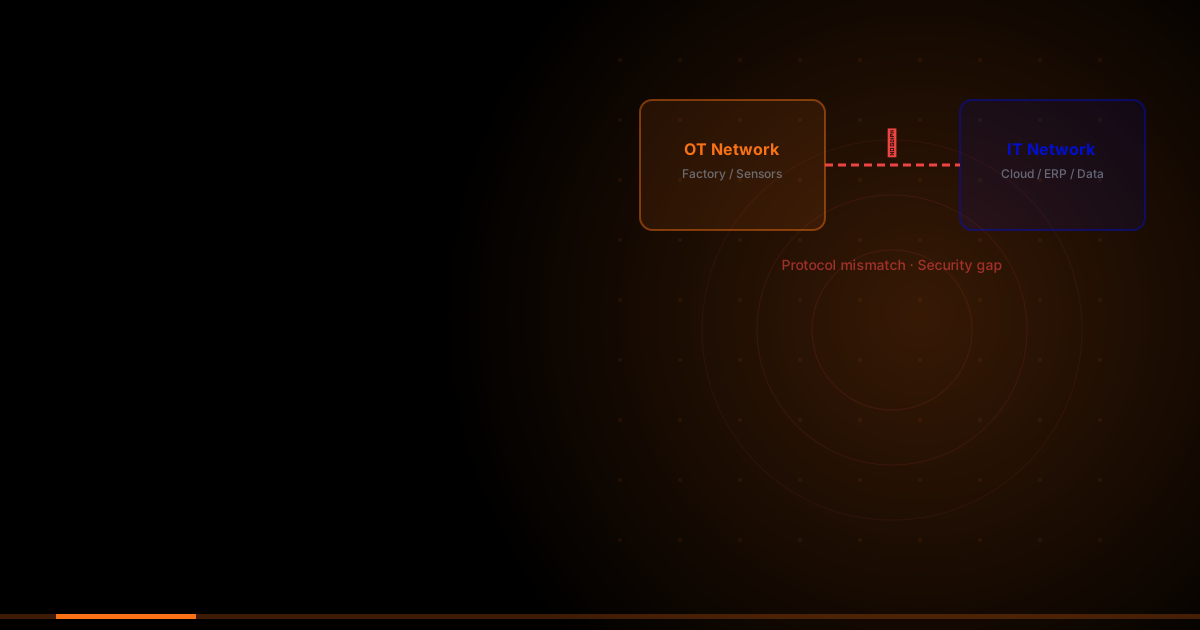
The failure point is rarely the AI model or the cloud platform. It is the layer beneath them: the connection between operational technology (OT), the PLCs, SCADA systems, industrial sensors, and machine controllers on the factory floor, and information technology (IT), the enterprise systems, cloud platforms, and data infrastructure that the AI runs on. This is the OT/IT integration problem, and it is the graveyard of Industry 4.0 initiatives.
The OT/IT Divide — Why It Exists
Operational technology was designed for a different era and a different set of priorities. Factory floor systems were designed for reliability, safety, and deterministic performance. A PLC controlling a hydraulic press must respond in milliseconds, every time, without fail. The design philosophy is conservative, proven protocols, proprietary hardware, long upgrade cycles, and physical isolation from external networks as a safety and security measure.
IT systems were designed for connectivity, interoperability, and rapid change. Enterprise software runs on standard hardware, uses internet protocols, and is designed to be updated, integrated, and replaced. The fundamental design philosophies are different and in many factories, the two worlds have operated entirely separately for decades, connected only by manual data entry and periodic reporting.
The organisational divide mirrors the technical one. OT is typically owned by plant operations or engineering. IT is owned by corporate IT. They have different budgets, different vendors, different risk tolerances, and different vocabularies. A smart factory initiative that does not specifically address the organisational divide will fail regardless of the technology architecture.
The Technical Barriers to OT/IT Integration
Protocol Heterogeneity
A typical manufacturing environment runs dozens of OT protocols: Modbus, Profinet, EtherNet/IP, OPC-UA, MQTT, CAN bus, and proprietary machine vendor protocols. Each machine vendor has its own communication standard. A CNC machine from one vendor communicates differently from a robot from another vendor on the same production line. Translating these protocols into a unified data stream that IT systems can consume requires an industrial IoT gateway layer with extensive protocol support and this layer is almost always underestimated in scope and complexity.
Legacy Systems With No Digital Interface
Many production assets, particularly in automotive, aerospace, and heavy industry, are 20-30 years old with no native digital communication capability. They have no API, no network port, and no integration pathway other than physical sensor retrofitting or manual data collection. Retrofitting sensors to legacy equipment is not insurmountable, but it requires physical installation, calibration, and validation and in regulated industries (aerospace, food safety), it requires documentation and sign-off that adds months to the integration timeline.
Real-Time Latency Requirements vs Cloud Architecture
Predictive maintenance and quality control applications require near-real-time data access, typically millisecond to sub-second latency for closed-loop control applications. Cloud-based analytics platforms operate on latency of seconds to minutes. This mismatch requires an edge computing layer that processes time-critical analysis locally before sending aggregated data to the cloud, an architectural pattern that is more complex to build and operate than a direct sensor-to-cloud integration.
OT Network Security Architecture
Traditional OT security architecture relies on physical network isolation, air-gapping factory floor systems from any external network connection. Connecting OT systems to cloud platforms fundamentally changes this security model. Industry 4.0 initiatives that connect OT systems to cloud without appropriate network segmentation, unidirectional security gateways, and OT-specific security monitoring create significant attack surface, as demonstrated by the Colonial Pipeline, Oldsmar water treatment plant, and Norsk Hydro incidents.
The Data Quality Problem That Emerges After Integration
Assuming OT/IT integration is achieved, data flowing from factory floor to cloud, the next failure mode is data quality. OT sensor data is messy in ways that enterprise data is not: sensors drift, calibration degrades, equipment wear changes the relationship between sensor readings and actual process state, and context (which product is running on which line on which shift with what raw material batch) is often not captured in the sensor stream.
Most enterprise AI spend underperforms. Benchmark yours.
A predictive maintenance model trained on clean historical data that was manually reviewed will fail in production when deployed against raw sensor streams that include all the noise, drift, and context gaps that the training data was cleaned of. Data quality for OT requires different standards and different tooling from enterprise data quality management.
A Systematic Approach to OT/IT Integration
Successful OT/IT integration programmes share a common approach:
- 1Start with a single production line, prove the integration architecture end-to-end, including protocol translation, edge processing, cloud ingestion, and data quality, before attempting factory-wide deployment
- 2Deploy an industrial IoT gateway. Kepware, Ignition, or AWS IoT Greengrass provide the protocol translation layer that abstracts OT diversity from IT systems
- 3Build edge computing for latency-sensitive analytics, process time-critical analysis at the edge; send aggregated, contextualised data to cloud for historical analysis and model training
- 4Implement OT-specific network segmentation. Purdue Model or IEC 62443-based segmentation that separates OT from IT while providing controlled, audited data flow pathways
- 5Define the data quality standard before the AI programme, establish what data quality level the AI models require, build the cleaning and validation pipeline to achieve it, and do not begin model training until the data pipeline is stable
Most Industry 4.0 business cases assume the data exists and is accessible. The real project is almost always building the data pipeline first and that project takes longer and costs more than the AI development that follows it.
Validated Outcomes
Siemens' MindSphere industrial IoT programme, deployed across their own manufacturing facilities before being commercialised, documented a 10% reduction in unplanned downtime in facilities where predictive maintenance models reached production. The internal case study is notable for what it revealed about the pre-deployment work: more than 60% of the total programme timeline was spent on OT/IT integration, protocol normalisation, and data quality remediation. The AI model development itself was the smaller workload. This ratio has been independently replicated in published Industry 4.0 research and aligns exactly with what manufacturers encounter in practice.
GYSP's OT/IT integration assessments consistently find the same pattern: clients with modern PLC and SCADA infrastructure but no historian layer or unified namespace are typically 12–18 months from AI readiness when they start. Clients who invest in the data infrastructure first, historian deployment, protocol normalisation, data quality pipelines, typically achieve their first validated predictive maintenance model within 6 months of completing the integration layer.
GYSP's Manufacturing and Industry 4.0 Practice
GYSP's Data Engineering and AI/ML Development teams have delivered OT/IT integration programmes that unlock the operational data foundation for predictive maintenance, digital twin, and quality optimisation initiatives in manufacturing environments.
We start with an OT/IT readiness assessment, mapping your current production assets, communication protocols, network architecture, and data quality state against the requirements of your target Industry 4.0 use cases. The output is a realistic integration roadmap with a phased delivery plan that builds the data foundation before the AI is trained on it.
“Industry 4.0 is not an AI problem. It is a data plumbing problem. Every client who has delivered measurable outcomes from industrial AI had one thing in common: they invested in the data infrastructure before they invested in the models.”
— Dhaval Rana, Founder & CEO — GYSP.tech