What you'll take away
The fractional CTO model emerged from a real problem: early-stage companies need technical leadership before they can afford a full-time technical executive. A fractional arrangement, a senior technology leader working two or three days a week across multiple engagements, seems to solve the problem economically. You get CTO-level thinking at a fraction of the cost. The CFO is happy. The investors are satisfied.
And then the cracks appear. The engineering team is making architectural decisions without consistent oversight. The vendor contract with significant technical implications gets signed before the fractional CTO reviewed it. The product roadmap and the technical roadmap are misaligned because the person who should be aligning them is only present two days a week and spends one of those days catching up on what happened in their absence.
The fractional CTO model is not inherently flawed. Used correctly, in the right company context, it provides genuine value. The problem is that it is frequently used in the wrong context, at companies where the technology risk exposure has outgrown part-time oversight, and the limitations are not recognised until damage has been done.
When Fractional CTO Works
Fractional CTO engagements deliver genuine value in specific company contexts: pre-seed to seed-stage companies that need a technical co-founder equivalent for investor credibility and early architecture decisions but do not yet have a development team that requires daily management; companies that are primarily non-technical businesses acquiring or deploying technology (a professional services firm digitising its operations, a retailer building an e-commerce platform) where technology leadership is important but not the core value-creation activity; and companies that have a strong VP of Engineering managing execution and need strategic CTO-level guidance for board interaction, technology strategy, and senior vendor management.
In each of these cases, the fractional CTO provides a specific, bounded capability that does not require full-time attention. The engagement is well-defined, the deliverables are clear, and the limitation of part-time availability is matched to the actual requirement.
The 5 Signs Your Company Has Outgrown Fractional
1. Your Engineering Team Is Making Architecture Decisions Without Oversight
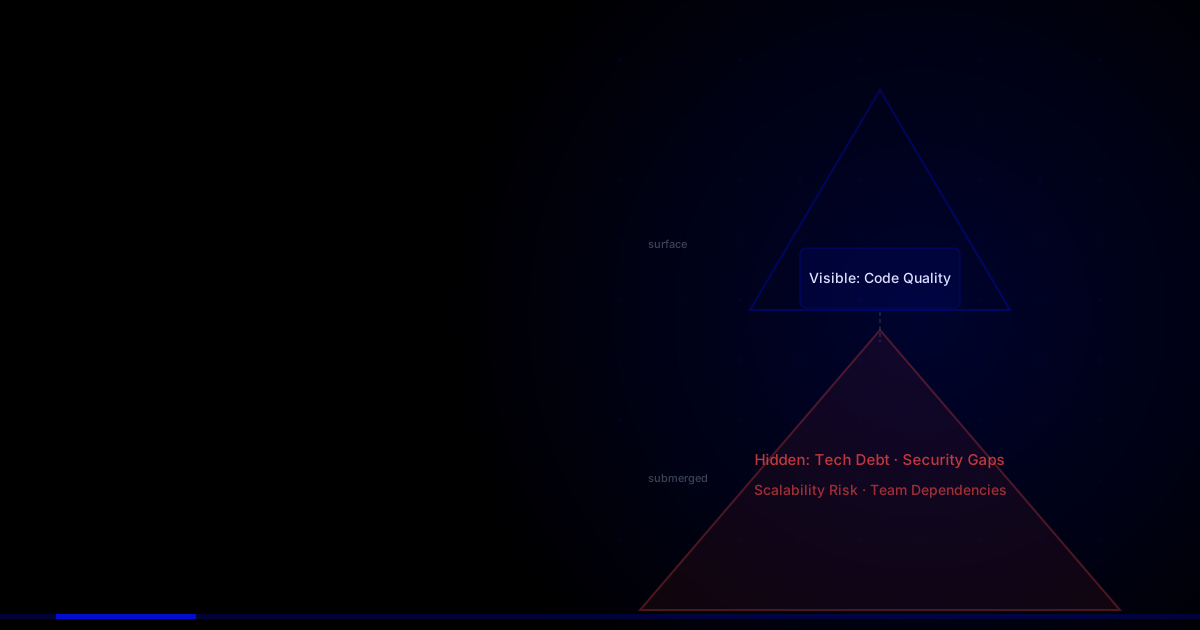
If engineers are choosing frameworks, designing data models, and selecting infrastructure without a technical authority reviewing the decisions, and your fractional CTO is not available to be consulted in real time, you have a governance gap. Architecture decisions made in the absence of senior oversight are almost never wrong immediately. They become wrong gradually, as the consequences of shortcuts and under-designed abstractions compound over eighteen months.
2. Your Technology Risk Profile Requires Real-Time Response Capability
If your business has regulatory technology obligations (HIPAA, PCI-DSS, FCA), customer data security requirements, or SLA commitments that require rapid escalation and decision-making when incidents occur, a fractional leader who is available two days a week and unreachable the other three is a governance risk. Technology incidents do not wait for scheduled days.
3. Your Technology Vendor and Contract Landscape Is Complex
When a fractional CTO manages relationships with cloud providers, SaaS vendors, development partners, and infrastructure suppliers across multiple clients simultaneously, the risk of reduced negotiating leverage, missed contract renewals, and vendor decisions made without full context increases materially. Your technology vendor relationships deserve undivided attention during negotiation and renewal cycles.
4. Your Engineering Team Is Growing Beyond 10 People
At ten or more engineers, the people management, hiring decisions, culture setting, and team structure questions that fall to the CTO require consistent, daily presence. A fractional leader who is not present for daily standups, not available for impromptu conversations, and not building continuous relationships with each engineer is not well-positioned to address the organisational challenges that emerge at this scale.
5. Your Product and Technology Roadmaps Are Diverging
The most consistently damaging consequence of fractional CTO arrangements at scale is roadmap misalignment. When the person responsible for translating business strategy into technical direction is not consistently present in strategic discussions, the product roadmap and the technology architecture evolve on different assumptions. This misalignment is invisible until it manifests as a major refactoring project, a failed product launch, or a technical debt crisis.
What to Demand If You Go Fractional
If a fractional CTO is the right choice for your stage, structure the engagement to mitigate the inherent limitations:
- Defined availability SLA. Minimum response time for urgent questions, scheduled weekly synchronisation with the engineering team, and explicit commitment to attend critical meetings (board meetings, major vendor negotiations, architecture reviews)
- Technology decision log. A written record of every significant technology decision made, with rationale and alternatives considered. This ensures continuity when the fractional CTO is unavailable and creates institutional memory that survives transitions.
- Succession planning from day one. A fractional arrangement should have a defined transition plan: either to a full-time hire as the company scales, or to a different engagement model. Fractional relationships that continue indefinitely because the transition conversation is uncomfortable become dependencies.
- Conflict of interest disclosure. A fractional CTO with multiple clients may have vendor relationships, equity positions, or client conflicts that are material to your decisions. These must be disclosed upfront and managed throughout the engagement.
Validated Outcomes
The Harvard Business Review published research on interim and fractional executive arrangements in 2023, documenting that technology companies using fractional C-suite executives for longer than 18 months showed measurably lower technical decision velocity than comparable companies that transitioned to structured advisory arrangements. The study attributed the gap to decision ambiguity: fractional leaders who lack full organisational authority take longer to drive alignment, and the time cost of that friction compounds as the organisation grows. The finding aligns with what practitioners observe, fractional works for speed-to-leadership; it does not scale as a permanent model.
GYSP's advisory clients who transitioned from fractional CTO arrangements to structured project-based advisory engagements reported 40–60% faster architecture decision timelines, not because the advice changed, but because the engagement model removed the ambiguity about authority and scope. When the advisory mandate is specific to a defined decision, alignment is faster and accountability is cleaner.
The IT Consulting Alternative
For companies that need strategic technology leadership without the ongoing fractional model, structured IT advisory engagements, project-based technology strategy, architecture review, digital transformation advisory, provide CTO-level thinking applied to specific decisions without the ambiguity of a part-time leadership role.
The best fractional CTOs will tell you themselves when you have outgrown them. If your fractional CTO is not having that conversation, either they have not noticed or they have an incentive not to. Neither is reassuring.
GYSP's IT Consulting & Advisory practice provides structured technology leadership engagements, from architecture advisory to digital transformation strategy, designed around the specific decisions your company faces rather than a time-based retainer model.
“The fractional CTO model solves a real problem for early-stage companies. The mistake is treating it as a permanent solution rather than a bridge to the technology leadership maturity your company actually requires.”
— Dhaval Rana, Founder & CEO — GYSP.tech