What you'll take away
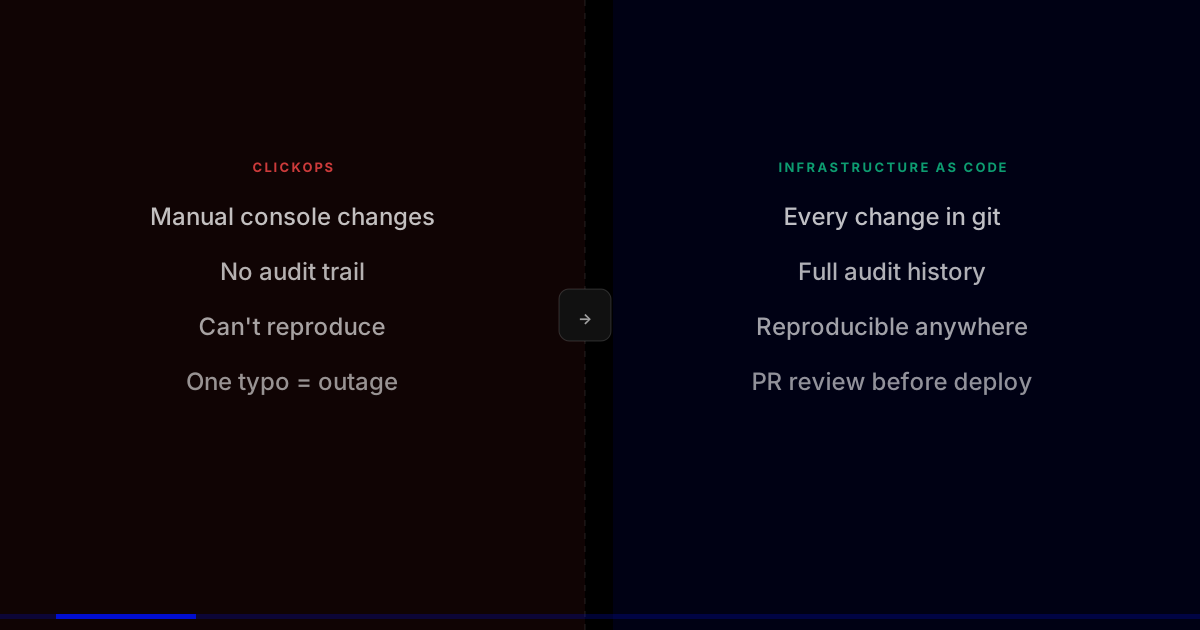
ClickOps is the practice of configuring infrastructure by clicking through cloud provider consoles, creating security groups by hand, configuring VPC settings through the AWS web interface, setting up databases by filling in forms. It's how most teams start with cloud infrastructure, because it's the most immediately accessible path: you can see what you're doing, the UI provides guidance, and you don't need to learn a new tool.
The cost of ClickOps doesn't appear on the first invoice. It accumulates over time, in ways that are diffuse and hard to attribute: the engineer-hours spent recreating an environment that no one documented; the production incident caused by a security group rule that was added manually and never reviewed; the compliance audit finding from infrastructure state that diverged from policy without anyone noticing. By the time the cost is visible, ClickOps has become the default culture and replacing it feels like a large project rather than a small fix.
The Costs ClickOps Imposes
Environment Drift
When infrastructure is configured manually, production, staging, and development environments drift apart over time. The person who updated the security group in production didn't update it in staging because the change was urgent and the documentation step was skipped. The result is environments that behave differently in ways that aren't obvious until a bug that didn't appear in staging surfaces in production and the debugging process requires comparing manual infrastructure configurations that aren't stored anywhere computable.
Knowledge Concentration Risk
Manual infrastructure lives in the heads of the people who configured it and, imperfectly, in the cloud console. When the person who built the original production VPC leaves, their knowledge leaves with them. Rebuilding the environment requires archaeology, examining existing configurations to reverse-engineer the intent behind them, rather than reading the code that defined them. Infrastructure that exists only as console configuration is infrastructure whose documentation is already out of date.
Slow Environment Provisioning
Spinning up a new environment manually, a new staging environment for a product launch, a developer sandbox for a new team member, a temporary environment for a penetration test, requires hours of careful manual configuration work. With Infrastructure as Code, it's a pipeline run. The compounded cost of manual environment provisioning across an engineering organisation is enormous: multiply the hours per provisioning event by the frequency of provisioning events by your engineering cost per hour.
Compliance and Audit Costs
Regulated industries require evidence that infrastructure meets security and compliance requirements. Manual infrastructure provides no automated evidence of compliance state, the compliance team must manually inspect configuration and compare it against policy. Automated compliance drift detection, comparing declared IaC state against actual infrastructure state, provides continuous compliance evidence and dramatically reduces audit preparation cost.
The ClickOps cost that typically closes the business case for IaC: the production incident caused by undocumented, manually configured infrastructure that required ten engineer-hours to diagnose because the configuration change wasn't tracked anywhere. One incident of this type typically costs more than the entire IaC migration would have.
29% of cloud spend is wasted on average. Find yours.
Infrastructure as Code: The Implementation Path
The standard tooling for Infrastructure as Code in cloud environments: Terraform (or OpenTofu, the open-source fork) for cloud resource provisioning; Ansible or cloud-native configuration management for server configuration; Helm or Kustomize for Kubernetes resource management. The combination covers the majority of infrastructure management needs and integrates with standard CI/CD pipelines for automated validation and deployment.
Validated Outcomes
HashiCorp's 2023 State of Infrastructure as Code report surveyed 1,000+ infrastructure engineers and found that organisations using IaC for the majority of their infrastructure provisioning had 50% fewer production incidents caused by configuration drift compared to teams using primarily manual provisioning. The same survey found that IaC teams provisioned new environments 10x faster on average and reported 70% less time spent on compliance audit preparation because infrastructure state was documented in code rather than reconstructed manually. The organisations that had not yet adopted IaC consistently cited 'migration complexity' as the barrier and consistently underestimated the cost of the status quo.
GYSP's IaC migration engagements begin with an infrastructure inventory to identify the highest-risk manually managed resources, those that have not been changed in years and whose configuration is not documented anywhere. These resources are migrated first, because the risk of an undocumented manual configuration being changed incorrectly in an incident is highest for resources nobody remembers configuring. The 6–12 month IaC migration ROI GYSP consistently observes is driven primarily by incident avoidance, not by provisioning speed, the first major incident prevented by an IaC-controlled environment typically recovers the entire engagement cost.
The Migration Strategy: Not Everything at Once
Migrating existing ClickOps infrastructure to IaC doesn't require rewriting everything before you start getting value. The pragmatic approach: start writing IaC for all new infrastructure from day one; import the highest-risk existing resources (VPCs, security groups, IAM policies) into Terraform state progressively; establish a policy that no manual console changes are permitted to resources managed by IaC, with changes to those resources requiring a Terraform plan and apply.
GYSP's Cloud & DevOps Engineering practice has conducted IaC migration projects for organisations ranging from startup scale to enterprise. The pattern is consistent: the migration investment is recovered within six to twelve months through reduced incident costs, faster environment provisioning, and the elimination of compliance audit manual effort.
“ClickOps feels free because the cost is invisible and deferred. IaC feels expensive because the cost is upfront and visible. The economics run the opposite way. ClickOps costs more, it just charges you later.”
— Akshay, Head of Delivery — GYSP.tech