
What you'll take away
In every organisation where an AI initiative has stalled, the conversation eventually arrives at the same diagnosis: the model is not the problem. The data is. The data that was good enough for reporting, dashboards, quarterly reviews, operational metrics, is not good enough for AI. And the gap between what you have and what you need is larger than most AI roadmaps account for.
Your data team knows this. They have known it for some time. They see the schema inconsistencies, the undocumented transformations, the columns that mean different things in different source systems, the historical data with quality gaps that make trend analysis unreliable. They have been managing these problems for the reporting use case, where a human analyst can contextualise noise and make judgment calls about anomalous data.
AI cannot contextualise noise. A machine learning model trained on data with systematic quality problems learns those problems as signal. A recommendation model trained on customer purchase data with 15% missing product category fields will consistently under-recommend in the categories where data is thin and nobody will know why until a data scientist traces the model's behaviour back to the training data gap.
The 5 Data Infrastructure Gaps That Block AI
1. No Unified Data Model
Most data warehouses that grew organically to serve reporting requirements are structured around individual source systems rather than business entities. The customer exists in three different tables with three different primary keys. The product exists in two schemas with slightly different field names and slightly different category taxonomies. The transaction is in one system for e-commerce and a different system for in-store, with no consistent identifier that links them.
For a reporting analyst, this is a manageable problem, they learn which version of the customer table to use for which report. For an AI model, it is a training data disaster. A customer lifetime value model that inconsistently identifies the same customer across channels will learn the wrong relationships between customer behaviour and value. The unified data model, a consistent, entity-resolved representation of the business's key objects, is the foundation that AI requires and reporting can limp along without.
2. Missing Data Lineage
Data lineage is the ability to trace every data point back to its source: what system created this field, what transformation applied to it, what business rule governs it, and when it was last verified. Reporting tolerates missing lineage because the analyst knows the data well enough to make judgments when something looks off. AI cannot make those judgments, and AI-generated outputs cannot be trusted if the lineage of the training data is unknown.
Regulatory pressure is accelerating the data lineage requirement. GDPR's right to explanation for automated decisions, emerging AI Act obligations, and financial services model governance requirements all demand that AI systems be able to explain what data influenced a decision. Without data lineage, that explanation is impossible and the AI system cannot be safely deployed in a regulated context.
3. Inadequate Data Quality at the Consistency Level
Data quality for reporting and data quality for AI require different standards. Reporting tolerates inconsistent naming conventions, occasional null values in non-critical fields, and historical data gaps that are documented and known. AI requires consistent schemas, defined null handling strategies, validated value ranges, and referential integrity that holds across the entire historical dataset, not just the current snapshot.
The data quality investment required to reach AI readiness is typically 3-6 months of dedicated data engineering work in organisations that have not run a systematic data quality programme. This is not a small project. It is the most common reason AI timelines slip: the business case was built on the assumption that the data was ready, and the data engineering work required to make it ready was not in scope.
4. No Feature Store
A feature store is the infrastructure layer that computes, stores, and serves the features (transformed data inputs) that machine learning models require. Without a feature store, every model that is built requires the data engineering team to build custom feature pipelines from scratch, which is expensive, slow, and produces feature implementations that are inconsistent across models.
More importantly, a feature store enables training-serving consistency: the features used to train the model are identical to the features served at inference time. Without this consistency, model performance in production degrades from model performance in training in ways that are extremely difficult to diagnose. Training-serving skew is one of the most common causes of production AI underperformance, and a feature store is the architectural solution.
5. No Data Catalogue or Semantic Layer
AI systems, including LLM-powered data analysis tools that allow business users to query data in natural language, require a semantic layer: a consistent, documented vocabulary that maps business concepts to data model entities. Without a semantic layer, an AI that answers the question 'what was our revenue last quarter?' has to guess which revenue field in which table with which date filter correctly answers the question. A wrong guess produces a confidently stated incorrect answer.
42% of AI projects fail at the data layer. Where do you stand?
The data catalogue and semantic layer are also the foundation for AI governance: understanding what data the AI has access to, what business rules apply to that data, and what the appropriate use constraints are. Without this layer, AI data access cannot be governed, which is a compliance risk in regulated industries and a data quality risk in all industries.
Building AI-Ready Data Infrastructure
The Modern Data Stack provides the components that AI-ready data infrastructure requires: dbt for transformation and data modelling (with built-in lineage and testing), Snowflake, Databricks, or BigQuery for scalable compute, Great Expectations or Monte Carlo for data quality monitoring, Feast or Tecton for feature store, and DataHub or Alation for data catalogue.
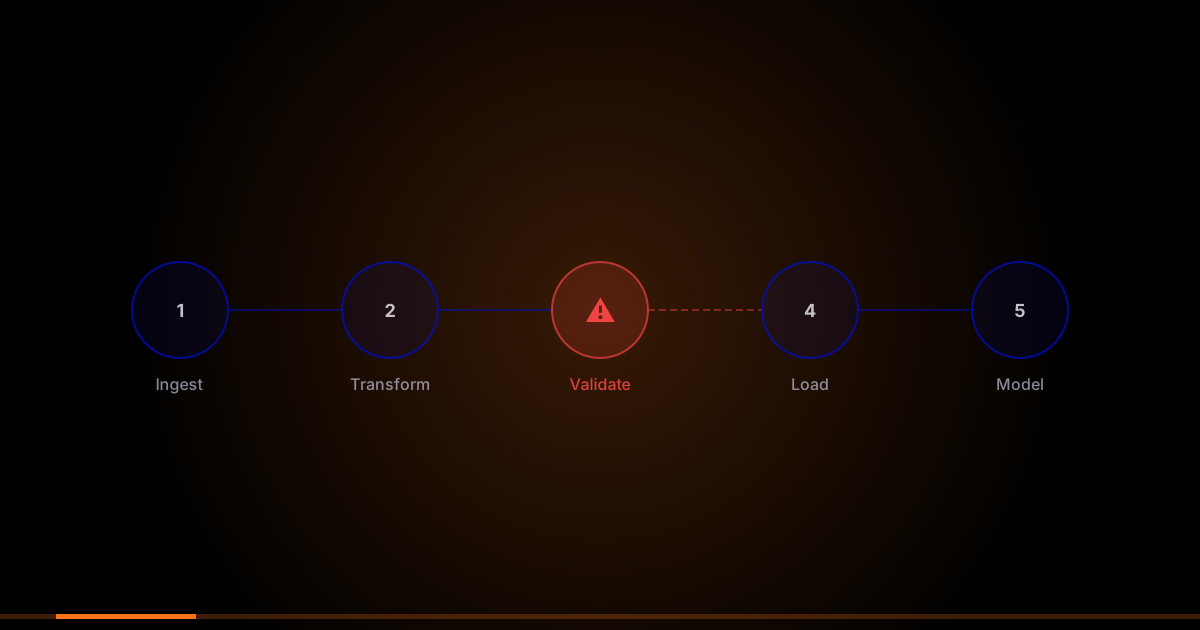
The sequence matters. Data model unification and lineage come first, they are the foundation that data quality, feature engineering, and the semantic layer build on. The right sequence: unified entity model → lineage documentation → data quality programme → feature store → semantic layer. Each step builds on the previous one, and each step unlocks a class of AI use cases that was not previously viable.
The honest answer to 'when can we start training the AI model?' is 'when your data is ready.' For most organisations, that answer is 3-6 months after the data infrastructure programme starts, not the day the data science team onboards.
Validated Outcomes
Airbnb's experience building an AI-ready data platform is one of the most detailed public case studies in the Modern Data Stack. The company documented that before building Minerva, their unified metrics layer, data scientists spent 30–40% of their time resolving conflicting metric definitions across teams rather than building models. After Minerva, that overhead was near-eliminated, and the company reported that model development velocity increased by over 50%. The investment was not in AI tooling, it was in the data infrastructure that made AI tooling actually usable.
GYSP's data readiness assessments consistently surface the same categories of AI-blockers: inconsistent entity resolution (the same customer appearing under multiple IDs across systems), missing feature history for time-series model training, and absence of data quality monitoring that would detect silent data corruption. Clients who address these infrastructure gaps before beginning AI model development avoid the 3–6 month delay that organisations typically experience when they attempt to train models on data infrastructure that was not designed to support it.
GYSP's Data Engineering Practice
GYSP's Data Engineering & Analytics practice builds the data infrastructure foundation that AI initiatives require. We start with a data readiness assessment, evaluating your current data architecture against the requirements of your target AI use cases, and deliver a sequenced infrastructure roadmap that closes the gaps in the order that unlocks AI value fastest.
For clients who are simultaneously building data infrastructure and AI models, we run both workstreams in parallel, the data engineering team building the foundation while the AI team prototypes against a representative subset of clean data. This parallel track approach compresses the overall timeline while managing the risk of AI work that is blocked on data readiness.
“The data infrastructure investment that unlocks AI is the same investment that makes your analytics more trustworthy, your reporting more reliable, and your data team more productive. It is not AI-specific overhead, it is foundational technical debt that you would have had to address eventually anyway.”
— Ankush, Chief Technology Officer — GYSP.tech
Frequently Asked Questions
Why do AI initiatives fail at the data layer?+
AI models are only as good as the data they consume. The most common failure is training-serving skew: the data used to build and evaluate models differs from the data available in production, different schemas, different cleaning logic, different freshness. Models that perform well in development degrade rapidly in production because the data reality they encounter differs from the data reality they were trained on.
What does a modern data stack that supports AI look like?+
An AI-ready data stack requires: a source-of-truth data warehouse (Snowflake, BigQuery, or Databricks) with strong data modelling, a transformation layer with quality checks (dbt with test coverage), a feature store for ML-specific feature serving, a vector store or unified data layer for RAG use cases, and observability across the pipeline. The stack must maintain consistency between the batch training path and the real-time serving path.
What are the 5 data infrastructure gaps that prevent AI from working in production?+
The five gaps are: (1) no unified data model, inconsistent schemas prevent reliable feature extraction; (2) no data quality gates, dirty data enters models without detection; (3) no feature store, features computed in training cannot be reproduced consistently in serving; (4) no real-time data path, batch-only pipelines create training-serving skew; (5) no data observability, pipeline failures go undetected until model outputs degrade.
How long does it take to make a data warehouse AI-ready?+
For a mid-sized organisation with an existing data warehouse, making it AI-ready typically takes 3–6 months: 4–6 weeks for data audit and gap identification, 6–8 weeks for data modelling and quality gate implementation, 4–6 weeks for feature store setup, and 4–8 weeks for observability and real-time path work. Organisations starting from a raw data lake should allow 9–12 months.