What you'll take away
The IT helpdesk is handling 340 tickets this month. Average resolution time is 4.2 hours. First-contact resolution rate is 72%. The SLA dashboard is green. The quarterly business review presents these metrics to the leadership team, and IT is congratulated on its performance.
Two weeks later, the company's CRM goes down for six hours during a sales event. The post-mortem reveals the outage was caused by configuration drift that had been building for three months, the kind of drift that proactive monitoring would have detected and remediated before it caused a failure. There was no proactive monitoring in place. The team was too busy processing the ticket queue.
The ticket queue is not a sign that IT is working. It is often a sign that IT is failing, that the environment it manages is generating more incidents than it is preventing. Measuring IT success by ticket throughput is like measuring a hospital by how quickly it discharges patients without asking how many of those patients came back.
The Cost of Unplanned Downtime
IDC research puts the average cost of critical application downtime at £4,000–£9,000 per minute for mid-market enterprises, accounting for lost revenue, employee productivity loss, and recovery costs. A six-hour CRM outage during a peak sales period is a £1.4–3.2M event. A week of degraded ERP performance during month-end close is harder to quantify but equally damaging to financial reporting accuracy and the productivity of the finance team managing it.
The reactive IT model is optimised for cost-efficiency in a narrow sense: minimise the cost of incident response. It is not optimised for the outcome the business actually cares about: minimise the business impact of technology failures. These are different objectives with different architectures and different economics.
Why Reactive IT Is a Growth Tax
The reactive IT model creates a consistent drag on company growth through mechanisms that are difficult to directly attribute to IT but are consistently present in organisations with reactive support models.
The Security Backlog
Reactive IT teams spend their capacity responding to user requests and fixing failures. Security patching, vulnerability remediation, and configuration hardening are backlog items that get scheduled and rescheduled as reactive work crowds them out. In 2024, the average enterprise had 1,800 days of unpatched vulnerability exposure, the gap between a critical vulnerability's public disclosure and the organisation's deployment of the patch (Tenable, 2024 State of Vulnerability Management). Reactive IT teams are a primary driver of this exposure.
The Productivity Tax on Every Employee
Every time an employee waits for IT support, a slow laptop, a broken integration, a password reset that takes 24 hours, that employee is paying a productivity tax. In organisations with reactive IT, this tax is pervasive: small delays, everyday friction, workarounds that employees build themselves because they have learned that waiting for IT is slower than working around it. Forrester research found that poor IT support correlates with a 12% productivity gap versus organisations with proactive IT models.
The Project Delay Multiplier
Technology projects, a new ERP, a data migration, a cloud deployment, are delayed when the IT team is too absorbed in reactive work to provide implementation support. The project arrives on the critical path, IT is not available, the timeline slips, and the business waits. In reactive IT models, this pattern repeats across every major technology initiative, creating a structural delay in the organisation's ability to execute on technology-dependent strategy.
Gartner's 2024 IT Operations research found that organisations with proactive monitoring and SRE practices experience 70% fewer unplanned outages and 45% lower mean time to recovery (MTTR) compared to organisations with reactive IT support models.
The Five Signs Your IT Model Is Becoming a Liability
- Ticket volume is growing faster than the business: if incident and support tickets are increasing faster than headcount or system complexity, your IT environment is getting less stable, not more.
- The same incidents recur month after month: if the same failures appear repeatedly in the ticket data, they are process failures, the root cause is not being addressed because reactive IT is designed to resolve incidents, not eliminate them.
- Security patches are routinely delayed: if critical security patches are not applied within two weeks of release because the team is too busy with reactive work, the security risk exposure is measurable and growing.
- Business units have built their own shadow IT: when business units are procuring and managing their own tools because IT cannot move fast enough, reactive IT has lost the confidence of its stakeholders.
- IT staff turnover is above 20% annually: IT teams in high-ticket, reactive environments experience burnout. High turnover creates knowledge loss, which creates more incidents, a compounding cycle.
What SRE-Driven Managed IT Looks Like
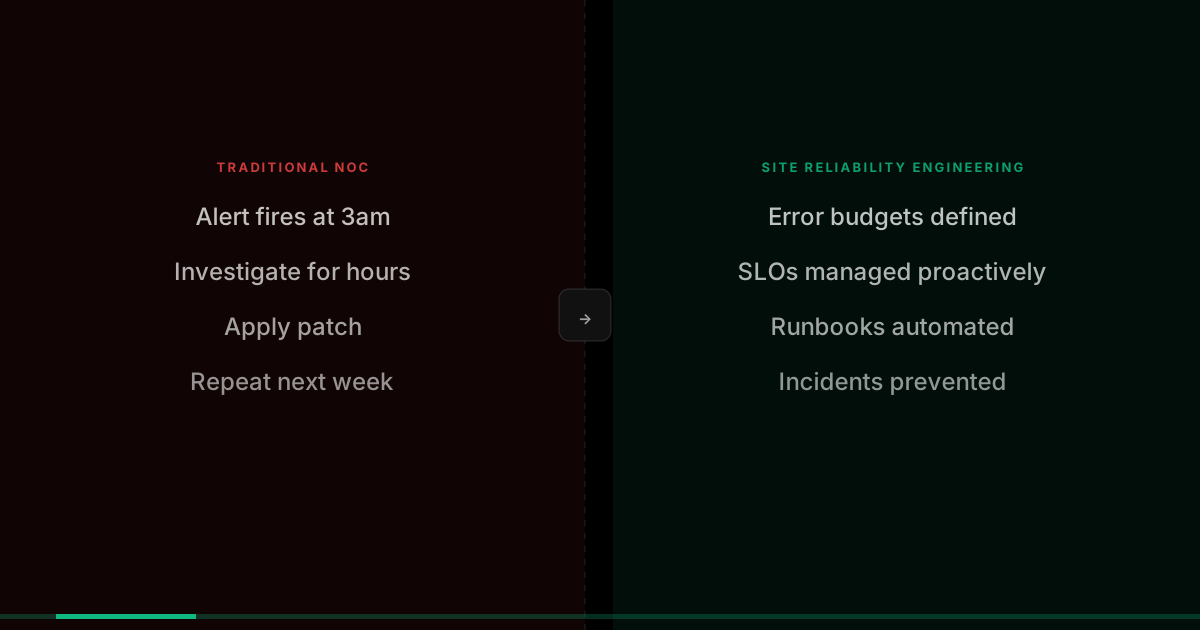
Site Reliability Engineering was developed at Google to apply software engineering principles to IT operations. Applied to managed IT, the SRE model shifts the primary objective from 'resolve incidents' to 'prevent incidents' and measures IT performance by reliability outcomes rather than ticket throughput.
33% of dev time goes to tech debt. Measure your exposure.
Service Level Objectives (SLOs)
SRE-driven managed IT begins by defining explicit service level objectives for the systems it manages: what does 'available' mean for each critical system, how fast does the team need to detect a failure, and what is the target time to restore service? SLOs transform IT from a reactive queue into a managed service with defined, measurable commitments to the business, commitments the business can plan around.
Error Budgets
Error budgets are derived from SLOs: if a system has a 99.9% availability SLO, the error budget is 0.1%, the acceptable amount of downtime. When the error budget is healthy, the team focuses on proactive improvement: monitoring, patching, capacity planning, infrastructure hardening. When the error budget is being consumed by incidents, the team deprioritises all other work to identify and address root causes. Error budgets create a governance mechanism that makes reliability a first-class outcome rather than a background intention.
Proactive Monitoring and Auto-Remediation
Modern SRE practice layers proactive monitoring on every managed system: synthetic monitoring that continuously validates critical workflows, anomaly detection that identifies degradation before it becomes an outage, and auto-remediation playbooks that resolve common failure modes without human intervention. A well-configured monitoring stack catches 60–80% of critical failures before they impact users, versus the reactive model where 100% of failures are discovered by users and reported through the ticket queue.
Validated Outcomes
IDC's research on the financial impact of unplanned downtime found that enterprise businesses lose an average of $250,000 per hour of critical system downtime, with the figure rising to over $1 million per hour for e-commerce and financial services operations. The same research documented that companies with reactive IT support models had 3–4x more unplanned downtime incidents annually than companies with proactive SRE-model IT operations, not because their infrastructure was technically inferior, but because reactive models lack the monitoring and auto-remediation infrastructure to catch degradation before it becomes an outage.
GYSP's managed IT transitions begin with an incident pattern analysis: reviewing 12 months of client incident history to identify the top-10 recurring incidents by frequency and business impact. In every engagement, the same finding: the top-3 incident categories account for 50–60% of total downtime and have clear, addressable root causes that automated remediation can resolve without human intervention. Deploying auto-remediation for these specific categories typically reduces total incident volume by 40–60% within the first 90 days of the engagement.
The Economics of the Transition
The shift from reactive to SRE-driven managed IT is not primarily a cost-reduction exercise, though reduced incident volume does lower cost. It is a risk and productivity investment. An organisation that reduces its unplanned downtime events from twelve per year to four avoids three to eight events with a combined business impact of £1M–5M. An organisation whose employees lose 30 minutes per week less to IT friction recovers that time across every knowledge worker in the company.
The investment required to make the transition, additional monitoring tooling, SRE process design, and the initial remediation sprint to address the root causes driving the highest-volume incident categories, is typically recovered within the first twelve months through avoided downtime cost and reduced reactive labour.
GYSP's Managed IT & SRE practice takes over the operational management of client environments with an SRE-first model: SLO definition, proactive monitoring, auto-remediation, and a commitment to reliability outcomes rather than ticket counts. The first thing we audit is always the incident log, because the pattern of past failures is the best predictor of future ones.
“The most expensive IT team is the one that is always responding. The most valuable IT team is the one that has made most response scenarios unnecessary.”
— Akshay, Head of Delivery — GYSP.tech