What you'll take away
Every company running digital infrastructure above a certain criticality threshold has a monitoring problem. They know something is wrong when the alert fires, but by the time the alert fires, customers are already affected, and the team is in reactive mode, investigating, escalating, scrambling to restore service, and promising a post-mortem that may or may not result in any actual change.
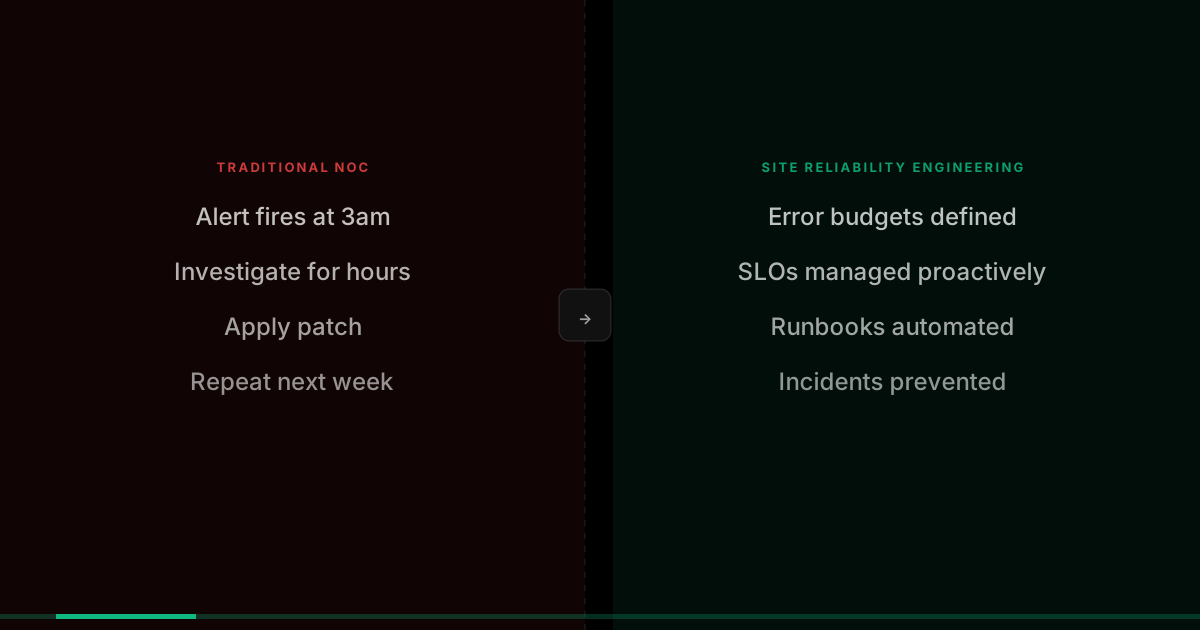
The traditional answer to this problem is a Network Operations Centre (NOC): a team of operations engineers who watch dashboards, acknowledge alerts, follow runbooks, and escalate when incidents exceed their authority to resolve. The NOC is a reactive capability by design. It is optimised for detection and response, not prevention and reliability.
Site Reliability Engineering (SRE) is a different answer to the same problem. SRE, as defined by Google's foundational practices, treats reliability as a software engineering problem rather than an operations problem. The goal is not to respond faster when systems fail, it is to build systems that fail less, recover automatically when they do fail, and generate the observability data needed to prevent the next failure before it affects customers.
The NOC Model — What It Gets Right and What It Gets Wrong
The NOC model gets several things right. It provides 24/7 coverage. It establishes clear escalation paths. It keeps a log of incidents. For infrastructure that is relatively stable, well-documented, and low-change, a NOC provides cost-effective monitoring coverage that would be expensive to replicate with on-call engineering staff alone.
Where the NOC model breaks down is in dynamic, rapidly-changing cloud-native environments. A NOC running against static runbooks cannot keep pace with infrastructure that is changing multiple times per day through continuous deployment. A NOC responding to alerts cannot prevent the cascading failures that occur when microservices architectures experience partial failure modes. And a NOC optimised for uptime metrics, is the service up or down, provides no signal for the degraded performance and increased error rates that affect user experience long before a service goes fully down.
What SRE Actually Is
Google's SRE book opens with a definition that has become canonical: SRE is what happens when software engineers are asked to do what used to be called operations. The key word is engineers, not operators, not technicians, but engineers who write code to solve operational problems.
The practical manifestation of SRE philosophy is a set of disciplines that distinguish it from traditional operations:
- Service Level Objectives (SLOs). Explicit, quantified reliability targets that define what good looks like for each service from the user's perspective. Not 'the service is up' but '99.9% of API requests complete in under 200ms.' SLOs replace uptime as the primary reliability metric.
- Error Budgets. The inverse of the SLO: the allowable error rate over a defined period. An error budget approach gives engineering teams a data-driven framework for balancing reliability investment against feature velocity. When the error budget is healthy, teams can move fast. When it is depleted, reliability work takes precedence over feature development.
- Toil Elimination. SRE teams are expected to automate away their own repetitive operational work. If an alert requires a human to perform the same manual action every time, the SRE goal is to automate that action so the alert becomes unnecessary. Toil that is not being eliminated is a team operating below its capability.
- Blameless Post-Mortems. When incidents occur, the analysis focuses on system design, process gaps, and knowledge failures rather than individual error. The question is not who made the mistake but what system conditions allowed the mistake to have the impact it did.
The AIOps Layer — Intelligent Operations at Scale
Modern SRE practice increasingly incorporates AIOps, the application of AI and machine learning to operations data, to extend what human SRE teams can monitor and respond to at scale. In complex microservices environments generating millions of metrics, logs, and traces per second, no human team can identify anomalies, correlate signals, and predict failures manually.
AIOps tools (Dynatrace, New Relic AI, Datadog AI, or custom models on top of OpenTelemetry data) provide anomaly detection that learns normal behaviour and surfaces deviations before they become incidents, correlation engines that link infrastructure signals to application symptoms and identify probable root cause, and predictive capacity management that forecasts resource exhaustion before it causes degradation.
AIOps is not a replacement for SRE practice, it is an amplifier. AIOps tools surface the signal; SRE engineers design the system response. The combination reduces mean time to detect (MTTD) and mean time to recover (MTTR) measurably, DORA research shows organisations with strong AIOps integration achieve 50% lower MTTR than those without.
When to Transition From NOC to SRE
33% of dev time goes to tech debt. Measure your exposure.
A NOC is the right answer when: your infrastructure is primarily on-premise or IaaS, your deployment frequency is weekly or lower, your service architecture is monolithic or semi-monolithic, and your user base tolerates maintenance windows and scheduled downtime. These conditions describe a significant portion of mid-market and traditional enterprise IT environments.
SRE is the right answer when: you deploy multiple times per day, you run microservices or containerised architectures, your user base expects continuous availability with no maintenance windows, or reliability degradation directly affects revenue, through churn, SLA penalties, or lost conversion. These conditions describe most growth-stage technology companies and digital-first enterprises.
The transition from NOC to SRE is not a tool change, it is a cultural change. You are moving from a team that responds to incidents to a team that engineers reliability. That shift requires investment in SRE skills, SLO definition, and error budget processes before it delivers the reliability improvement it promises.
Validated Outcomes
Google's original SRE model, documented in the 2016 SRE Book authored by Google's engineering team, reported that services operating under SRE discipline with defined SLOs and error budgets achieved 99.9–99.99% availability while simultaneously increasing deployment frequency by 200–300% compared to the same services under traditional operations. The counterintuitive finding: reliability improved as deployment frequency increased, because the SRE discipline of error budgets made teams more deliberate about risk, not more conservative about shipping. The NOC model, by contrast, had no mechanism to translate incident data into architectural reliability improvements.
GYSP's SRE transition engagements produce measurable results within the first 90 days. The most consistent early metric is mean time to resolution (MTTR): clients transitioning from NOC to SRE-style automated runbooks typically see MTTR drop by 50–70% within the first quarter, as the first round of automated remediation eliminates the most frequent incident categories entirely. By month six, error budgets are actively influencing deployment decisions, the cultural shift that defines a mature SRE programme.
GYSP's Managed IT and SRE Practice
GYSP's Managed IT & SRE practice provides SRE-grade reliability for clients who are ready to move beyond reactive monitoring. We define SLOs, implement error budget tracking, build automated runbooks, deploy AIOps tooling, and run the on-call programme, either as a fully managed service or as a hybrid engagement where we operate alongside your internal team.
For clients transitioning from traditional managed IT or NOC arrangements, we provide a structured migration pathway: maintaining NOC-level coverage while building the SRE disciplines and automation layer that make it redundant.
“A NOC tells you when your system broke. SRE tells you why it broke, how to prevent the next one, and how to measure whether your reliability is improving. For any organisation where downtime has a direct cost, the second capability is the one that matters.”
— Ankush, Chief Technology Officer — GYSP.tech