What you'll take away
Vector search has become the default architecture for enterprise retrieval-augmented generation. Embed documents, embed queries, find nearest neighbours in high-dimensional space, it's elegant, fast, and works remarkably well for a specific class of retrieval problem. The trouble is that class is narrower than most enterprise use cases actually require.
When a query asks 'summarise the key terms of our MSA with Acme Corporation,' a vector search finds the right document. When a query asks 'which of our European suppliers are exposed to the amended GDPR clause we ratified last quarter, and what notification obligations does each agreement trigger?', vector search starts to strain. Not because the embeddings are bad, but because the answer to that question lives in a web of entities, supplier names, jurisdictional clauses, amendment references, contract dates, spread across dozens of documents connected by named relationships rather than semantic similarity.
Why Vector Search Has a Hard Ceiling
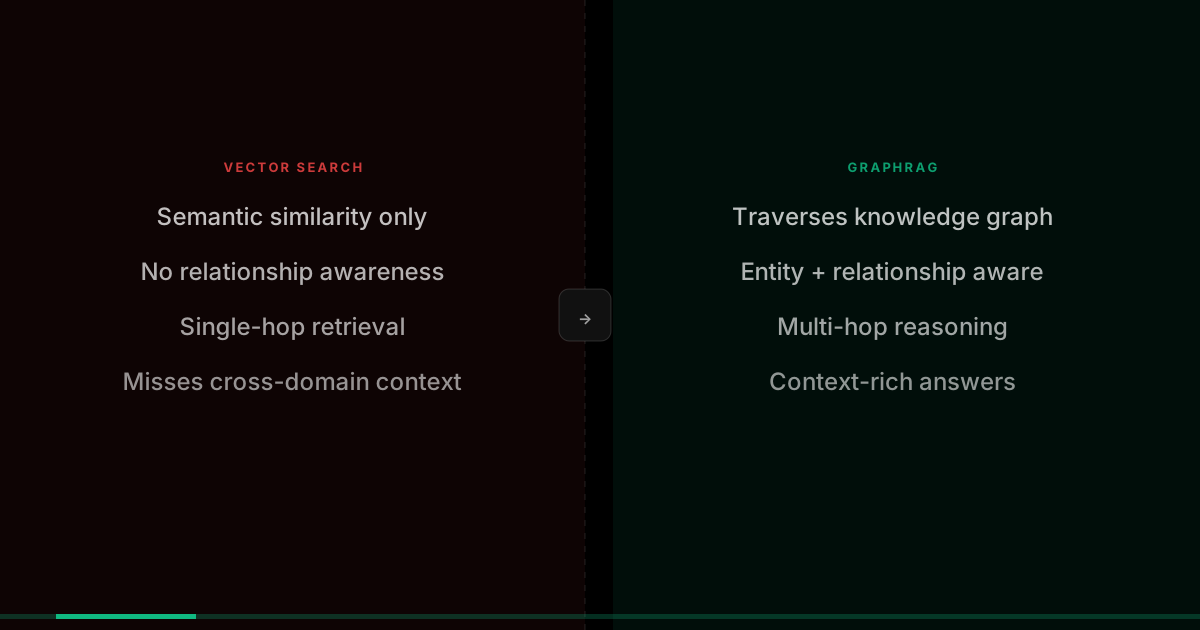
Embedding-based retrieval answers the question: which chunks of text are most semantically similar to this query? That's the right question for a lot of retrieval problems, finding relevant policies, surfacing similar support tickets, identifying matching product descriptions. But it's the wrong question when the task requires multi-hop reasoning: reasoning that requires traversing a chain of connected facts before an answer can be assembled.
Consider a legal intelligence platform that helps contract teams understand cross-document obligations. A query like 'if Supplier X breaches the SLA in Schedule 3, what are the downstream consequences under the force majeure clause in Appendix B?' requires the system to first understand the structure of the contract, identify the named cross-references, retrieve the relevant clauses in the correct order, and then reason across them. A vector search might return the most semantically similar chunks but 'Schedule 3' and 'Appendix B' might have low cosine similarity to the query even though they contain the critical information.
- Multi-hop reasoning across documents connected by named entities
- Queries that ask about relationships between entities, not just entities themselves
- Knowledge bases where the same entity appears under different surface forms
- Compliance questions that require tracing an obligation through a chain of linked documents
- Enterprise knowledge graphs where the structure of the information is as important as the content
What GraphRAG Actually Does Differently
GraphRAG, a retrieval architecture that combines knowledge graph traversal with vector or keyword retrieval, attacks the problem at a different level. Rather than treating documents as independent blobs of text, it first runs an entity extraction pass over the document corpus: identifying named entities (people, companies, products, clauses, dates, locations), extracting relationships between them ('Supplier X is subject to Schedule 3', 'Schedule 3 references Appendix B'), and storing that structured graph alongside the original text.
The Graph Layer
When a query arrives, GraphRAG doesn't just embed it and search for similar vectors. It also parses the query for entity mentions, looks those entities up in the graph, and traverses the entity relationships to identify connected documents and clauses. The graph traversal assembles a structured context, 'these are the nodes and edges relevant to this query', which is then combined with the retrieved text chunks before being passed to the LLM.
The result is that a question about cross-document obligations can surface all the relevant clauses in the right reading order, with the graph-derived structure making it clear how they connect, information that would never surface from a pure embedding search because the connection between the documents is positional and relational, not semantic.
When GraphRAG Is the Right Architecture
GraphRAG adds significant complexity to a retrieval system: entity extraction pipelines, graph construction, graph maintenance as documents change, and a more complex query pipeline. That complexity is only justified when the retrieval problems that fail with vector search are a significant part of the use case.
- Legal and contract intelligence: Cross-document obligation tracing, clause dependency mapping, compliance auditing across large contract portfolios
- Enterprise knowledge management: Answering questions that require navigating organisational hierarchies, product relationships, or process dependencies
- Financial due diligence: Entity relationship queries across filings, ownership structures, and regulatory documents
- Healthcare and life sciences: Drug interaction queries, clinical trial relationship graphs, patient history cross-referencing
- Regulatory compliance: Tracing how a regulation applies across product lines, geographies, and business units
When GraphRAG Is Overkill
For most FAQ-style enterprise applications, internal knowledge bases, HR policy search, product documentation retrieval, vector search is sufficient and far simpler to maintain. The query pattern for these use cases is fundamentally semantic: 'find me content that's about the same topic as this question.' Multi-hop relational reasoning isn't required.
Most enterprise AI spend underperforms. Benchmark yours.
Adding a knowledge graph to a use case that doesn't require multi-hop reasoning is a guaranteed way to triple your implementation complexity without measurably improving answer quality. Start with vector search. Instrument your evaluation. Let the failure modes you observe drive the architectural upgrade.
A Practical Decision Framework
Before committing to GraphRAG, run this diagnostic: build the simplest possible vector RAG prototype and evaluate it against 50 representative queries from your actual users. Categorise the failures. If most failures are 'wrong chunk retrieved' or 'answer not in corpus,' the problem is data quality or chunking strategy, not retrieval architecture. If a significant proportion of failures are 'answer requires connecting information from multiple documents that aren't semantically similar,' that's the GraphRAG signal.
- What percentage of queries require reasoning across multiple connected documents?
- Do your users ask relationship questions ('what is the relationship between X and Y?') or content questions ('what does document X say about Y?')?
- Is the structure of your knowledge domain as important as the content, are named entities and relationships part of the domain model?
- Do you have a team capable of building and maintaining a knowledge graph extraction pipeline?
Validated Outcomes
Microsoft Research published the original GraphRAG paper in 2024, documenting evaluation results on datasets where questions required synthesising information across multiple document relationships. On these multi-hop reasoning tasks, GraphRAG produced answers that were rated more comprehensive and contextually accurate than standard vector RAG by human evaluators at a rate of over 70%. The paper was equally clear about where GraphRAG did not outperform: for single-document factual retrieval and most keyword-answerable queries, the added complexity of the graph produced no improvement. The tool is genuinely better, for the specific class of problems it is designed for.
GYSP's RAG architecture assessments include explicit evaluation of whether a client's use case warrants GraphRAG investment. The evaluation criteria: what proportion of actual user queries require multi-entity reasoning, what is the existing graph extraction infrastructure, and what is the operational overhead tolerance of the team. For fewer than 20% of enterprise RAG use cases does GraphRAG produce enough lift to justify the additional complexity and those use cases are almost always characterised by complex, interconnected knowledge domains such as compliance research, supply chain analysis, or multi-system root cause investigation.
The Hybrid Approach Most Enterprises Actually Need
In practice, most enterprise AI applications benefit from a hybrid architecture: vector search as the primary retrieval mechanism, with a lightweight entity index layered on top to handle the subset of queries that require entity-based navigation. A full knowledge graph is reserved for applications where graph traversal is genuinely central to the use case, not a speculative future requirement.
GYSP's AI & ML Development practice has built production RAG systems for regulated enterprises where the retrieval architecture had to handle exactly these multi-hop compliance queries. The pattern we've seen repeatedly: teams that start with GraphRAG because it sounds more advanced end up with complex pipelines that are hard to debug and maintain; teams that start with vector RAG and upgrade surgically based on measured failures end up with simpler, more reliable systems that still handle the hard queries.
“GraphRAG is not a better version of RAG. It's a different tool for a different problem. Using it when you don't need it is as wrong as not using it when you do.”
— Rahul, AI/ML Delivery Head — GYSP.tech