What you'll take away
The AI system breaks, and the team's first instinct is to examine the model. Prompts are adjusted, retrieval parameters are tuned, model versions are compared. Weeks later, someone notices that the data feeding the system has been silently malformed since the pipeline change three sprints ago and every output since then has been confidently, systematically wrong based on bad input.
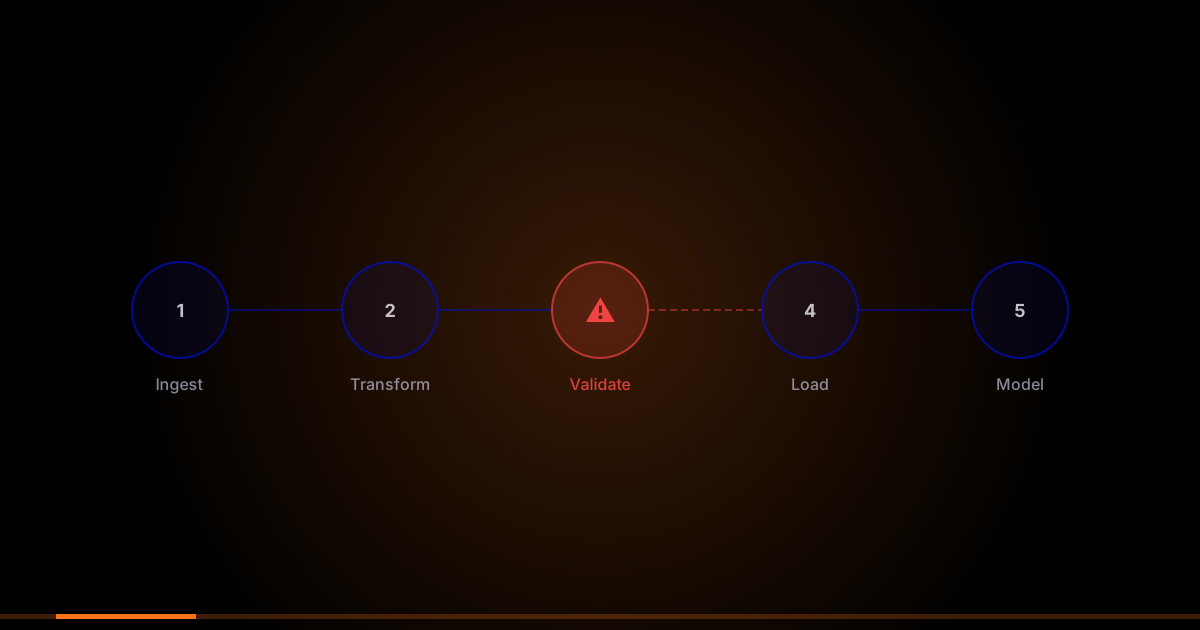
This pattern repeats in enterprise AI deployments with depressing regularity. The model is almost never the root cause of a production AI failure. The root cause is the data pipeline, the collection, validation, transformation, and delivery of data from source systems to the AI layer. Production AI systems require a level of data pipeline discipline that most organisations have never needed before, because earlier software systems failed loudly when given bad data. AI systems fail quietly, they produce output that looks plausible until someone compares it to ground truth.
How Bad Data Becomes Confident Wrong AI Output
Traditional software fails noisily when data is bad: a NULL where an integer was expected throws an exception; an unexpected enum value triggers an error branch; a malformed JSON string crashes the parser. These failures are visible, alarming, and actionable.
AI systems are different. A language model given corrupted or stale context doesn't crash, it generates a response based on what it's been given. A RAG system retrieving stale documents doesn't return an error, it retrieves the stale documents and generates an answer from them. A recommendation model trained on biased historical data doesn't flag the bias, it amplifies it at scale. Bad data produces plausible-seeming output, not obvious failure. By the time the problem surfaces in user experience or business outcomes, the damage is already done.
The Five Data Pipeline Failure Modes That Kill AI in Production
1. Schema Drift
An upstream data source changes its schema, a field is renamed, a new categorical value is added, a timestamp format changes, and the downstream pipeline doesn't catch it. The AI system continues to run, but it's now being fed data with a different structure than it was designed for. In a structured ML pipeline, this produces a model error. In a RAG system, it might just produce subtly degraded retrieval quality that's invisible until you're actively looking for it.
2. Latency Accumulation
Real-time AI systems, recommendation engines, dynamic pricing, fraud detection, depend on data that is sufficiently fresh. When pipeline stages accumulate latency, the data reaching the model is older than the system was designed for. A fraud model that depends on near-real-time transaction data making decisions on data that's 20 minutes stale will miss the fraud patterns it was trained to catch.
3. Volume Anomalies
An upstream source suddenly delivers fewer records than normal, a silent failure in a data collection job, a rate limit being hit, a source system that went offline for maintenance. The pipeline doesn't fail: it just processes fewer records and delivers them to the AI layer. A RAG system that's supposed to have access to today's product catalogue but is missing forty percent of the records will generate inaccurate recommendations without any visible error.
4. Distribution Shift
The statistical properties of the data change over time, seasonality, market conditions, user behaviour evolution, regulatory changes. A model trained on historical data may have been accurate when deployed, but its accuracy degrades as the world it was trained on diverges from the world it's now operating in. Without distribution monitoring, this degradation is invisible until it's severe.
5. Upstream Data Quality Regression
42% of AI projects fail at the data layer. Where do you stand?
A source system changes its data entry validation, or a migration introduces inconsistencies, or a third-party data provider degrades in quality. The pipeline faithfully delivers the worse data to the AI system, which faithfully produces worse outputs.
Every AI system is only as reliable as the data pipeline feeding it. A state-of-the-art model on top of a poorly instrumented pipeline is less reliable than a simpler model on top of well-monitored, high-quality data.
The Data Pipeline Discipline Production AI Requires
- Schema contracts and validation: Every pipeline stage should validate that incoming data conforms to the expected schema. Schema changes in upstream sources should trigger alerts, not silent adaptation
- Data quality gates: Define minimum quality thresholds, completeness, uniqueness, freshness, referential integrity, and halt downstream processing when they're violated
- Volume and freshness monitoring: Track record counts and timestamps at each pipeline stage. Anomalies in volume or freshness should trigger alerts before they impact AI output quality
- Distribution monitoring: For ML models, track the statistical distribution of input features over time. Alert when distributions drift beyond acceptable bounds
- End-to-end data lineage: Be able to trace any AI output back to the source data that produced it. When an AI system produces a bad output, you need to determine whether the fault is in the model, the prompt, or the data
Validated Outcomes
Amazon's recommendation engine, which the company has estimated drives 35% of its total revenue, operates with an extensive data quality and freshness monitoring layer that is as sophisticated as the model itself. Amazon engineering presentations have detailed how silent data pipeline failures (missing click events, delayed inventory updates, corrupted session data) produce recommendation quality degradation that is nearly invisible in standard application monitoring but measurable in A/B tests. The monitoring investment Amazon made in its data pipeline for recommendation quality directly translates to the revenue figure: without it, the model performs reliably only until the data silently stops being reliable.
In GYSP data engineering engagements supporting AI workloads, the most consistent finding is that clients who built their AI pipeline without data quality monitoring experienced at least one significant silent data failure within the first 6 months of production operation. In every case, the failure was detectable in retrospect from metrics that were available but not being monitored. Deploying end-to-end pipeline monitoring with volume, freshness, and distribution checks at build time, rather than retrofitting after a production incident, is consistently among the highest-ROI investments in any AI data programme.
Designing AI Systems to Be Data-Failure-Resistant
Beyond monitoring, production AI architectures should be designed to degrade gracefully when data quality is poor, rather than failing loudly or, worse, continuing to operate with degraded accuracy. A recommendation system that detects it's receiving stale data should fall back to a static best-sellers list rather than continuing to serve recommendations from outdated context. A RAG system with retrieval confidence below a threshold should acknowledge uncertainty rather than generating a confident answer from low-quality retrieval.
GYSP's Data Engineering & Analytics practice designs data pipelines for AI systems with these failure modes as first-class concerns from day one. The cost of retrofitting data quality infrastructure to a live AI system is significantly higher than building it in from the start and the production incidents you avoid are worth multiples of the upfront investment.
“AI failures attributed to the model are frequently actually data pipeline failures that the model made visible. Fix the data infrastructure first. The model often turns out to be fine.”
— Ankush, Chief Technology Officer — GYSP.tech