What you'll take away
The Gartner statistic has been cited so often that it has lost its impact: 70% of enterprise AI projects are deprioritised or cancelled within 18 months. Behind that statistic is a consistent set of failure modes, not bugs in the AI, not limitations of the models, but organisational unreadiness that was never diagnosed before the investment was approved.
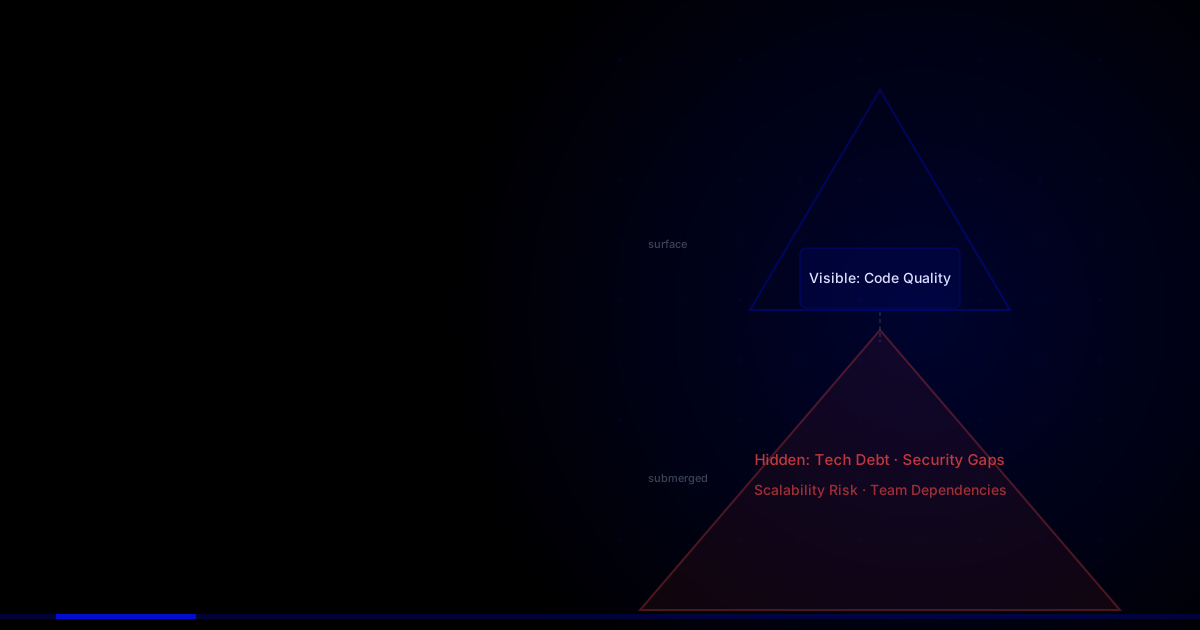
Data that looked clean in the demo turned out to be inconsistent, poorly governed, and inaccessible to the systems that needed it in production. Infrastructure that handled dev-scale inference couldn't support production load. Teams that enthusiastically adopted AI pilots had no process for owning AI-generated outputs or escalating when the AI was wrong. Governance frameworks that would satisfy the audit committee didn't exist.
Every one of these failures is diagnosable before the investment is made. The AI readiness assessment is the diagnostic tool that surfaces them.
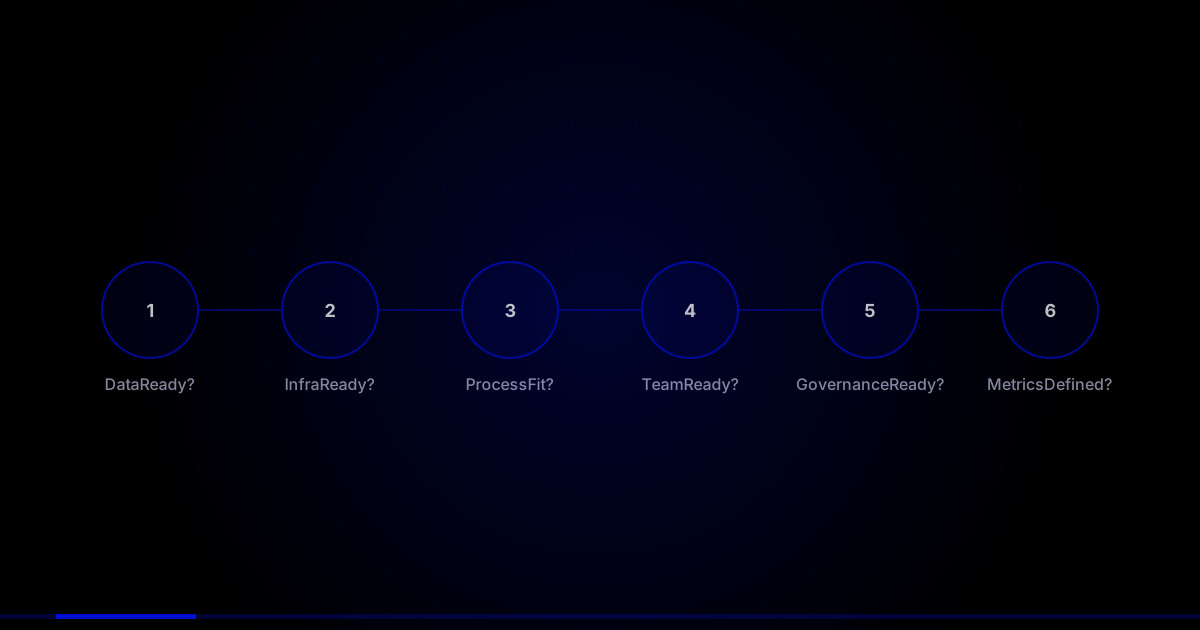
The Six Readiness Questions
Question 1: Is Your Data Ready?
Data readiness is the most commonly underestimated dimension and the most common cause of project failure. A readiness assessment examines four data properties: quality (are the data accurate, consistent, and complete?), accessibility (can the AI system access the data at the latency and volume required?), labelling (for supervised learning use cases, does labelled training data exist or can it be created at reasonable cost?), and lineage (can you trace where every data point came from, which matters for model debugging and regulatory compliance?).
The data readiness assessment should include sampling and profiling of the actual datasets the AI system will consume, not the cleaned examples used in demos. It is common to discover in this process that data the business believed was unified is actually stored in three different systems with different schemas, that fields which appear consistent have categorical inconsistencies that break model assumptions, or that historical data required for training was never retained.
Question 2: Is Your Infrastructure Ready?
Infrastructure readiness covers compute, latency, storage, and integration. GPU compute requirements for fine-tuning or on-premises inference are an order of magnitude different from what most enterprise IT teams have provisioned. API-based inference avoids the compute question but introduces latency and dependency management questions, can your application handle variable inference latency in its user-facing workflows? Does your current data infrastructure support the retrieval patterns that RAG systems require?
Question 3: Are Your Processes Ready?
Not every business process benefits from AI automation, and the processes that benefit most are often not the most obvious ones. Process readiness assessment maps candidate processes against two axes: suitability (does the process involve pattern recognition, classification, generation, or retrieval, the things AI does well?) and change readiness (is the process sufficiently understood, documented, and stable that an AI system can be trained and validated against it?).
Processes that are poorly understood, frequently changing, or highly exception-driven are poor candidates for AI automation, not because AI cannot handle them in principle, but because the validation and governance burden is too high to manage alongside a volatile underlying process.
Question 4: Is Your Team Ready?
Team readiness has two components: AI/ML literacy and ownership clarity. AI/ML literacy does not mean every team member needs to understand transformer architecture, it means the team can formulate AI use cases in terms of measurable outcomes, understand the difference between a model performing well in evaluation and performing well in production, and interpret model outputs critically rather than treating them as authoritative. Ownership clarity means knowing who is accountable for AI-generated outputs when they are wrong, and what the escalation path is.
Question 5: Are Your Governance Frameworks Ready?
The EU AI Act's risk classification (covered separately) makes governance readiness a compliance question, not just a best-practice question. Beyond regulatory compliance, governance readiness covers model versioning and rollback capability, output monitoring for quality degradation, bias assessment processes, incident response for AI failures, and documentation requirements for audit. Organisations without these frameworks in place before deployment will need to build them retrospectively, under time pressure, after a governance gap has already been noticed.
Question 6: Are Your Success Metrics Defined?
The most consistent predictor of AI project failure is the absence of defined, measurable success criteria before the project begins. 'Improve customer service' is not a metric. 'Reduce average handle time from 8 minutes to 5 minutes while maintaining CSAT above 4.2/5' is a metric. Without pre-defined success criteria, AI projects drift, adding capabilities, chasing accuracy improvements without a target, and consuming budget without a clear answer to 'is this working?'
In GYSP's AI readiness assessments, data readiness (Q1) and success metric definition (Q6) are the two dimensions where the gap between what organisations believe and what we find is largest. Most organisations rate themselves as 'data ready' before assessment and as 'partially ready' after. Most organisations believe they have success metrics and discover under questioning that they have aspirations.
The Readiness Score and Sequencing
A readiness assessment scores each dimension on a 1-5 scale and produces a heat map that identifies which dimensions are blocking deployment and which sequence of investments will most efficiently close the gap. Typically, data readiness and governance are the most common blockers; infrastructure is rarely the primary constraint for API-based deployments; team readiness is the most addressable through training and governance design.
The sequencing question, what to fix in what order, depends on the gap profile. Organisations with severe data readiness gaps should complete a data remediation programme before any AI deployment. Organisations with governance gaps can often deploy in lower-risk contexts while building the governance framework that will enable higher-risk deployments. The readiness assessment output should include a sequenced implementation roadmap, not just a gap list.
Validated Outcomes
McKinsey's 2023 State of AI report surveyed 1,500+ organisations across sectors on AI deployment outcomes and found that the single factor most correlated with AI deployment success was not model sophistication or investment size, it was defined success metrics agreed before project start. Organisations that defined measurable AI success criteria before beginning development had a 2x higher rate of achieving meaningful business impact from their AI investments compared to those who defined success criteria during or after implementation. The same report documented that data readiness gaps were cited as a barrier to AI deployment by 57% of respondents, consistently the most frequently cited obstacle, ahead of talent, budget, and technology.
GYSP's AI readiness assessments complete in 2–3 weeks and produce a scored readiness profile across the six dimensions, a sequenced investment roadmap, and a prioritised gap closure plan. In over 70% of assessments, data readiness is the primary blocking dimension and in most of those cases, the data gaps are addressable within 60–90 days with targeted data engineering investment, rather than requiring a multi-year data transformation programme. Identifying the specific gap and the specific remediation plan is the work that prevents organisations from either deploying prematurely or waiting unnecessarily.
GYSP's AI Advisory Practice
GYSP's IT Consulting & Advisory practice conducts AI readiness assessments for organisations at every stage of the AI adoption journey from pre-investment validation through to programme governance for organisations already executing AI initiatives. Assessments are conducted over 2-3 weeks and deliver a scored readiness profile, a gap analysis across all six dimensions, and a sequenced implementation roadmap. Our AI/ML Development and Data Engineering & Analytics practices provide the implementation capability to close the gaps the assessment identifies.
“Every AI project that fails for 'technical' reasons was actually failing for organisational reasons that an honest readiness assessment would have surfaced. The data was never ready. The team didn't own the outputs. The success criteria were never defined. These are not AI problems, they are programme management problems that happen to involve AI.”
— Dhaval Rana, Founder & CEO — GYSP.tech