What you'll take away
The procurement conversation usually goes: 'We need to move faster on X. We don't have the internal capacity. Should we hire contractors or give it to a vendor?' The decision is typically made based on a day-rate comparison and whoever has the fastest availability. Six months later, either the contractors are still there with no transition plan, or the vendor delivered something the internal team cannot maintain.
Staff augmentation and project outsourcing are not interchangeable delivery models priced at different rates. They make different assumptions about where control lives, where knowledge should accumulate, who owns what is produced, and how the engagement ends. Confusing the two, or choosing one without examining those assumptions, creates the most common and most expensive technology engagement failures.
Defining the Models
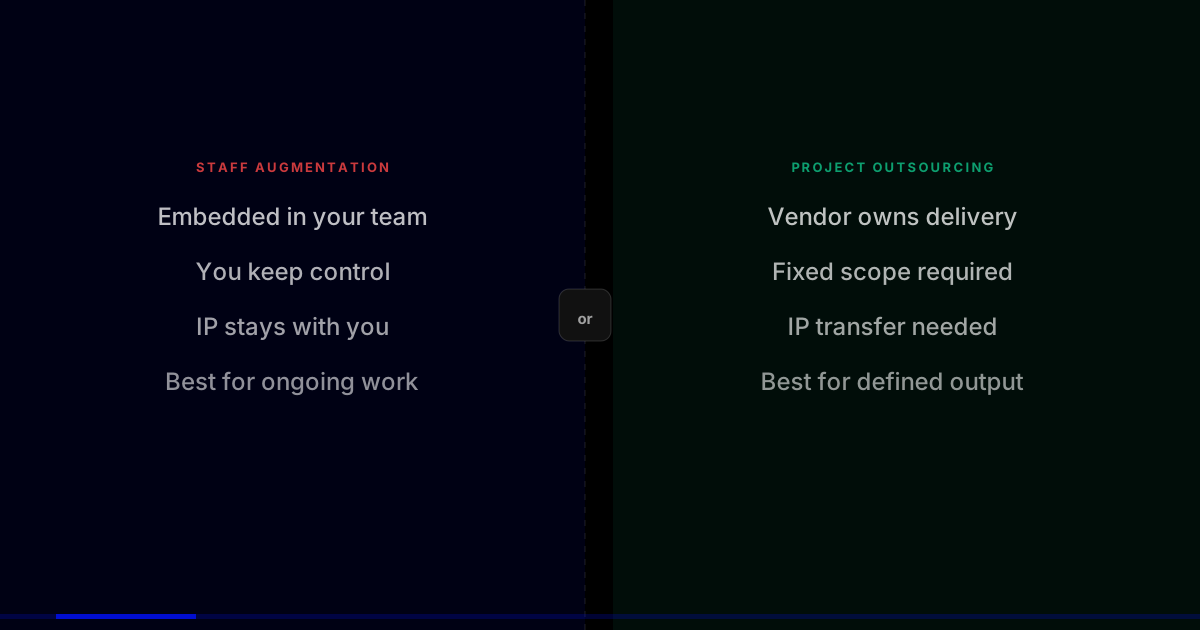
Staff augmentation embeds external talent into your existing team. Augmented engineers report to your managers, follow your processes, use your tooling, and participate in your planning. The work they do is yours: the code, the architecture decisions, the institutional knowledge. At the end of the engagement, you have gained capability and output; the knowledge sits inside your organisation because it was built there.
Project outsourcing engages an external team to deliver a defined scope under their ownership. The vendor manages their own engineers, their own processes, and their own approach to the work. You are a customer of the output, not a manager of the process. The delivery risk sits primarily with the vendor; the coordination overhead sits primarily on the requirement specification and acceptance testing side of the boundary.
The Decision Framework
Control — How much day-to-day oversight do you need?
If the work requires close integration with internal teams, frequent direction changes, or real-time collaboration on emergent requirements, staff augmentation is the natural fit. The augmented resource can be redirected as priorities shift without renegotiating a statement of work. If the work can be specified upfront and delivery managed through milestones and acceptance criteria, outsourcing provides the delivery accountability that augmentation does not.
Knowledge — Where does domain expertise need to live?
If the work will require ongoing maintenance, future development, or integration with systems that only internal engineers understand, the knowledge produced needs to end up inside the organisation. Staff augmentation transfers knowledge automatically, the work is done inside your team, by people who are working alongside your engineers. Outsourcing requires an explicit, designed knowledge transfer phase at the end of the engagement; without it, the delivered product is a black box.
IP — Who owns what comes out of the engagement?
Staff augmentation generates IP that belongs to your organisation under standard work-for-hire provisions in the contract. Outsourcing IP ownership requires explicit contractual definition, defaults vary by jurisdiction and vendor relationship. For any work that will become a commercial product, a proprietary tool, or a core operational system, IP ownership must be resolved in the contract before a single line of code is written.
Duration — How long does the engagement last?
Staff augmentation works well for continuous, ongoing work with no natural completion point, a growing engineering team, sustained delivery capacity, or capability that needs to scale with demand. For time-bounded projects with defined deliverables, a platform migration, a new product build, a system integration, outsourcing's milestone-and-delivery model provides better alignment between payment and progress.
Cost — What is the real total cost?
Day-rate comparison understates the true cost of staff augmentation (management overhead, onboarding, tooling, IP governance) and understates the true cost of outsourcing (requirement specification, vendor management, acceptance testing, knowledge transfer). A fair comparison assigns a management cost to augmented headcount (typically 10-20% of augmented cost, based on internal management time consumed) and a transition cost to outsourced delivery (typically 15-25% of contract value for knowledge transfer and handoff at end of engagement).
The worst-of-both-worlds failure mode is treating an outsourcing engagement like staff augmentation, providing unclear specifications, redirecting the vendor mid-delivery, reviewing individual commits, and providing continuous direction. This creates a relationship with the overhead of both models and the accountability of neither.
When Staff Augmentation Is the Right Choice
- The work is ongoing with no defined completion point
- Requirements are emergent and will change frequently
- Deep integration with internal systems and processes is required
- Knowledge retention inside the organisation is critical
- The skill gap is specific (one or two specialisations) rather than requiring a full delivery team
- The internal team has management bandwidth to direct and review the work
When Outsourcing Is the Right Choice
- The scope is well-defined and unlikely to change significantly
- The deliverable has clear acceptance criteria that can be evaluated objectively
- The work is time-bounded with a natural completion point
- You need a full team capability (design, development, QA, project management) rather than individual contributors
- Delivery risk is better carried by the vendor than by internal capacity
- The internal team lacks the management bandwidth to direct augmented resources
Validated Outcomes
Gartner's 2024 Workforce Strategies for Technology Leaders survey found that organisations using a deliberate mix of staff augmentation and outsourcing, rather than a single model, achieved 30% higher technology project delivery rates compared to those committed to either model exclusively. The study attributed this to model-to-task alignment: outsourcing works best for self-contained, well-specified deliverables; augmentation works best for knowledge-intensive, evolving workloads where institutional context is valuable. Organisations that matched the engagement model to the task characteristics outperformed those that defaulted to the model that was easiest to procure.
GYSP's advisory experience across both engagement models reveals the most costly mistake consistently made by technology buyers: choosing outsourcing for evolving AI and data infrastructure work because it felt lower-risk, then discovering that the vendor's output was not maintainable by the internal team at handover. The correct signal for choosing augmentation over outsourcing is any workload where internal team knowledge transfer is a success criterion, not just delivery. GYSP's augmentation model builds that transfer in from the first sprint, with documented knowledge transfer milestones as contractual deliverables rather than aspirational goals.
The Hybrid Model
Many technology engagements benefit from a hybrid approach: outsourcing the initial build to a vendor with well-defined scope, then transitioning to staff augmentation for ongoing enhancement and maintenance. The outsourced phase delivers the initial capability under vendor accountability; the augmented phase builds internal ownership of what was delivered. This model works particularly well for platform builds, product launches, and system modernisations where the initial delivery has clear scope but ongoing development will be continuous.
GYSP's Staff Augmentation practice embeds experienced engineers, across cloud, AI/ML, data, and cybersecurity specialisations, into client teams under a model designed for knowledge transfer and internal capability building. Our IT Consulting & Advisory practice helps organisations structure technology engagement decisions, including vendor selection, contract design, and transition planning for hybrid models.
“The question is not 'augmentation or outsourcing?' The question is 'where does the knowledge need to live when this is over, and what model produces that outcome?' Once you answer that question, the decision is usually obvious.”
— Dhaval Rana, Founder & CEO — GYSP.tech