
What you'll take away
The median time-to-hire for a senior software engineer at a mid-market technology company is 22 weeks (LinkedIn Talent Insights, 2024). For specialised roles, ML engineers, platform engineers, data engineers, it is longer. For roles requiring specific compliance domain knowledge, HIPAA, FCA, SOC 2, it can exceed six months.
The projects waiting on those hires do not pause. The product roadmap that requires two senior engineers to deliver does not slip gracefully, it creates a cascade of delays, workarounds, and trade-offs that the business will be paying for in technical debt and missed market windows for twelve to eighteen months after the hire finally joins.
The 22-week hiring timeline is not a solvable problem for most organisations in the short term. It is a structural feature of the senior engineering talent market. What is solvable is how you manage the gap between the capability you need and the hire you are still waiting for.
Why Senior Engineering Hiring Takes So Long
The senior engineering talent shortage is not a perception problem. The UK alone had an estimated 173,000 unfilled technology roles in 2024 (TechNation Digital Economy Report). Senior roles, requiring five or more years of experience in a specific domain, are structurally harder to fill because the supply is finite, the competition is global, and candidates at this level receive multiple offers and do not stay available for long.
The Interview Process Is the Bottleneck
Most engineering interview processes were designed for a buyer's market where candidates waited. Four to six interview stages, multiple days of take-home assessments, and cross-functional sign-off from three to five stakeholders add weeks to a process that senior candidates will endure for a role they really want and withdraw from immediately for a role they are lukewarm on. The companies that hire the best senior engineers have redesigned their interview process for the candidate experience, not the hiring manager's convenience.
The Specification Problem
A job description that requires eight years of experience in a technology that is five years old, lists fifteen 'required' skills that are actually nice-to-haves, and uses the same title for roles ranging from individual contributor to technical lead is not a specification, it is a barrier. Most engineering job descriptions are written by HR with input from a hiring manager who has not thought carefully about which skills are actually essential versus desirable. The result is a process that screens out qualified candidates and fails to assess what actually predicts success.
The Passive Candidate Problem
Senior engineers with a strong track record receive unsolicited approaches from recruiters multiple times per week. They are not browsing job boards. They are being recruited passively, which means your job posting does not find them. Finding and engaging passive candidates requires a deliberate outreach strategy, a compelling employer value proposition, and relationship-building that starts months before you need the hire. Most companies start this process when the role is already urgent.
The Hidden Cost of the Hiring Gap
Project Delay Compounding
A five-month hiring delay for a senior engineer whose role is on the critical path of a product launch does not simply delay the project by five months. It delays the launch by five months, delays the revenue from the launch, creates additional context-switching cost as the team works around the missing capacity, and frequently leads to technical shortcuts that create six to twelve months of additional remediation after the engineer joins and has to address what the workaround broke.
Team Overload and Attrition Risk
When a senior engineering role is vacant, the work that the role would have done is distributed across the existing team. Sustained for months, this overload drives attrition in the team members absorbing the extra load. Losing a second senior engineer because the first vacancy created unsustainable workload turns a five-month problem into a ten-month crisis. Engineering organisations with persistent vacancy pressure consistently show higher attrition rates than peers, a pattern confirmed by McKinsey's 2023 technology talent research.
The Opportunity Cost of Delayed Decisions
Many senior engineering roles are not primarily execution roles, they are decision-making roles. The principal engineer who is supposed to make the architecture decision about the data layer. The security architect who is supposed to define the compliance posture before the product goes to market. The platform lead who is supposed to design the internal developer platform before the team triples in size. Delaying these hires means delaying decisions, which means subsequent work is done on foundations that will need to be revised, at higher cost, once the decision maker finally arrives.
Stack Overflow's 2024 developer survey found that companies with senior engineering vacancies open for more than 90 days were 2.4x more likely to report significant project delays and 1.8x more likely to report elevated team burnout scores compared to companies that maintained full engineering capacity.
Why Traditional Staffing Agencies Fail Senior Roles
The traditional staffing agency model was designed for volume placement: sourcing and placing candidates quickly against a defined specification, earning a placement fee. For junior and mid-level roles, this model can work, the supply is larger, the specification is simpler, and speed is the primary value.
For senior roles, the model breaks down. Agency recruiters who do not understand the technical domain cannot meaningfully screen senior candidates for the qualities that predict success, they can check boxes against a job description but cannot assess architectural thinking, technical judgement, or the communication skills required to function effectively at senior level. The candidates who pass agency screening for senior roles are often the candidates who were available because they were not competitive for the roles filled by direct search.
The Senior-Only Augmentation Model
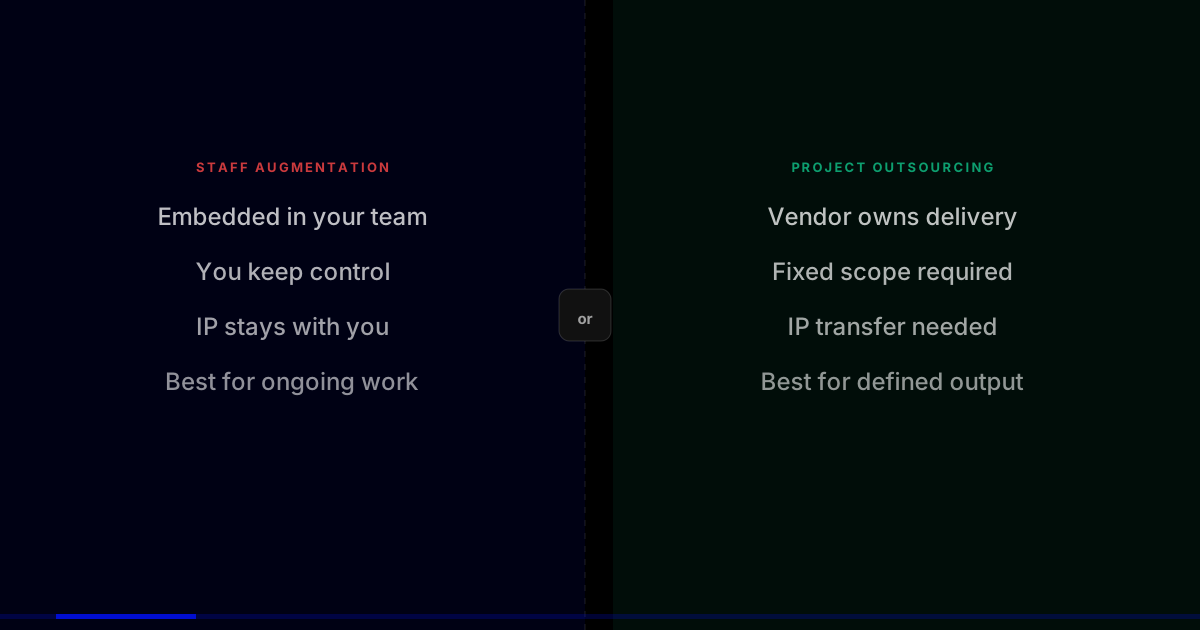
Staff augmentation at the senior level is architecturally different from traditional placement. The value proposition is not simply filling a seat, it is providing a specific senior capability on-demand, embedded in the client team, with the accountability and communication expectations of a senior employee rather than a contractor following instructions.
Capability-First Matching
Senior augmentation begins with a capability conversation, not a specification review. What decision does the business need made? What technical problem needs a senior perspective? What does 'done' look like for this engagement? A senior engineer matched to a capability need, rather than a list of required technologies, integrates faster and delivers value earlier than one matched against a job description.
Integration, Not Delegation
Senior augmented engineers should be integrated into the client team's ceremonies, communication channels, and decision-making processes, not managed at arm's length as an external resource who receives tasks and delivers outputs. Integration is the difference between an augmented senior who becomes a force multiplier for the existing team and one who completes assigned work competently without transferring expertise or institutional knowledge to the people around them.
IP and Security Governance
Senior engineers working in an augmented capacity have access to source code, architecture documentation, and sometimes customer data. Governance frameworks for augmented senior roles should include: clear IP ownership clauses in the engagement agreement, role-scoped access controls rather than organisation-wide access, NDA coverage that specifies what constitutes confidential information for the specific engagement, and offboarding procedures that revoke access and document any systems or knowledge the augmented engineer was the primary holder of.
Validated Outcomes
LinkedIn's Talent Insights platform documented in their 2024 Engineering Talent Report that the median time-to-productivity for a senior software engineer at a technology company, defined as the time from offer acceptance to making a meaningful contribution to production systems, was 4–6 months, accounting for interview-to-start lag, onboarding, and context acquisition. For specialist roles (ML engineers, platform architects, security engineers), the figure extended to 6–9 months. Augmented engineers operating in a well-defined scope and already working with the team's stack from day one typically reach comparable productivity in 2–4 weeks, a 10–15x speed advantage during the critical early period of a project.
GYSP's staff augmentation clients consistently report that the most valuable aspect of the engagement model is not the day rate, it is the absence of the productivity gap. In projects where GYSP engineers were placed alongside a team starting a new initiative, the team consistently reached first production milestone 6–10 weeks faster than the client's own estimate for a traditional hiring-led approach. That speed advantage directly translates to earlier revenue delivery, earlier product validation, and earlier learning, the benefits that compound most powerfully for growth-stage businesses.
The Retention Bridge: When to Convert
Augmentation is a bridge strategy, not a permanent substitute for core capabilities. The right moment to convert an augmented senior engineer to a full-time hire is when the volume and permanence of the work justify a permanent employee, when the institutional knowledge accumulated by the individual makes replacement costly, and when the individual has expressed genuine interest in the permanent role.
The wrong moment to convert is when a project is ending and conversion feels like an easy way to retain someone the team has become comfortable with. Senior augmented engineers who convert to full-time roles because of social inertia rather than genuine strategic need create costs and management overhead that the original augmentation arrangement was designed to avoid.
GYSP's Staff Augmentation practice provides senior-only engineers, architects, and technical specialists embedded in client teams on a capacity basis. We start every engagement with a capability definition conversation, not a job spec review and we measure success by the technical outcomes the engagement enables, not by the number of hours billed.
“The companies that navigate engineering capacity gaps most effectively are not the ones that move fastest in the hiring market. They are the ones that know the difference between the work that needs a permanent employee and the work that needs a specific senior capability right now.”
— Dhaval Rana, Founder & CEO — GYSP.tech