
What you'll take away
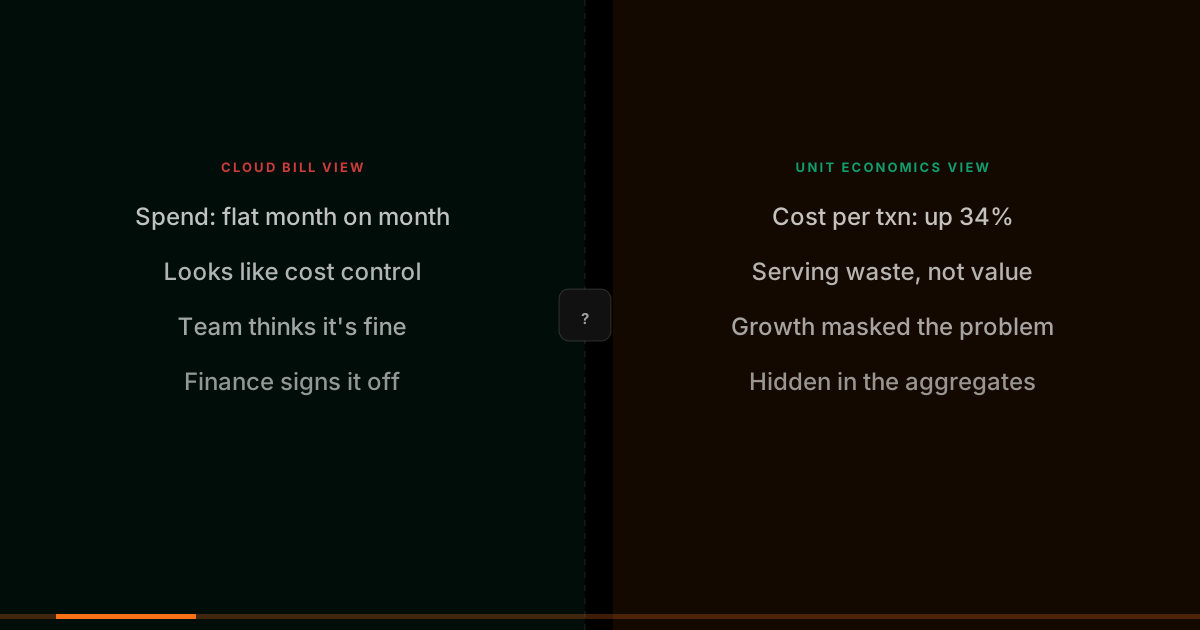
The finance team sends a message: cloud spend is up 30% year-over-year. The infrastructure team should prepare to defend the increase in next quarter's budget review.
This scene plays out at thousands of companies, and it represents a fundamental misunderstanding of what cloud cost data actually tells you. A 30% increase in cloud spend against 50% revenue growth is not a cost problem, it's a scaling efficiency win. A 30% increase in cloud spend against flat revenue is a serious structural issue. The cloud bill alone cannot tell you which of these situations you're in. Unit economics can.
What Unit Economics Actually Measures
Unit economics, in the context of cloud infrastructure, is the cost of delivering one unit of business value. The 'unit' depends on your business model: cost per transaction for a payments company; cost per active user per month for a SaaS product; cost per gigabyte processed for a data platform; cost per order fulfilled for an e-commerce business. The calculation is straightforward, total infrastructure cost divided by the relevant unit volume, but the insight it provides is qualitatively different from looking at the total cost.
The Three Questions Unit Economics Answers That the Cloud Bill Cannot
1. Is Growth Increasing or Decreasing Infrastructure Efficiency?
If your cost per transaction is declining as volume grows, your infrastructure has positive unit economics: scale is creating efficiency. This is expected and desirable, distributed systems should become more efficient at scale due to amortisation of fixed costs and better resource utilisation. If your cost per transaction is flat or increasing as volume grows, you have a unit economics problem: growth is consuming resources faster than the efficiency gains of scale, which is unsustainable.
2. Which Features or Product Lines Are Economically Viable?
In a multi-product or multi-feature organisation, different features have dramatically different infrastructure cost profiles. A machine learning feature that costs ten times more to serve than a standard database query might be economically justified if the feature drives ten times the revenue conversion, or it might be consuming infrastructure budget without generating proportional business value. Without attribution of costs to features and product lines, you cannot make this assessment.
3. What Is the ROI of Infrastructure Investment?
When you invest in a major infrastructure improvement, migrating to a more efficient architecture, implementing caching, refactoring a hot query path, the business impact should show up in cost per unit. An investment that costs a hundred thousand pounds in engineering time but reduces cost per transaction by thirty percent has a clear ROI. An investment that the engineering team describes as 'significantly improving efficiency' but produces no measurable change in unit cost did not deliver what was expected.
The question that unlocks unit economics thinking: 'If we serve twice as many users next year with twice the current infrastructure spend, have we succeeded or failed?' The answer depends entirely on the unit cost trajectory, not the absolute spend figure.
Building the Unit Economics Model
The first step is cost attribution: mapping infrastructure costs to the features, services, or product lines that incur them. This requires tagging discipline in your cloud environment (every resource tagged with team, service, and environment) and a cost allocation model that divides shared infrastructure costs (networking, management tooling, base platform) proportionally across the workloads that use them.
The second step is identifying the right unit. For most businesses, the primary unit should be the core transaction that delivers customer value: the API call, the processed order, the analysed document, the active user session. Secondary units can be defined for specific workloads where the primary unit doesn't capture the cost driver well.
Validated Outcomes
Twilio's engineering and finance teams published a case study on how they transitioned from cloud cost management to unit economics management across their communications platform. Twilio's unit: cost per message processed. Before unit economics tracking, Twilio's infrastructure team was defending quarterly cloud budget increases to Finance based on revenue growth, without a clear mechanism to demonstrate whether infrastructure cost efficiency was improving. After building unit cost tracking into their engineering metrics, Twilio documented a 40% improvement in cost per message over an 18-month optimisation programme, a metric the Finance team found far more compelling than an absolute cloud spend reduction.
GYSP's unit economics framework engagements begin with cost attribution: mapping every cloud resource to the service or product feature that consumes it. The most common finding at the start of this exercise: 25–40% of cloud costs cannot be attributed to any specific product or team, they sit in shared infrastructure accounts with no tagging or allocation model. Before unit economics can be calculated, this attribution gap must be closed. GYSP's approach closes it within 30 days and delivers the first unit cost baseline within 60 days.
Using Unit Economics in Architecture Decisions
The highest-value use of unit economics data is in architecture decision-making. When evaluating a proposed infrastructure change, model its expected impact on cost per unit: will this optimisation reduce cost per transaction by 15%, and if so, at what engineering investment? When evaluating a new feature, model its expected infrastructure cost as a cost-per-user component: will serving this feature cost more or less per active user than the features it replaces?
GYSP's IT Consulting & Advisory practice builds unit economics frameworks for technology organisations that need to move from cloud bill management to infrastructure business alignment. The transformation from 'defend the budget increase' to 'here's what we deliver per pound spent' changes the conversation with Finance, the Board, and the business permanently.
“A CFO who asks 'why is the cloud bill going up?' is asking the wrong question. The right question is 'what is our cost per unit of value delivered, and is it improving?' Getting to that conversation requires unit economics, not cost forecasts.”
— Dhaval Rana, Founder & CEO — GYSP.tech